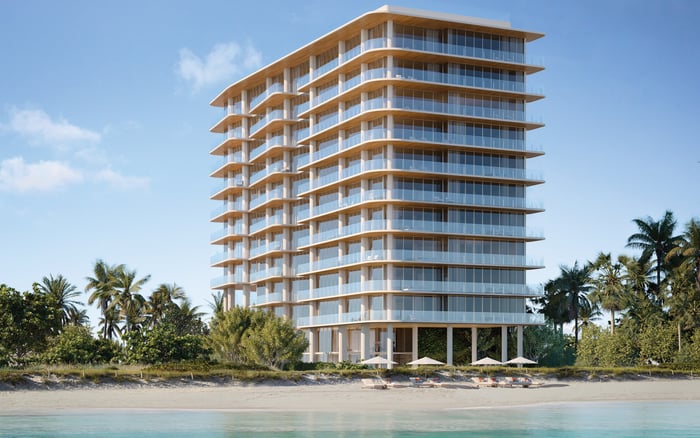
A buyer-focused examination of Shore Club’s operating-cost questions, from residential and hotel expense allocation to service-fee escalators, staffing commitments, and opening-period exposure.

At Shore Club Private Collections Miami Beach, the proposition pairs residential privacy with five-star hotel service. The redevelopment at 1901 Collins Avenue spans approximately three oceanfront acres, bringing together a restored Cromwell House, a new residential tower, and a separate Beach House component. Robert A. M. Stern Architects is the designated architect, with Witkoff and Monroe Capital as developers and Auberge Resorts Collection as hospitality operator.
For a private client, the central financial question extends beyond the opening assessment: do the documents connect the promised experience to a transparent, durable operating structure? Service quality and cost visibility belong in the same conversation.
The distinction matters. An estimated budget describes assumptions; an executed agreement establishes obligations. A purchase decision should account for both, without treating architectural distinction or hospitality positioning as proof of predictable carrying costs.
The residential program is described as 49 private residences alongside a luxury hotel. Hotel counts are stated as either 75 or 79 keys. That discrepancy should be reconciled through the purchase agreement, condominium documents, approved plans, and executed operating agreements, particularly where hotel inventory affects shared-cost calculations.
Starting residence prices are indicated at approximately $6 million, with delivery anticipated in 2027. Neither figure establishes a closing value or a contractual completion guarantee.
An unofficial association-dues estimate of $2.50-$3.50 per square foot monthly provides a preliminary illustration, not an official budget or assessment schedule. Applied to a hypothetical 3,500-square-foot residence, it yields $8,750-$12,250 per month. Buyers should not assume that range includes every mandatory charge, reserve contribution, or personally selected service.
The next step is a unit-specific assessment schedule reconciled to the proposed declaration, bylaws, and line-item operating budget. Confirm the measurement basis for assessments rather than assuming it matches the square footage presented for the residence.
Actual budget variances cannot be established without comparable budget and operating figures. Before determining whether Shore Club is running above or below plan, request any available operating results, audited statements, and a clear explanation of the period covered. A proposed opening budget is not evidence of operating performance.
The buyer’s adviser should separate three questions: what the original budget assumed, what the current budget assumes, and what has actually been spent. Changes between proposed budgets are revisions to assumptions, not necessarily operating overruns.
For each material expense, identify the underlying driver. A payroll increase might reflect different coverage assumptions; a maintenance increase might reflect a revised service scope. Ask management to distinguish recurring changes from opening expenses and timing differences rather than accepting a single aggregate variance.
Reserve contributions warrant separate scrutiny. Request the reserve methodology, any available reserve study, and the basis for projected funding. A lower assessment is not inherently more attractive if it depends on obligations being deferred or funded elsewhere.
The residential and hotel components make cost allocation a primary diligence item. Request the formula separating residential-only, hotel-only, and shared expenses, including security, engineering, parking, insurance, landscaping, and management.
The critical detail is how that formula works. Ask whether allocations depend on area, usage, inventory, staffing hours, or another documented basis. Then establish who can revise them, what approvals are required, and what access owners have to supporting records.
A buyer also considering Setai Residences Miami Beach should apply the same questions independently, rather than carry assumptions from one property to another. A service-oriented shortlist is no substitute for building-specific financial review.
For Shore Club, request worked examples showing how a shared invoice becomes a residential expense. These make the allocation easier to evaluate than a broad assurance that costs are equitably divided.
No specific Shore Club contractual escalation percentage is established here. The inquiry should therefore focus on the agreements themselves, not an assumed annual increase.
Review management, branding, licensing, and service agreements for the initial fee basis, adjustment formula, frequency, caps, renewal terms, termination rights, and owner remedies. Ask whether a minimum fee applies and whether reimbursable expenses fall outside a stated cap. A ceiling on one fee does not necessarily cap total service spending.
Where an adjustment is linked to an index or operating measure, request a worked calculation. Where pricing can reset at renewal, identify the notice period and the association’s practical alternatives. Counsel should also clarify which party holds enforcement rights and what happens if contracted service standards are not met.
For a client weighing The Surf Club Four Seasons Surfside alongside Shore Club, the comparison should remain grounded in the documents. Neither shared hospitality language nor a recognizable brand establishes equivalent fee structures or owner protections.
Five-star positioning does not establish a residential staffing schedule. Request departmental headcounts, shifts, employer identity, payroll burden, outsourcing arrangements, training costs, and relief coverage.
The most revealing schedule connects each promised function to actual coverage. Ask who serves residents during peak hotel demand, how absences are covered, and whether shared personnel are charged through recorded time or a fixed allocation. Headcount alone does not show when someone is available or which component bears the expense.
Separate base service from optional consumption. Potential à-la-carte offerings include butler services, spa services, in-residence dining, and private chefs, but finalized rates and minimum charges are not established here. Obtain a written schedule distinguishing included access, separately charged services, minimums, and usage fees.
Assess staffing as both a cost and a service commitment. A leaner budget is not necessarily a better outcome if it cannot support the experience the buyer expects.
For an intermittently occupied residence, distinguish unavoidable annual obligations from discretionary spending. Personal usage may change the latter without changing the former; the documents should define the boundary.
Build separate sensitivity cases for higher staffing costs, insurance and reserve requirements, and service-fee escalation. These are buyer-selected stress tests, not Shore Club forecasts. Keep each assumption visible so a change in one expense category does not become an unexplained increase across the entire budget.
Finally, establish who funds initial operating deficits, whether any developer subsidy or staffing guarantee exists, and when it expires. Compare the opening assessment with the expense structure expected after any support ends. The strongest private-client decision pairs confidence in the residence with clarity about the obligations that sustain it.
For a discreet conversation about your South Florida residential shortlist, connect with MILLION.
If branded residences are on your mind — as a home or as an allocation — we would be glad to share what we are seeing, privately.
Begin a quiet conversationThe project is at 1901 Collins Avenue, Miami Beach, on an approximately three-acre oceanfront site.
The residential program is described as 49 private residences alongside a luxury hotel. Published hotel counts differ between 75 and 79 keys and require reconciliation against final project documents.
Auberge Resorts Collection is identified as the hospitality operator. That designation alone does not establish residential staffing levels or included services.
No. The $2.50–$3.50 per square foot monthly range is unofficial and should not be treated as an approved Shore Club budget or owner obligation.
It produces an illustrative monthly amount of $8,750–$12,250. The calculation does not establish a unit-specific assessment or confirm that all mandatory charges are included.
No. Actual variances require comparable budget and operating figures; changes between proposed budgets may simply reflect revised assumptions.
Review fee formulas, adjustment frequency, caps, minimums, reimbursable expenses, renewal terms, termination rights, and owner remedies. No specific Shore Club escalation percentage is established here.
Request departmental headcounts, shifts, employer identity, payroll burden, outsourcing, training, and relief coverage. Clarify how shared staff time and expenses are allocated between residents and the hotel.
Potential à-la-carte butler, spa, dining, and private-chef services are described, but finalized rates and minimum charges are not established. Buyers should obtain a written included-versus-optional service schedule.
The anticipated 2027 timeframe is a marketing target, not a contractual completion guarantee. Review the purchase agreement for the applicable completion provisions.