A disciplined timeline can help a Cora Merrick Park buyer separate contract milestones, closing, occupancy and the broader work of establishing Florida domicile.

For a primary-residence buyer, Cora Merrick Park presents two distinct propositions. The first is residential: a boutique, wellness-oriented condominium across from Shops at Merrick Park in Coral Gables. The second is logistical: a pre-construction purchase whose completion window must be coordinated with a genuine move and a carefully documented domicile plan.
The essential discipline is to separate three events. The first is contractual closing, when the purchase is completed under the agreement. The second is physical occupancy, when the residence is ready and the buyer actually moves in. The third is legal domicile, which should not be treated as an automatic consequence of signing a contract, funding deposits or receiving keys.
Those moments may occur close together, but buyers should not assume they will. Contract terms, construction progress, developer notices, personal travel and moving arrangements can all affect the sequence. Florida counsel and the buyer’s tax adviser should determine which actions are appropriate, when they should occur and how they interact with obligations in another state.
A credible domicile plan follows the actual closing and occupancy sequence, not a marketing date.
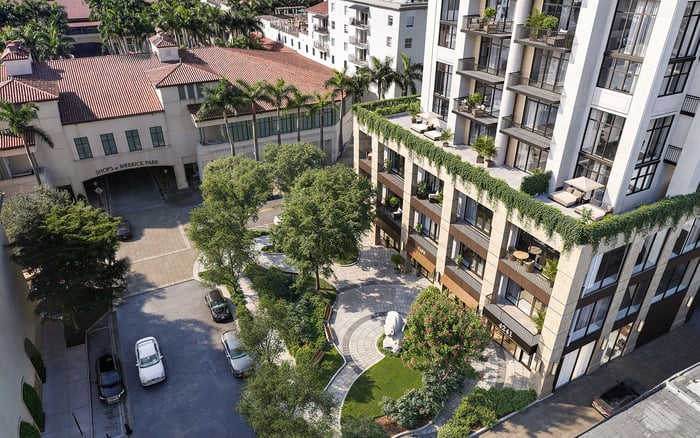
Cora Merrick Park is planned for 4241 Aurora Street with 74 residences, including one-, two- and three-bedroom homes and penthouses. The building has been described as having either 12 or 13 stories, making the consistent residence count more useful for early planning than the discrepancy in floor count.
Interiors range from approximately 678 to 2,651 square feet. Pricing begins in the $900,000s and extends beyond $4 million for penthouses. Private balconies, 10-foot ceilings, Italkraft kitchens and Sub-Zero and Wolf appliances define the residential offering. Arquitectonica is the architect, Urban Robot is responsible for the interiors, and Constellation Group and The Boschetti Group are co-developing the project.
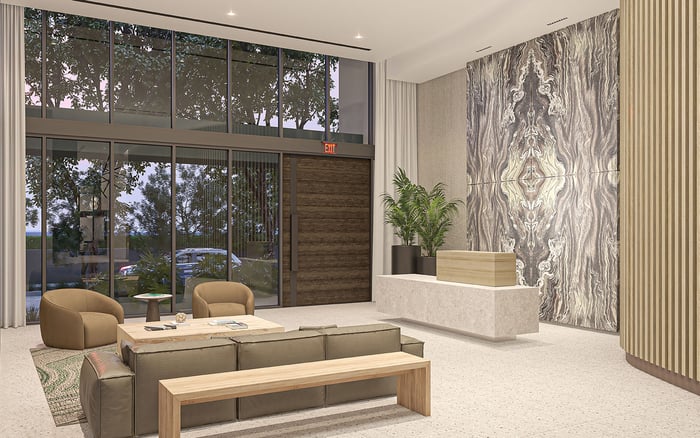
The lifestyle proposition extends beyond the private residence. Plans include a rooftop pool, summer kitchens, a fitness center with a recovery area, an infrared sauna, a steam room, hydrotherapy pools and red-light therapy. An approximately 5,000-square-foot landscaped park or sculpture garden is also planned. For an owner-occupant, these elements matter because domicile planning should begin with a home selected for daily life, not paperwork alone.
Sales launched in 2025. Work had begun by April 2026, with completion targeted for 2028, while 2027 has also been identified as an anticipated build year. Neither estimate should be mistaken for a guaranteed closing date for a particular residence.
The purchase agreement and current developer communications should therefore anchor the buyer’s calendar. Create a working timeline that identifies contract dates, deposit obligations, anticipated notices, financing or liquidity decisions, inspection and walkthrough periods, closing preparation and the practical move. Preserve enough flexibility for delivery or closing delays.
This distinction is familiar across South Florida new construction. A buyer comparing the cadence of Ponce Park Coral Gables or the residential character of The Village at Coral Gables should still evaluate each contract independently. Proximity does not make project schedules interchangeable.
A well-ordered file allows the buyer and advisers to reconstruct what happened and when. Preserve the executed purchase agreement, amendments, deposit confirmations, developer correspondence, notices and final closing documents. These materials can document the acquisition timeline, but they do not, by themselves, establish Florida domicile.
Alongside the real-estate file, maintain a separate chronology of the physical move and the domicile actions recommended by counsel and the tax adviser. The purpose is consistency: dates, addresses and representations across different records should reflect the buyer’s actual circumstances rather than an aspirational delivery estimate.
Before taking any formal step involving homestead, tax residency, a driver’s license, voter registration or the termination of former-state ties, obtain current professional guidance. The appropriate sequence may depend on closing, the ability to occupy the residence and the buyer’s broader circumstances. A contract signed years before completion is evidence of a purchase commitment, not a substitute for individualized legal and tax analysis.
For readers of MILLION Buyer’s Guides, the practical standard is simple: keep property and domicile records coordinated, but do not collapse them into a single concept. One file establishes the transaction’s progression. The broader record should support the reality of the buyer’s principal home and intentions, as advised by counsel.
The period between contract and completed residence deserves particular attention. A buyer may have made substantial deposits while the home remains unavailable for occupancy. That interval can be used productively to organize advisers, review the purchase agreement, prepare liquidity, map the move and identify which decisions must await a firmer closing window.
Avoid anchoring irreversible personal or tax decisions to the earliest completion estimate. Instead, establish decision points tied to contractual notices and verified readiness. As closing approaches, confirm the current schedule through the channels designated in the agreement and reconcile it with travel, furnishings, insurance, movers and any sale or transition involving another residence.
Buyers considering an interim South Florida home should treat it as a separate transaction with its own legal consequences. A comparison with Ziggurat Coconut Grove may help clarify location and design preferences, but it does not determine when domicile begins or which evidence is sufficient. Those conclusions remain fact-specific.
When the developer provides a more reliable path to closing, convene the relevant professionals. The buyer’s real-estate counsel can focus on the agreement and closing mechanics, while Florida counsel and the tax adviser address domicile and tax timing within their respective roles. The objective is a unified calendar without assuming that any one professional document resolves every issue.
At that checkpoint, confirm the latest anticipated closing sequence, identify the records that will be generated and determine which domicile-related actions should coincide with closing, occupancy or a later date. If the schedule changes, update the chronology and retain the correspondence explaining why. A transparent delay is easier to understand when the file preserves contemporaneous documentation.
Cora Merrick Park’s location-directly across from luxury shopping and dining and minutes from downtown Coral Gables-supports an appealing primary-residence narrative. Yet the strongest plan remains practical rather than theatrical: choose the home for the way it will be lived in, follow the actual delivery path and let the evidence reflect reality.
For discreet guidance on Cora Merrick Park and a coordinated South Florida purchase, connect with MILLION.
If branded residences are on your mind — as a home or as an allocation — we would be glad to share what we are seeing, privately.
Begin a quiet conversationNo. A purchase agreement, deposits and closing records document the transaction, but they do not alone establish Florida domicile.
Public estimates span 2027 and 2028. Buyers should rely on their purchase agreement and current developer notices while maintaining flexibility for delays.
No. They are distinct milestones and may occur on different dates depending on the project schedule and the buyer’s circumstances.
Keep the contract, amendments, deposit confirmations, developer correspondence, notices and final closing documents in a dated transaction file.
Timing should follow the actual closing and occupancy sequence, with current guidance from Florida counsel and the buyer’s tax adviser.
It may help with preliminary scheduling, but it is not a guaranteed individual closing date and should not control irreversible decisions.
Plans call for 74 residences, including one-, two- and three-bedroom homes and penthouses.
The condominium is planned for 4241 Aurora Street in Coral Gables, directly across from Shops at Merrick Park.
Reported interior sizes range from approximately 678 to 2,651 square feet.
Buyers should seek current, individualized guidance from Florida counsel and their tax adviser before taking formal action.