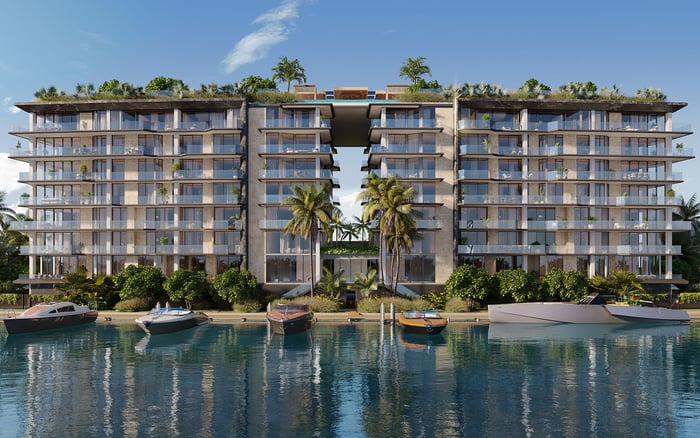
For Alma buyers funding a purchase from another currency, staged deposits create several exchange-rate decisions, not just one. This guide explains the illustrative payment schedule, the distinction between fixed and milestone-based obligations, and how to prepare for the larger closing balance.

At Alma Bay Harbor Islands, the residential offering is intimate in scale: a seven-story boutique building at 1160 101st Street, Bay Harbor Islands, FL 33154, with advertised two- to five-bedroom residences measuring 2,500-4,443 square feet. For a buyer whose wealth is held outside the United States, however, the funding plan deserves as much attention as the floor plan.
A dollar-denominated purchase funded from another currency has two moving parts: the contractual dollar obligation and the home-currency amount needed to meet it. Staged deposits spread those decisions across the purchase period. Converting funds for the first payment does not resolve the exchange-rate exposure on later installments.
The objective is not to predict the perfect trading day. It is to ensure each obligation can be funded without making a preferred exchange rate a condition of completing the purchase.
Alma’s illustrative payment plan allocates the purchase price as follows:
| Payment trigger | Share of purchase price | | --- | --- | | At contract | 5% | | 45 Days after contract | 5% | | At groundbreaking | 10% | | At top-off | 20% | | At closing | 60% |
Assuming these percentages apply to the purchase price, the four pre-closing installments total 40%, leaving 60% at closing. The final installment exceeds all earlier deposits combined. For a buyer converting foreign currency, it deserves a separate funding strategy-not treatment as an administrative afterthought.
These figures are a planning framework, not a binding offer or confirmation of terms for a particular residence. Before arranging conversions around them, reconcile the schedule with the current purchase agreement, including its payment triggers and obligations.
The distinction matters beyond arithmetic. A buyer who budgets accurately for the initial deposits but leaves the closing balance unplanned has addressed only the smaller portion of the purchase-price funding requirement.
The second installment falls due 45 days after the contract date. Groundbreaking and top-off, by contrast, are construction milestones rather than specified calendar dates in this schedule.
That difference should shape the funding calendar. For a contract-date-based obligation, identify the dollar requirement and discuss conversion and transfer arrangements before payment is due. For milestone-based obligations, discuss how dollars will be available when the contractual trigger occurs. Do not treat an anticipated construction date as a guaranteed payment date.
Ask counsel to explain the agreement’s notice provisions, payment deadlines and consequences of late payment. Ask the bank what it requires to execute the intended conversion and transfer. Do not build the plan around an assumed wire-processing window, grace period or milestone notice period.
A useful working document records four fields for each payment: contractual trigger, dollar amount, intended funding source and conversion decision. Keep estimates clearly separate from obligations established by the agreement.
Early conversion fixes the exchange rate for the amount converted. Its appeal is certainty: those dollars are no longer exposed to subsequent currency movements. The trade-off is the carrying or opportunity cost of moving capital into dollars before it is needed.
Later conversion preserves the buyer’s existing currency allocation for longer but leaves the unconverted amount exposed. The eventual home-currency cost can move favorably or unfavorably. Neither approach guarantees the best financial outcome.
Staggered conversions offer another approach. Rather than making one decision for the entire purchase, a buyer can discuss converting portions over time with a banking adviser. This spreads conversion decisions over time but does not remove exchange-rate exposure from funds that remain unconverted.
Bank-offered forwards or options may also warrant discussion. These are buyer-side funding tools, not features of Alma’s payment plan. Before committing, ask the bank to explain suitability, costs, obligations and how any proposed arrangement would accommodate uncertain milestone timing.
Keep the property contract and the currency arrangement distinct. A funding tool should support the purchase obligations, not be mistaken for an amendment to them.
Under the illustrative schedule, 60% of the purchase price remains payable at closing. That is the remaining purchase-price obligation-not necessarily the buyer’s personal cash contribution if financing is arranged. Nor is it the entire closing budget.
Plan separately for closing costs and reserves. Establish those amounts for the transaction rather than inferring them from the deposit percentages. The working budget should distinguish money already paid, the remaining price balance, anticipated loan proceeds and additional cash requirements.
Do not assume a future mortgage will fund pre-closing deposits unless a financing arrangement explicitly provides for those payments. Deposits and closing financing belong in the same overall plan, but they are not interchangeable sources of liquidity.
If an appraisal falls below the contract price, the buyer’s cash requirement may increase. For someone funding from another currency, that can also increase the amount requiring conversion. Discuss that possibility with the lender and banking adviser before relying on a single projected closing figure.
When considering Alma alongside Alana Bay Harbor Islands, compare the actual agreements rather than applying Alma’s illustrative schedule across the shortlist. The useful comparison is not simply how much is due before closing, but when each obligation becomes payable and how it will be funded.
The same discipline applies if the search extends to Bal Harbour and Rivage Bal Harbour. Review each residence’s contractual structure without assuming equivalent deposit terms, financing arrangements or completion timing.
For a buyer funding from another currency, payment timing belongs beside architecture, layout and purchase price in the decision. Evaluate an appealing residence with a clear understanding of the liquidity its agreement requires.
Florida condominium escrow requirements apply to condominium deposits, but that general framework does not establish Alma’s specific escrow-release provisions. Have counsel review the applicable documents and explain how the agreement addresses the deposits.
Before signing, align the purchase agreement, financing assumptions and currency plan. Confirm what must be paid in dollars, which triggers are fixed or milestone-based, and which funds remain exposed to exchange-rate movements. Revisit the plan as contractual obligations and financing figures become clearer.
The strongest approach prioritizes the ability to meet the purchase obligations over the ambition to capture an ideal rate. For an Alma buyer, that means treating the initial deposits and the substantially larger closing balance as connected but distinct funding decisions.
For a discreet conversation about Alma and your South Florida residential search, connect with MILLION.
If branded residences are on your mind — as a home or as an allocation — we would be glad to share what we are seeing, privately.
Begin a quiet conversationAlma is located at 1160 101st Street, Bay Harbor Islands, FL 33154. It is a seven-story boutique residential building.
Alma advertises two- to five-bedroom residences measuring 2,500–4,443 square feet. These advertised specifications do not confirm current availability.
The illustrative schedule lists 5% at contract, 5% 45 days afterward, 10% at groundbreaking, 20% at top-off and 60% at closing. Confirm the current terms for the specific residence before relying on it.
The four pre-closing installments total 40% of the purchase price. The remaining 60% is payable at closing under the illustrative schedule.
Groundbreaking and top-off trigger the illustrative 10% and 20% installments. Unlike the second payment, these are milestone-based rather than contract-date-based.
Early conversion fixes the exchange rate for the amount converted, not for funds left in another currency. It also introduces carrying or opportunity costs.
No. Bank-offered forwards or options are general buyer-side currency-management tools whose suitability and terms should be discussed with a banking adviser.
No. Buyers should not assume mortgage financing will cover pre-closing deposits unless an arrangement explicitly provides for those payments.
Include the remaining purchase-price balance, closing costs and reserves, while separately accounting for anticipated loan proceeds. A below-contract appraisal may increase the buyer’s cash and currency-conversion requirements.
No. Florida condominium escrow requirements apply, but Alma’s specific provisions must be reviewed in the applicable transaction documents with counsel.