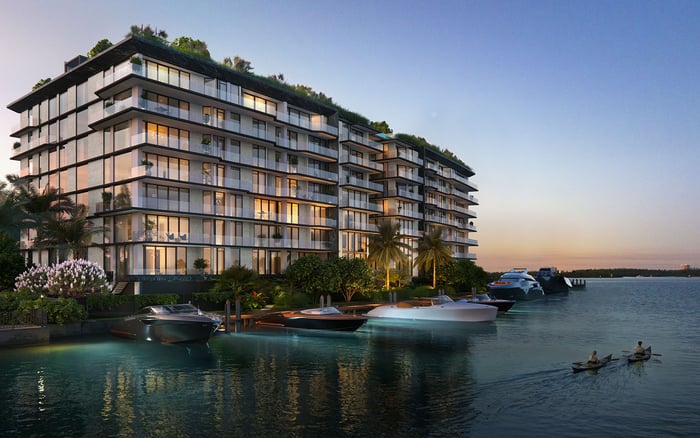
Waldorf Astoria and Faena advertise distinct approaches to residential receiving. For family offices, the decisive questions concern screening, authorized signatories, insured storage, and written approval for bonded couriers, none of which should be inferred from concierge amenities alone.

For a family office, a residence's service proposition extends beyond an elegant arrival. A valuable consignment demands a more exacting welcome: an authorized recipient, an approved route, documented custody, and a clear allocation of responsibility. That distinction matters when an owner expects deliveries to proceed discreetly while away.
Waldorf Astoria and Faena advertise different approaches to receiving in Downtown Miami. Waldorf emphasizes parcel delivery to the residence and courier support. Faena identifies tower-specific package areas and staffed district access. Neither offering, on its own, establishes a verified protocol for high-value shipments, package screening, or bonded-courier entry.
The buyer's task is not to select a security winner from an amenity menu. It is to determine whether the final operating arrangements can accommodate the household's actual delivery requirements.
Planned at 300 Biscayne Boulevard, Waldorf Astoria Residences Downtown Miami is marketed as a 100-story tower across from Bayfront Park and Biscayne Bay. Its advertised private residential entrance and porte cochère suggest a distinct residential arrival, but do not establish a permitted route for valuable consignments.
The service offering includes 24-hour reception, doorman and bellman services, valet parking, and a dedicated on-site director of residences. More relevant to this review are advertised parcel receiving and delivery to the residence, alongside courier and outbound-mailing services. These are meaningful conveniences. Courier support, however, does not confirm that a bonded courier may enter, transfer custody, or reach a residential floor.
The residential application is described as connecting owners to 24-hour concierge services, including package delivery. Evaluate that connection as a service interface, not an assurance of an auditable custody record. Likewise, advertised 24-hour security does not identify screening equipment, inspection practices, or storage protections.
The Waldorf-specific diligence question is whether residential receiving will be physically and operationally separate from hotel deliveries and guest traffic. Ask management to identify the arrival point, receiving personnel, holding location, and final handoff procedure-and explain what changes when the owner is absent.
Faena Residences Miami Downtown Miami is a separate Miami River development marketed within the proposed 14-acre Faena District Miami River. Its advertised program comprises 406 serviced residences, including one- to four-bedroom homes, River Lofts, Sky Lofts, and penthouses.
For delivery diligence, the clearest spatial distinction is the proposed provision of separate package-delivery areas and elevator lobbies for each tower. The residential lobby is also advertised with a dedicated 24-hour concierge and front-desk reception, while district access includes a 24/7 staffed guardhouse.
These features identify proposed receiving locations and staffed access points-not the rules governing movement between them. A family office should ask how guardhouse clearance connects to the correct tower, whether delivery appointments are required, and where responsibility transfers from courier to building personnel.
Faena's advertised smart mail and package handling does not specify screening or secure-storage standards. Nor do in-residence butlers and personalized concierge programs establish who is authorized to sign for a valuable shipment. Hospitality availability and consignment acceptance should remain separate questions in the purchase review.
Bonded-courier access remains unconfirmed at both projects. Neither advertised courier services nor staffed access establishes acceptance of bonded couriers, armored vehicles, regulated consignments, or courier travel to residential floors. Written approval should address the proposed delivery; a general assurance that packages are welcome is not enough.
Before scheduling a shipment, request confirmation of the following:
Advance authorization requirements, delivery windows, and procedures for delayed arrivals.
Courier credentials and insurance documents required for admission.
Permitted vehicle access, unloading locations, and the approved route to receiving.
Named or designated signatories, including restrictions when the resident is away.
Escort requirements and whether a courier must retain custody until the final recipient signs.
These are recommended diligence questions, not established features of either property. If a building cannot meet a shipment's requirements, the family office should settle an alternative handoff arrangement before dispatch rather than improvise at the entrance.
Screening, custody, and financial protection require distinct answers. A staffed desk is not a disclosed screening procedure. A delivery notification is not necessarily a custody record. Accepting a parcel does not, by itself, explain the building's liability for its contents.
For screening, ask what inspection occurs, who conducts it, and how exceptions or rejected deliveries are handled. Do not presume a particular technology is installed. For custody, request the proposed record of arrival, recipient identity, each internal transfer, storage placement, and final release. Ask whether the family office can obtain those records after an incident.
Storage deserves equal attention. Confirm access permissions, camera coverage, retention periods, and any available environmental protections relevant to the intended contents. Establish how long an item may remain, whether overnight holding is permitted, and who can authorize release to a household employee or other representative.
Finally, obtain declared-value limits, insurance exclusions, and incident-response procedures. Have the family's insurance adviser review the proposed arrangement against the shipment's coverage. Neither project's advertised amenities establish these protections or justify assuming that building insurance follows an item through every handoff.
Faena advertises private riverfront access, yacht arrival, and a dedicated marine concierge. These are arrival amenities, not confirmation of cargo receiving or bonded delivery from a vessel. A family office anticipating vessel-to-residence transfers should obtain separate confirmation of acceptance, routing, signatories, and custody.
Apply the same discipline to a broader shortlist that includes Aston Martin Residences Downtown Miami: compare written receiving arrangements rather than infer shipment permissions from an address or arrival experience. Do not assume equivalent delivery capability without property-specific confirmation.
Before closing, ask the property manager, condominium association, operator, and security director to confirm the final protocols within their respective responsibilities. Clarify which arrangements are committed, which require individual approval, and which may change under future operating policies.
Waldorf's clearest advertised advantage for this inquiry is the explicit combination of residence parcel delivery and courier support. Faena's is the identification of tower-specific package areas and district guardhouse staffing. That distinction is useful, but it does not support a security ranking. For a family office, the stronger fit is the residence whose confirmed procedures align with the household's couriers, insurance conditions, and authorized recipients.
For a discreet discussion of your residential priorities, connect with MILLION.
If branded residences are on your mind — as a home or as an allocation — we would be glad to share what we are seeing, privately.
Begin a quiet conversationYes. Waldorf advertises parcel receiving and delivery to the residence, but high-value shipment acceptance and custody procedures require separate confirmation.
No. Advertised courier and outbound-mailing services do not establish bonded-courier acceptance or access to residential floors.
Faena advertises separate package-delivery areas and elevator lobbies for each tower. This identifies proposed receiving locations without establishing their screening or storage specifications.
Faena advertises 24/7 staffed guardhouse access, but delivery-vehicle inspection procedures are not specified.
The advertised amenities do not establish a screening or shipment-protection ranking. Buyers should compare confirmed operating procedures.
That authority is not established by the advertised staffing or hospitality services. Obtain written confirmation of authorized signatories for the intended shipment.
Marine concierge and yacht-arrival services are advertised, but cargo receiving and bonded delivery from vessels remain unconfirmed.
Confirm access permissions, storage specifications, camera coverage, retention periods, and release procedures. Also obtain declared-value limits and insurance exclusions.
Ask whether residential receiving will be physically and operationally separate from hotel deliveries and guest traffic. Confirm the entire route through the final handoff.
Seek confirmation from the property manager, condominium association, operator, and security director within their respective responsibilities. Distinguish committed arrangements from those requiring shipment-specific approval.