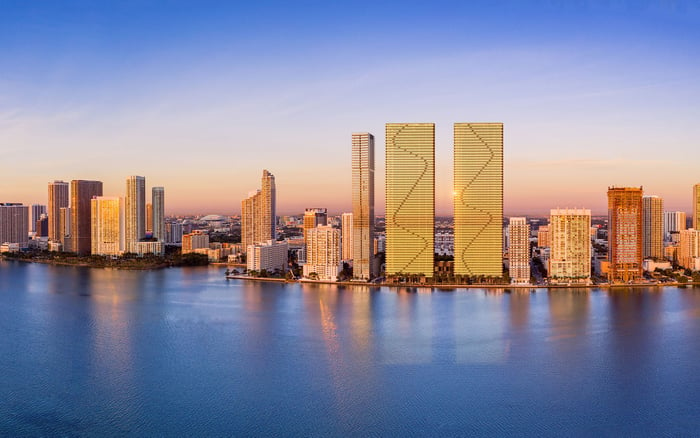
An Edgewater buyer’s framework for evaluating address-specific internet service, backup connectivity, cybersecurity controls, and access-log policies before committing to a residence.
For an Edgewater buyer, digital infrastructure deserves the same deliberate attention as a residence’s layout and service arrangements. A beautifully resolved home should also support confidential calls, remote work, and arrivals without avoidable uncertainty. The question is not simply whether internet service exists, but what is available to the specific residence, who controls it, and what happens when it fails.
Organize the review around four connected inquiries: carrier availability, backup connectivity, cybersecurity, and access-log governance. Each should yield a written answer, not a general assurance. A project name or premium positioning does not establish a particular technical configuration.
When considering Aria Reserve Miami, for example, include the proposed residence’s service documentation in the comparison file. Apply the same discipline to every Edgewater purchase; neighboring buildings should not be assumed to share infrastructure or policies.
Internet availability is address-specific. A carrier’s Miami presence does not establish service at a particular condominium, and statewide fiber marketing is not proof of an Edgewater connection. Even within a carrier’s offerings, distinguish fiber from fixed wireless rather than treating the brand name as a technology specification.
Begin with an exact-address availability check, then request confirmation of the unit’s installation eligibility. Location-level broadband mapping can help identify advertised providers and technologies, but maximum advertised download and upload speeds are not measurements inside the residence. Request a practical performance check where possible, especially if daily work depends on upload capacity.
Ask management for carrier-entry and riser diagrams, unit wiring details, and service handoff locations. Establish who owns the equipment and who handles repair or replacement. These are requests to make, not assumptions about what a building will disclose or provide.
Finally, review bulk-service terms, permissions for a second provider, installation procedures, and written outage-escalation instructions. Keep carrier availability distinct from building permission: both need to be clear before planning a home network.
Assess redundancy through physical routes, equipment, and power-not merely two provider names. Ask whether the proposed connections use separate building entrances and risers, and have the appropriate technical representative identify shared dependencies. The objective is to understand which failures the backup is intended to address.
For a residence under consideration at EDITION Edgewater, treat backup connectivity as a documentation and testing request, not an assumed amenity. Ask whether a wired-plus-wireless arrangement is permitted and practical within the unit, and whether it can be evaluated before the buyer relies on it.
If dual-WAN failover is proposed, request a demonstration of the transition between the two internet connections. Ask what happens to active calls during the switch and how normal service resumes. Separately, request details of uninterruptible power supply coverage and a written account of which telecom components receive generator power.
Second-home buyers should also establish who can diagnose a failure while the residence is unoccupied. Identify an authorized contact, the boundaries of remote support, and the escalation procedure before departure-not during an outage.
Organize cybersecurity diligence around authority and accountability rather than a product inventory. Ask how resident, guest, management, and building-system networks are separated. Request an explanation suitable for a buyer’s adviser without seeking sensitive credentials or unrestricted access to building systems.
Next, establish whether administrators use multifactor authentication and individual accounts. Ask who approves vendor remote access, whether it is limited to the work required, and how it is withdrawn. Identify responsibility for patching, backups, incident notification, and immediate credential revocation when personnel or vendors leave.
A buyer evaluating Villa Miami can apply the same governance checklist without presuming any specific security feature. Ask management to distinguish implemented policies from proposed arrangements and identify who can confirm their status.
Request an incident-notification procedure that explains whom residents contact and who communicates with them. An assurance that a system is secure is no substitute for named responsibilities, documented controls, and a clear response path.
Include door, visitor, garage, elevator, denied-entry, and administrator events in the retention inquiry. Ask which events are recorded, how long each category is kept, where it is stored, and who can search or export it. A blanket answer such as “we retain records” is not specific enough.
Have counsel verify current requirements and the treatment of the building’s particular records. Request an event-specific retention schedule, accompanied by policies governing access permissions, search, export, deletion, and legal holds.
Distinguish retention from disclosure. Ask what process applies when a resident seeks records and who determines what may be released. The aim is an accountable policy, not unrestricted visibility into other residents’ movements.
Bring the four areas of inquiry together in a compact comparison sheet. For each residence, record the question, written response, responsible party, and any unresolved item. Separate confirmed arrangements from proposals and verbal assurances. A technical adviser can evaluate connectivity questions, while counsel addresses recordkeeping obligations and transaction implications.
The file should include service eligibility, wiring information, applicable service terms, backup design and testing information, security responsibilities, and retention policies. Where detailed infrastructure documents are sensitive, ask whether an appropriately qualified adviser can review them through an agreed process.
Before committing, decide which unanswered questions materially affect your intended use. A household dependent on remote work may prioritize tested continuity; an owner frequently away may emphasize authorized support and credential control. The strongest outcome is not a promise of perfect uptime or absolute security. It is a clear understanding of arrangements, limitations, and responsibility.
For a considered approach to your Edgewater residence search, explore MILLION.
If branded residences are on your mind — as a home or as an allocation — we would be glad to share what we are seeing, privately.
Begin a quiet conversationNo. Verify availability at the exact building address and confirm installation eligibility for the particular unit.
A carrier may offer different technologies, including fiber and fixed wireless. Confirm the technology offered at the residence rather than relying on the carrier’s name.
No. Location-level mapping shows maximum advertised speeds, not measured performance inside the residence; request a practical performance check where possible.
Request carrier-entry and riser diagrams, unit wiring details, equipment ownership information, bulk-service terms, second-provider permissions, and outage-escalation procedures.
Ask about separate physical routes, shared dependencies, wired-plus-wireless options, and failover testing. Review which equipment has backup power as a separate inquiry.
Do not assume it does. Ask which telecom components receive generator power and what uninterruptible power supply coverage is provided.
Identify who handles network separation, administrator authentication, vendor access, patching, backups, incident notification, and credential revocation.
Do not assume a single period applies. Ask counsel to verify current requirements and the classification of each record category before relying on the building’s retention schedule.
Ask for schedules covering entry, denied-entry, visitor, garage, elevator, and administrator events. Request related policies for permissions, search, export, deletion, and legal holds.
No project-specific technical configuration is established here. The linked residences are contexts for applying the diligence questions, not confirmations of particular features.