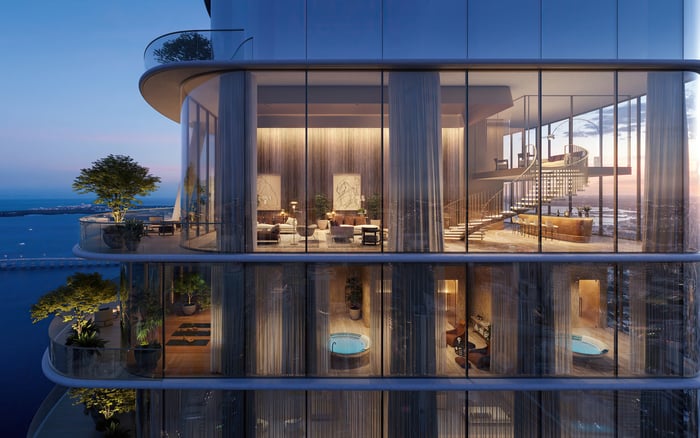
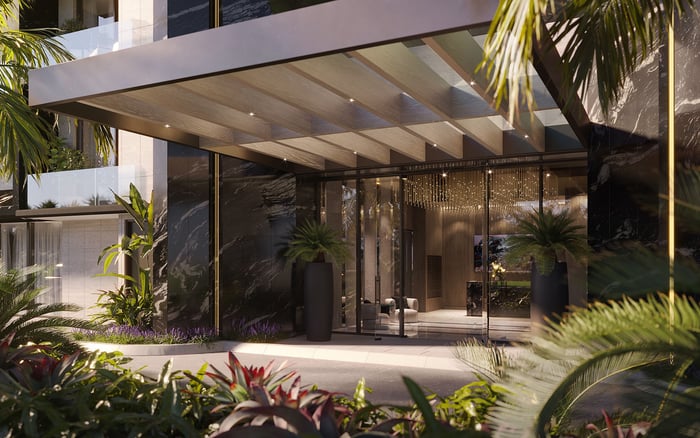
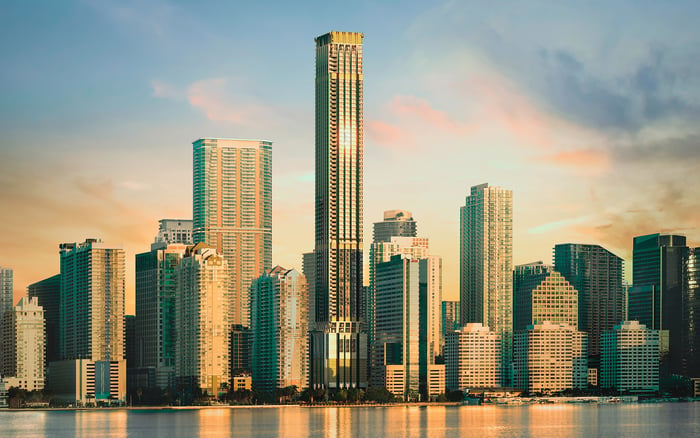
A buyer-oriented analysis of how 888 Brickell by Dolce & Gabbana translates Milanese fashion codes into a branded ultra-luxury residential proposition in Miami’s most globally connected urban enclave.
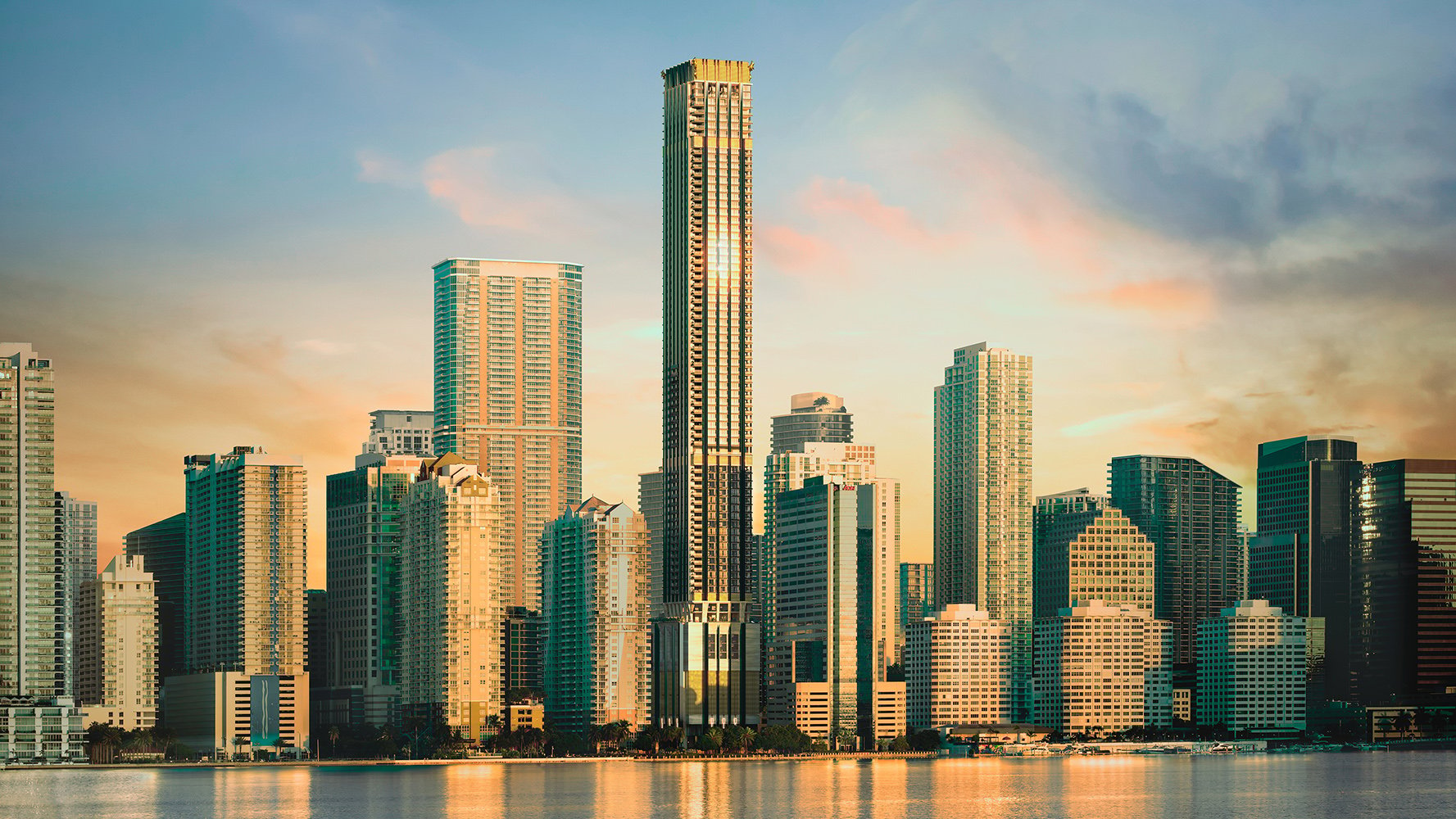
In Miami’s highest residential tier, branding now functions as more than a marketing layer. At 888 Brickell by Dolce & Gabbana, the premise is that a residence can carry the emotional and visual codes of a fashion house as convincingly as a couture collection or flagship boutique. That distinction matters in Brickell, where a dense concentration of finance, private wealth, and international business has created a buyer base fluent in global luxury signals.
888 Brickell is positioned within the neighborhood’s ultra-luxury segment rather than the broader premium condo market. That distinction is important for buyers comparing product across Brickell. In a district already defined by high-rise living and international demand, the project aims to distinguish itself through identity, not simply height, finishes, or amenity count.
The more compelling question is not whether branded residences exist, but whether the brand meaningfully shapes the real estate. In this case, the answer appears to be yes. Publicly presented material frames Dolce & Gabbana’s role as extending into interiors, finishes, and the aesthetic language of common areas, signaling a fully authored environment rather than a nominal licensing exercise.
That places 888 Brickell by Dolce & Gabbana in dialogue with other high-concept developments in Brickell, including Baccarat Residences Brickell and Cipriani Residences Brickell, where brand identity is central to market positioning.
Dolce & Gabbana’s relevance here lies in its recognizability. The house carries a visual language associated with Italian glamour, theatricality, craftsmanship, and a deliberate sense of occasion. When translated into a residence, those codes can shape everything from palette and materiality to the choreography of arrival, entertaining, and shared spaces.
That is what makes 888 Brickell notable. The concept is not a generic luxury tower with a famous logo attached. It is presented as a residential environment informed by a specific design worldview. For buyers, that creates a sharper proposition: not merely the purchase of square footage in Brickell, but entry into a curated aesthetic universe.
In practical real estate terms, this matters because branded immersion often carries more resonance than standard amenity language. A fitness center, lounge, or pool deck can be found in many top-tier towers. A residence whose hospitality-style spaces and common areas are conceived to reflect a fashion house’s own aesthetic vocabulary is rarer in the local market.
This approach also aligns with a broader migration of luxury brands into hospitality and real estate. Homes offer something boutiques cannot: permanence. A residence can become the most complete physical expression of a brand’s values, rituals, and visual signatures.
Brickell is not simply a Miami neighborhood. It is one of the city’s most legible addresses for international capital, second-home demand, and globally mobile professionals. That profile makes it especially receptive to a project whose appeal depends in part on immediate brand recognition.
For overseas buyers, familiarity matters. A globally known fashion house can function as shorthand for taste, quality, and social positioning long before a buyer studies a floor plan. In that sense, 888 Brickell uses Milanese fashion identity as a commercial advantage in a competitive skyline.
The district’s buyer pool is especially relevant here. Brickell has long drawn purchasers from Latin America, Europe, and other international wealth corridors, alongside domestic buyers seeking a primary home with strong prestige value. In such an environment, branded residences are not merely a novelty. They are a way of compressing identity into a readily understood signal.
That is also why projects such as The Residences at 1428 Brickell and Mercedes-Benz Places Miami help illustrate the neighborhood’s current direction. Brickell increasingly rewards distinct points of view, especially when those points of view are already embedded in global luxury culture.
The ultra-luxury market no longer competes on finishes alone. Imported stone, expansive glazing, and high-touch service are expected at this level. What creates separation is narrative clarity. Buyers want to understand not just that a residence is premium, but why it is singular.
888 Brickell’s strategy appears to rest on that singularity. Dolce & Gabbana is not positioned as a decorative afterthought. The brand is central to the building’s market identity, shaping the emotional promise of ownership. The result is a proposition that moves beyond amenity accumulation into lifestyle authorship.
For a buyer or investor, that can be meaningful in several ways. First, a highly legible identity may improve memorability in a crowded field. Second, a distinctive brand association can strengthen international appeal among purchasers who already view fashion houses as prestige assets in their own right. Third, a coherent aesthetic proposition can create a more durable perception of exclusivity than generic luxury language.
Sophisticated buyers will still want to evaluate execution, service structure, and long-term desirability in context.
888 Brickell stands as a strong example of where luxury residential development is heading in Miami. The city’s wealth profile, gateway status, and second-home demand make it a natural setting for concepts that fuse hospitality, fashion, and real estate into a single proposition.
That trend is broader than one project, but 888 Brickell offers a particularly vivid case study because fully fashion-branded residential projects remain relatively uncommon in the local conversation. Its significance lies in the seriousness of the translation. If the fashion identity truly informs interiors, finishes, and common-space atmosphere, the residence becomes an extension of brand culture rather than a simple endorsement.
For Brickell, this raises the competitive standard. Buyers at the top end are increasingly comparing not only location and views, but also authorship. They are asking which buildings possess a genuine point of view. In that context, 888 Brickell is less about novelty than precision: an attempt to give ultra-luxury real estate a recognizable Milanese accent in the center of Miami.
For investors, the implication is equally clear. In markets driven by global wealth, branded residences can command attention because they are immediately intelligible across borders. In neighborhoods as active and visible as Brickell, the projects most likely to endure are often the ones that communicate identity with the least ambiguity.
For those evaluating Brickell today, 888 Brickell is best understood through three lenses: design authorship, international legibility, and long-term positioning in the ultra-luxury category. It is not merely a new-construction tower in a favored district. It is a branded proposition calibrated for buyers who want a home to function as both residence and statement.
That may particularly resonate with purchasers seeking a second home in Miami, as well as investment-minded buyers who believe prestige branding can support enduring appeal. In a market where many towers promise refinement, the projects with the clearest identity often hold the strongest psychological advantage.
For readers watching Brickell evolve, 888 Brickell represents an inflection point. It suggests that the future of the neighborhood may belong not only to well-located towers, but to those capable of translating an established luxury language into a complete residential experience.
What is 888 Brickell by Dolce & Gabbana? It is an ultra-luxury branded residential tower in Brickell that extends Dolce & Gabbana’s fashion identity into real estate.
Why is this project important in Brickell? It uses brand differentiation to stand out in one of Miami’s most competitive luxury condo districts.
Is Dolce & Gabbana involved beyond the name? Yes. The project is presented as incorporating the brand’s influence into interiors, finishes, and shared-space aesthetics.
Who is the likely buyer profile? The concept is aimed at ultra-high-net-worth purchasers seeking globally recognizable prestige in a primary residence, second home, or investment property.
Why does Brickell suit a fashion-branded residence? Brickell attracts international wealth, finance professionals, and cross-border buyers who are highly responsive to established luxury branding.
How is this different from a typical luxury condo? The emphasis is on immersive branded lifestyle rather than a standard package of upscale amenities.
Is 888 Brickell part of a larger market trend? Yes. It reflects the broader expansion of luxury fashion and hospitality brands into residential development.
Does the project sit in the luxury or ultra-luxury segment? It is positioned in Miami’s ultra-luxury segment rather than the broader luxury market.
What should buyers evaluate beyond the branding? Buyers should still assess execution, service structure, location fit, and long-term desirability within Brickell’s competitive market.
What is the best way to shortlist comparable options for touring? Start with location fit, delivery status, and daily lifestyle priorities, then compare stacks and elevations to validate views and privacy.
If you'd like a private walkthrough and a curated shortlist, connect with MILLION Luxury.
If branded residences are on your mind — as a home or as an allocation — we would be glad to share what we are seeing, privately.
Begin a quiet conversation