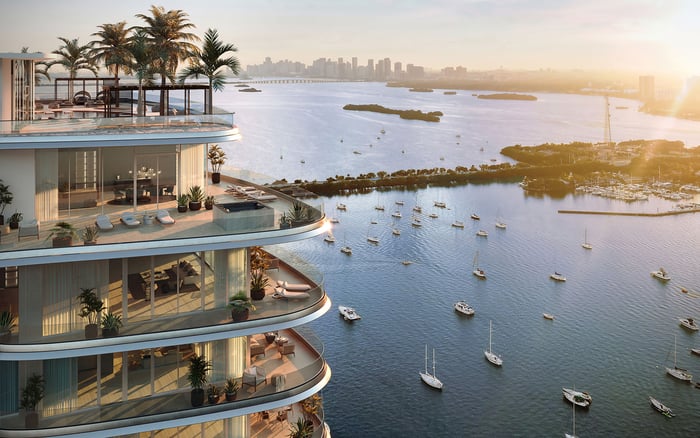
For yacht owners considering a residence near Tula Residences, the decisive questions extend beyond the view. Navigation constraints, berth documentation, severe-weather procedures, insurance coordination, and discreet movement between vessel and home should all be verified against the buyer’s actual operating profile.

For a yacht owner, a bayfront address is not automatically a functional marine base. The view from a residence and the practicality of arriving by water are distinct propositions. Before committing near Tula Residences North Bay Village, the buyer’s team should translate the vessel’s operating profile into a written property brief.
That brief should identify the yacht’s length overall, beam, draft, air draft, tender arrangement, shore-power needs, crew model, and expected frequency of use. It should also distinguish daily convenience from occasional access. A route suitable for a center-console may not accommodate a larger vessel, while a berth that works at rest may not allow comfortable maneuvering in wind, current, or traffic.
This is as much a Lifestyle and Second-home decision as a Waterfront one. Marina and Boat-slip considerations deserve equal weight in any North-bay-village search.
Bridge clearance should be evaluated as a route-wide constraint. The relevant figure is not simply a published maximum. Buyers should ask a qualified marine professional to review every fixed and movable bridge along the intended path against the yacht’s true air draft in operating condition.
The review should account for antennas, radar equipment, towers, canvas, and anything that can be lowered only with preparation. Water levels and operating conditions can affect practical margins, so clearance on paper should never be treated as a promise of safe passage. Movable bridges introduce separate concerns: opening procedures, timing, communications, maintenance interruptions, and the consequences of delay.
A prudent buyer will sea-trial the preferred route with an experienced captain before treating it as dependable. The test should cover the actual approach, turning room, visibility, and a realistic contingency if passage is unavailable.
“Dockage” can describe markedly different legal and operational arrangements. A berth may be deeded, licensed, leased, assigned, separately owned, or subject to association control. None of these arrangements should be assumed. Counsel should confirm the right being acquired, whether it transfers with the residence, how long it lasts, and which vessel approvals apply.
Physical fit demands a separate assessment. Length limits alone do not establish suitability. Beam, draft, water depth, piling placement, fendering, gangway geometry, utility capacity, wake exposure, and maneuvering space can determine whether a berth is genuinely comfortable. Buyers should also establish who maintains the dock, utilities, seawall, and access systems-and how those costs may be allocated.
Nearby residential comparisons can sharpen the inquiry without implying equivalent marine rights. Documentation associated with Continuum Club & Residences North Bay Village and Shoma Bay North Bay Village should be reviewed on its own terms, preserving the distinction among marketing language, governing documents, and physical feasibility.
Storm readiness is a chain of responsibilities, not a single building feature. The yacht owner should know when the vessel must leave, who issues the instruction, how notice is delivered, and whether an alternate berth or haul-out arrangement is realistically available. The plan should also identify the captain, management contact, towing support, and decision authority if the owner is away.
Residence, vessel, dock, and personal-property insurance should be reviewed together. The objective is to identify gaps, conflicting obligations, deductibles, exclusions, and documentation requirements before severe weather becomes imminent. The owner should understand which party handles dock preparation, utility shutdown, loose equipment, access control, and post-event inspection.
A written timeline is especially valuable for a seasonal owner. It should establish trigger points for moving the yacht, securing the residence, protecting vehicles, preserving records, and restoring access afterward. The strongest plan remains executable when flights, roads, contractors, and marine facilities are under pressure.
Arrival privacy is best tested as a sequence. Begin offshore and trace the route through the dock, gangway, gate, lobby or private entry, elevator, parking connection, service circulation, and residence. At each stage, ask who can see the owner, who can record the movement, and who can authorize access.
Buyers should examine sightlines from neighboring properties and public areas, guest-registration procedures, camera placement, credential controls, delivery protocols, staff access, and the separation of residents, crew, vendors, and guests. Lighting should support security without making every evening arrival a visible event.
Operational discipline matters as much as architecture. Inconsistent guest handling or uncontrolled service access can undermine a discreet physical plan. Conversely, clear protocols can make shared circulation feel composed. Privacy expectations should therefore be discussed directly with management rather than inferred from renderings.
Consistency makes comparisons useful. Apply one written checklist to Tula and every alternative, recording verified route constraints, berth terms, storm obligations, and the arrival sequence. For a nearby island-market comparison, La Baia North Bay Harbor Islands can be considered through the same framework, without assuming that location, access, or operating rules are interchangeable.
The final decision file should include counsel’s document review, the captain’s route assessment, insurance feedback, management answers, and a list of unresolved conditions. Beautiful water exposure may begin the conversation. Operational certainty should finish it.
What yacht measurements should a buyer provide? Provide length overall, beam, draft, air draft, equipment profile, and utility requirements in operating condition.
Is a published bridge clearance enough? No. A captain or qualified marine professional should assess the complete route and actual operating margins.
Should the preferred route be tested before closing? Yes. A practical run can reveal issues involving approach, timing, visibility, maneuvering, and contingencies.
Does access to a dock mean a slip transfers with the residence? Not necessarily. Counsel should verify the legal structure, duration, approvals, and transfer provisions.
What determines whether a berth truly fits? Beam, draft, depth, piling geometry, utilities, wake exposure, and turning room matter alongside length.
Who should review dock and seawall obligations? Real-estate counsel should review governing documents, while marine specialists assess physical condition and use.
What belongs in a yacht storm plan? Include decision authority, departure triggers, alternate dockage, vendor contacts, securing duties, and return procedures.
Why coordinate residence and vessel insurance? A coordinated review can identify conflicting duties, coverage gaps, exclusions, and documentation requirements.
How can a buyer test arrival privacy? Walk the full route from vessel to residence, reviewing sightlines, credentials, cameras, and staff protocols.
What should remain as a closing condition? Any material uncertainty involving navigation, berth rights, insurance, storm obligations, or controlled access warrants resolution.
For a tailored shortlist and next-step guidance, connect with MILLION.
If branded residences are on your mind — as a home or as an allocation — we would be glad to share what we are seeing, privately.
Begin a quiet conversation