For South Florida waterfront buyers, yacht access depends on the entire passage from berth to inlet. Draft, air draft, bridge operations and maneuvering room deserve the same scrutiny as the residence itself.
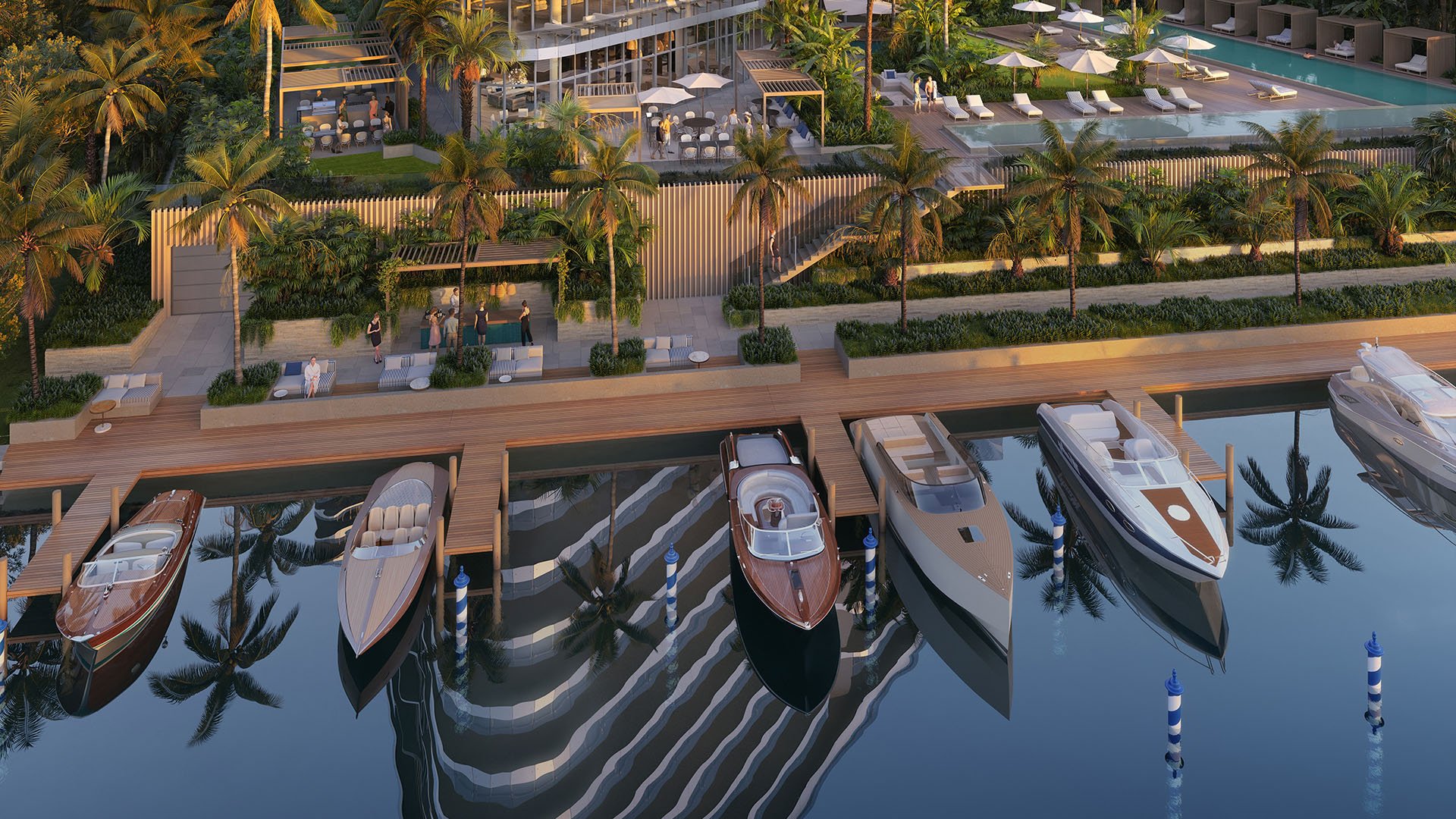
A waterfront residence can offer an elegant arrival by land and a more complicated departure by sea. For a yacht owner, the decisive question is not simply whether a vessel fits beside the property. It is whether that vessel can travel from its berth to the intended inlet through every bridge, channel and turning area along the way.
That distinction changes how a buyer should read a listing. A usable dock does not establish ocean access for a particular yacht, and “no fixed bridges” should describe a specific dock-to-inlet route, not an entire neighborhood. The most useful waterfront map is personal: one vessel, one berth and a clearly defined passage to open water.
Draft is the vessel’s depth below the waterline. Air draft is its height above it. Both matter, and neither can be reliably inferred from overall length alone. Two yachts with similar lengths and underwater drafts may have very different bridge requirements because one carries a flybridge, a taller hardtop or fixed outriggers.
Air draft must account for the highest equipment that cannot be lowered or removed. Radar arches, antennas and other fittings belong in that assessment. If passage depends on lowering equipment, the captain should confirm the vessel’s actual configuration rather than assume a brochure dimension reflects it.
Begin the property search with the yacht’s loaded dimensions. Slip length is only the beginning: beam, underwater draft, air draft and maneuvering requirements should be part of the buyer’s brief. These details sharpen the search, distinguishing an appealing waterfront setting from a berth the owner can actually use.
The familiar 65-foot ICW bridge-clearance benchmark is not continuous. At Atlantic Intracoastal Waterway Mile 1087.1, Miami’s Julia Tuttle Causeway has a published fixed clearance of 56 feet.
A yacht that exceeds that clearance cannot continue beneath the bridge on the ICW. An offshore alternative, such as a passage between Fort Lauderdale and Miami’s Government Cut, may be necessary. That alternative requires its own navigational assessment; it is not interchangeable with a protected inland route.
For buyers considering Miami Beach residences such as The Ritz-Carlton Residences® Miami Beach, the key question is where the intended berth sits relative to the owner’s preferred cruising route. A residential address alone does not establish whether Julia Tuttle is relevant to a particular journey.
Published clearance is not a guaranteed passage height. The stated water-level datum and conditions at the time of transit must be checked. A nominal comparison of yacht height and bridge clearance is not sufficient clearance planning.
Pier Sixty-Six illustrates why marina-level descriptions must give way to berth-level questions. Its south docks sit seaward of the 17th Street Causeway, allowing access to open water without passing that bridge. Access to the north docks may require passage through the 17th Street drawbridge.
That distinction matters even within one marina. A fixed span imposes a height constraint; a drawbridge introduces operating arrangements that must be checked for the intended passage. The two should not be treated as equivalent simply because both appear as bridge symbols on a route.
Pier Sixty-Six can accommodate vessels up to approximately 400 feet, illustrating a different access profile from inland residential canals. That figure does not establish suitability for every berth or approach. Buyers weighing St. Regis® Residences Bahia Mar Fort Lauderdale alongside other residential options should evaluate the home and the intended yacht berth as related but distinct decisions. The berth still requires its own route assessment.
A route without a prohibitive fixed bridge can still be unsuitable. Channel depth, shoaling, beam restrictions, tight turns and dock maneuvering room can each prevent a yacht from reaching or comfortably using a berth.
For a deeper-draft vessel, sufficient water must exist throughout the journey: at the canal entrance, through the channel, in turning areas, along relevant ICW reaches and through the inlet approach. Depth beside the dock answers only part of that question. An advertised marina maximum draft should not be treated as verified controlling depth for every berth and approach.
The same discipline applies when considering Onda Bay Harbor as part of a residential search. Rather than infer yacht suitability from the setting, identify the intended berth and have the full passage assessed. A captain’s review should match the vessel’s dimensions to the physical constraints of that exact route.
Bridge projects require careful reading. Proposed navigational improvements are not completed changes. The proposed clearance increases for the SE 6th Terrace bridge in Pompano Beach should not be treated as an improvement already available along a yacht’s route.
For a buyer considering The Ritz-Carlton Residences® Pompano Beach while arranging yacht accommodation, current navigational conditions should govern the access decision. A future improvement may become relevant later, but it cannot substitute for a workable passage today.
The principle extends beyond construction. Every bridge on an intended route needs separate review, with fixed spans distinguished from opening bridges. A general assurance about local boating access cannot replace that bridge-by-bridge assessment.
Before committing to a waterfront residence or associated berth, give a qualified captain the yacht’s loaded dimensions and exact dock location. Ask for a complete assessment of bridge clearances and operations, channel conditions, berth geometry and maneuvering room.
The route assessment should make the constraints explicit: which crossings are fixed, which require an opening, where depth needs particular attention and whether an offshore alternative is necessary. Any “no fixed bridges” representation should be tied to that identified passage. Where clearance is tight, current water conditions and an appropriate safety margin require professional judgment.
For the luxury buyer, this is not a secondary technical exercise. It defines whether the residence supports the intended boating life. The right pairing is a home and a berth whose access works for the yacht-not a yacht forced to accommodate an assumption made during the property search.
Explore South Florida residences with MILLION and make verified yacht access part of your waterfront brief.
If branded residences are on your mind — as a home or as an allocation — we would be glad to share what we are seeing, privately.
Begin a quiet conversationDraft measures a yacht’s depth below the waterline. Air draft measures its height above the waterline, including equipment that cannot be lowered or removed.
Its published fixed clearance is 56 feet at Atlantic Intracoastal Waterway Mile 1087.1. Actual available clearance must be assessed against the stated water-level datum and passage conditions.
No. Julia Tuttle Causeway is a significant exception to the commonly cited 65-foot benchmark.
It cannot follow the ICW beneath the bridge. An offshore alternative, such as routing between Fort Lauderdale and Government Cut, may be necessary and requires separate assessment.
No. Depth, shoaling, beam restrictions, turns, drawbridge operations and maneuvering room can still limit access.
The south docks sit seaward of the 17th Street Causeway. Access to the north docks may require passage through its drawbridge.
Yes. Flybridges, hardtops, radar arches and fixed outriggers can produce substantially different air drafts.
No. Adequate depth is needed throughout the approach, including canal entrances, turning areas, ICW reaches and inlet approaches.
Proposed improvements should not be treated as completed changes. The SE 6th Terrace bridge clearance proposal does not establish an already-improved route.
A qualified captain should review the yacht’s loaded dimensions against the complete route, bridge operations, berth geometry and current navigational conditions.