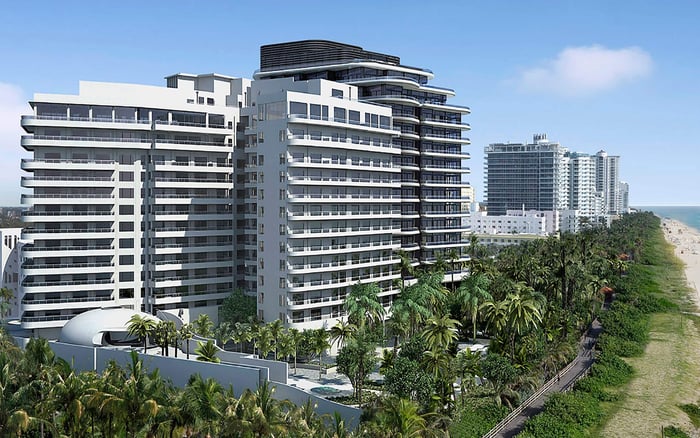
A buyer’s guide to separating condominium expenses, private-club membership and pay-per-use services at Auberge Beach and Setai, with particular attention to current pricing and resale rights.

For a buyer considering a South Florida residence, a private beach club promises something more personal than an amenity deck: an established rhythm of arrival, recreation and service. The financial questions, however, are precise. What does ownership include, what requires a separate membership, and what is payable each time it is used?
At Auberge Beach Residences & Spa Fort Lauderdale and Setai Residences Miami Beach, answering those questions means keeping hospitality privileges distinct from condominium rights. At Auberge, beach-club membership is included through association common expenses. The separately documented Setai Club program does not establish its current availability or its relationship to residence ownership.
That distinction matters more than the headline fee. A sound purchase evaluation separates the right to enter, the cost of using services and the conditions under which those rights survive a sale.
At 2200 North Ocean Boulevard in Fort Lauderdale, Auberge offers multiple swimming pools and a private beach club. Unit-owner beach-club memberships fall within association common expenses. This supports a bundled membership structure, not a promise that every service is included.
Fee-only areas and services remain, with additional payment for food, beverages and certain privileges. Concierge services are also available to owners for additional fees. Buyers should distinguish access from consumption: membership may sit within the recurring condominium bill, while dining and other services generate separate charges.
Request a current inclusion schedule. Ask management to identify what common expenses fund, what requires separate payment and which services carry restrictions. Concierge availability should not be mistaken for complimentary execution of every request.
Apply the same discipline to a broader Fort Lauderdale search. A buyer considering Four Seasons Hotel & Private Residences Fort Lauderdale should request the same breakdown rather than assume that one property’s membership structure applies to another.
Auberge resale examples illustrate why a building-wide estimate is insufficient. Unit N703 has been advertised with monthly HOA dues of $2,790 and no required membership fee. N704 has been advertised at $4,074 monthly, while N605 has been advertised at $7,645, both with no required membership purchase.
These are listing snapshots, not current quotations. They show substantial variation between residences, but neither explain every component of the charges nor establish what a buyer will owe after closing. An indication that no membership fee or purchase is required does not replace the governing agreements.
Before calculating annual carrying costs, obtain the specific residence’s assessment schedule, adopted association budget, reserve contributions and any special assessments. Identify which amounts recur, which are temporary and which may be billed separately. Do not assume that differences in dues reflect differences in club privileges.
The figures discussed here also establish no beach-service allocation. Assigning an assumed percentage of HOA dues to beach operations would imply precision without a supporting budget.
The documented Setai Club offering at 2001 Collins Avenue in Miami Beach carries an “Ultra-Luxury” membership fee of $300,000 plus $60,000 in annual dues. These are documented program amounts, not verified current prices or established condominium obligations.
The first question is not whether the annual fee represents good value. It is whether this particular program still operates and, if so, whether it is available to residence owners, required of them or entirely separate from their ownership rights. Until those points are confirmed, adding these amounts to a residence’s carrying costs is premature.
The program’s structure reinforces the distinction. Its documented benefits include a minimum of 47 nights and a four-reservation policy, alongside spa, pool and beach-club access, guest privileges, and restaurant and bar discounts. Those stay and reservation provisions describe the club offering; they should not be read as restrictions on occupying a condominium one owns.
Request current terms directly from the responsible operator, along with written clarification of the relationship between the program and the residence under consideration. A hotel’s service environment is not, by itself, a schedule of owner entitlements.
An extensive benefits package can still carry meaningful exceptions. Under the documented Setai Club offering, boat-fleet access requires payment for the captain’s time. Complimentary Bentley and Range Rover taxi service covers South Beach, with charges outside ZIP code 33139. These remain documented program benefits and conditions, not confirmed current residence entitlements.
Similarly, the absence of a traditional hotel resort fee does not establish what condominium HOA dues include. Hotel guest amenities, club privileges and residential common expenses should remain separate categories until current agreements explicitly connect them.
Build a realistic service budget around how the household will live. Separate fixed assessments from any applicable club dues, then allow for dining, treatments, concierge requests, transport exceptions and other usage charges. Confirm service availability and pricing before assigning amounts.
For a seasonal owner, the relevant measure is the cost of the expected season, not the theoretical value of every advertised benefit. For a frequent host, guest eligibility and charges may matter as much as personal access.
At Auberge, including unit-owner beach-club memberships in common expenses does not, on its own, resolve resale procedures, tenant eligibility or guest rights. At Setai, it remains unclear whether the documented club membership follows the residence, remains personal or requires transfer approval.
Ask for written answers before assigning value to a seller’s existing privileges. Does the purchaser receive access upon closing? Is a new application required? Are there transfer charges, approval conditions or interruptions in access? Which rights extend to family, guests and tenants?
For any applicable separate membership, review resignation terms and initiation-fee refundability as well. Have counsel distinguish rights attached to ownership from personal arrangements that may end with the seller. A seller’s experience can inform the questions, but it cannot substitute for the purchaser’s enforceable terms.
The strongest comparison starts with a unit-specific schedule of recurring ownership charges, any applicable membership costs and expected service spending. Keep a written account of access rights and transfer conditions alongside it.
Auberge’s bundled membership structure provides a starting point; the documented Setai Club offering requires clarification before it belongs in an ownership budget. Neither supports an all-inclusive assumption. The better purchase is the one whose services fit the household and whose obligations are understood before closing.
For a discreet conversation about matching South Florida residences to your ownership priorities, connect with MILLION.
If branded residences are on your mind — as a home or as an allocation — we would be glad to share what we are seeing, privately.
Begin a quiet conversationAuberge’s published terms include unit-owner beach-club memberships in association common expenses. Buyers should confirm current inclusions for the specific residence.
No. The published terms identify additional charges for food, beverages, certain privileges, fee-only areas and services, and the described concierge services.
Published monthly figures of $2,790 for N703, $4,074 for N704 and $7,645 for N605 illustrate unit-to-unit variation. They are listing snapshots, not current assessment quotations.
No. That field does not establish all access rights, service charges or transfer conditions; current governing agreements require review.
That obligation is not established. A documented Setai Club program lists a $300,000 membership fee and $60,000 annual dues, but its current availability and applicability to residence owners remain unconfirmed.
No such conclusion is supported. The minimum of 47 nights and four-reservation policy describe the documented club program, not established limits on occupying an owned residence.
The documented offering requires payment for the boat captain’s time and charges for transport outside ZIP code 33139. Current availability and owner eligibility should be confirmed.
No. Hotel guest policies do not establish which services are funded by residential HOA dues.
Automatic transfer is not established for either property by the terms discussed. Buyers should confirm purchaser eligibility, approval requirements, transfer charges and any interruption in access.
Request the unit-specific assessment schedule, adopted budget, reserve contributions, special assessments and current service pricing. Also obtain applicable club agreements and rules governing transfers, guests and tenants.