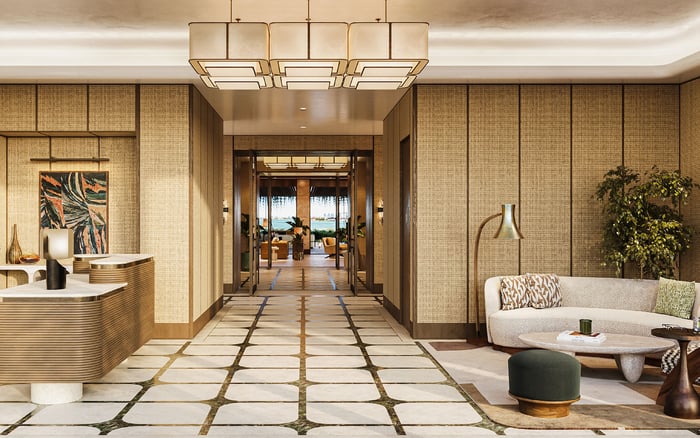
South Florida’s winter calendar gives privacy-minded buyers a useful lens for evaluating how a residence supports discreet arrivals, intimate entertaining, private dining, and a composed return home.

For privacy-conscious buyers, South Florida’s winter social season is more than a calendar of dinners, cultural engagements, charity evenings, and gatherings at home. It offers a practical lens for assessing whether a residence can support an active public life without compromising the calm of home.
A property may appear serene during a quiet tour. The more revealing question is how it performs when residents, guests, staff, deliveries, and vehicles converge around the same evening. Buyers who value private dining access should consider the full sequence of an occasion-from invitation and arrival through service and departure to the return to residential privacy.
This is fundamentally a lifestyle decision, but it also belongs in any serious buyer’s guide. The right address should make entertaining feel effortless while preserving control over who enters the residential environment, where they circulate, and how visible the household becomes.
“Private dining” can describe several distinct experiences. A buyer may want a dining room within the residence, a reservable setting elsewhere in the building, convenient access to preferred restaurants, or the ability to host with professional support. These options are not interchangeable.
Begin by defining the desired degree of separation. Some owners want guests welcomed directly into the home. Others prefer to entertain beyond the residence, keeping private rooms, family routines, and personal collections removed from the occasion. Buyers comparing Miami Beach options such as Shore Club Private Collections Miami Beach can use that distinction to guide questions during a tour, without assuming every property offers the same dining arrangements or service model.
Access also encompasses reservation procedures, guest policies, staffing boundaries, catering rules, and the route between the dining setting and the residence. These operational details often determine whether an elegant space is genuinely useful.
Residential privacy is not a single feature. It is a sequence of spatial and operational decisions. Buyers should examine the entire path from a street or waterfront arrival to the residence, including vehicle staging, lobby visibility, elevator circulation, visitor registration, package handling, and service access.
In Brickell, where an owner may value proximity to a full urban evening, Cipriani Residences Brickell and The Residences at 1428 Brickell can be considered as distinct residential propositions on a touring itinerary. The valuable exercise is not to judge from branding or imagery, but to walk the likely route at the hour when the home will actually be used.
Ask where a driver waits, how an unexpected guest is handled, whether visitors share resident circulation, and how staff enter when preparing a dinner. The answers reveal how much control an owner retains during a busy week.
South Florida is not a single social district. A buyer’s preferred pattern may center on Miami Beach, Brickell, Fisher Island, Palm Beach, or a combination of them. The best residential base is therefore personal, shaped by where evenings tend to begin, how often the household hosts, and whether the owner prefers proximity to activity or distance from it.
For a buyer considering an island setting, The Residences at Six Fisher Island offers a relevant point of comparison within the broader privacy conversation. Farther north, Mandarin Oriental Residences, West Palm Beach can anchor a separate evaluation of how an urban residence fits a Palm Beach County routine.
The goal is not to select the address closest to the greatest number of engagements. It is to choose the home that minimizes unwanted friction. A slightly longer journey may be worthwhile when arrival is composed, guest management is clear, and the residence feels removed once the doors close.
A conventional tour emphasizes views, finishes, proportions, and daylight. Buyers who prioritize privacy should add a scenario-based review. Imagine hosting eight guests while family members remain at home. Consider where coats, flowers, wine, catering equipment, and waiting drivers would go. Then imagine returning from dinner just as another resident receives a larger party.
This exercise tests the boundary between shared luxury and private life. It also clarifies whether the residence has the appropriate acoustic separation, dining proportions, kitchen relationship, powder-room placement, terrace access, and storage for the owner’s preferred style of entertaining. These observations are property-specific and should be verified in person.
Where possible, tour at more than one hour. Daylight reveals architecture and outlook; evening can reveal lighting, arrival atmosphere, and the emotional transition from the public realm to the home.
Buyers should request precise explanations of policies rather than rely on broad labels such as exclusive, private, or club-like. Determine whether dining privileges are included, optional, reservation-based, or subject to separate terms. Ask who may book, how far in advance arrangements can be made, and what happens during periods of high demand.
Apply the same discipline to privacy. Review guest authorization, elevator access, surveillance boundaries, staff credentials, event restrictions, and protocols for household vendors. If a residence will be used seasonally, establish how these systems operate while the owner is away and how preferences are recorded for the next arrival.
Finally, distinguish discretion from isolation. The ideal residence need not remove an owner from South Florida’s social life. It should allow the owner to participate selectively, host beautifully, and return home without carrying the evening’s energy into private space.
Why does winter matter when evaluating a South Florida residence? It provides a realistic framework for assessing how arrivals, entertaining, guest circulation, and privacy function during an active calendar.
What does private dining access mean for a buyer? It may include in-residence entertaining, a reservable shared room, restaurant proximity, or service support. Buyers should define which version they actually need.
Should private dining be treated as a guaranteed building benefit? No. Availability, eligibility, fees, booking procedures, and guest rules should be confirmed for each property.
Which privacy details deserve attention during a tour? Review arrival routes, visitor registration, elevators, service circulation, vehicle handling, package procedures, and the transition into the residence.
Is a branded residence automatically more private? Branding alone does not establish privacy. Operational protocols, physical planning, staffing, and resident policies require separate evaluation.
How should buyers compare Miami Beach and Brickell? Measure each location against the household’s actual evening routine, preferred venues, travel tolerance, hosting style, and desired degree of retreat.
Does a larger residence always entertain better? Not necessarily. Circulation, acoustics, kitchen placement, guest facilities, storage, and separation from private rooms may matter more than size alone.
What should seasonal owners ask about? They should clarify residence preparation, vendor authorization, deliveries, guest permissions, security procedures, and how preferences are maintained while they are away.
When is the best time to tour? Tour in daylight for spatial clarity and, when feasible, return in the evening to assess arrival atmosphere, lighting, circulation, and the sense of retreat.
What is the central buying principle? Choose a residence that supports selective participation in social life while keeping access, hospitality, and the private household under the owner’s control.
To compare the best-fit options with clarity, connect with MILLION.
If branded residences are on your mind — as a home or as an allocation — we would be glad to share what we are seeing, privately.
Begin a quiet conversation