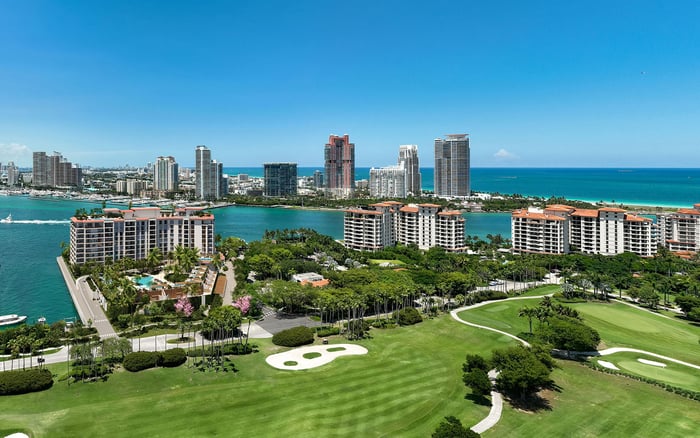
On Fisher Island, the most consequential luxury may be an operating system that protects privacy while allowing daily life, guests, staff, and services to move with precision.

A flawless stone slab is easy to admire. A privacy system is harder to see, yet may exert a greater influence on ownership.
For serious Fisher Island buyers, the residential experience begins well before the front door. Property showings require advance security clearance and coordination with the listing agent. Guests typically need sponsorship through a resident, the club, or authorized property staff, and visitors may be asked to provide full names and government-issued identification. Security teams operate around the clock, monitoring key entry points.
These procedures are not decorative amenities. They are integral to the island's operating environment, shaping arrivals, entertaining, staffing, maintenance, and periods of owner absence. Labels such as Gated-community, Waterfront, Second-home, and Lifestyle may capture the broad appeal, but they do not reveal whether a particular household will function smoothly within the applicable protocols.
Fisher Island is a governed community with formal rules and regulations. Buyers should review the current association rules before contingencies expire, as community procedures can affect how a property is used after closing.
That review should be practical, not ceremonial. Ask how a dinner guest is registered, how a recurring housekeeper is cleared, how a contractor arrives, and what changes when the owner is traveling. Larger gatherings may require special advance arrangements, meaning entertaining capacity depends partly on operations-not simply the size of a terrace or dining room.
The essential question is not whether access is controlled. It is whether the control system aligns with the buyer's actual rhythms and expectations.
Island access, club privileges, building procedures, and unit-level security should be evaluated independently. Different entities may control each layer, and approval at one point should not be assumed to govern another.
Island-level controls establish the perimeter experience. Building protocols determine how visitors, deliveries, vendors, and staff move closer to the residence. Club rules can affect sponsored guests and privileges. Inside the home, the owner still needs clearly defined household access procedures and residence-level planning.
Geographic separation alone does not provide complete protection. A sophisticated security assessment may also consider insiders, marine approaches, drones, and coordination across multiple properties. The correct framework is layered: community controls support private planning, but they do not replace it.
This distinction is especially important when considering residences at Palazzo del Sol or Palazzo della Luna. The project setting may establish the architectural context, but the buyer's diligence must still address current building-specific procedures and the security plan within the individual home.
A primary residence, seasonal retreat, and occasionally occupied property each place different demands on access systems. Seasonal buyers should examine how recurring guests, household employees, property managers, and service providers are cleared when the owner is away.
Test realistic scenarios: an assistant arriving before the family, a chef preparing for guests, a repair team responding during an absence, or several visitors reaching the island within a narrow window. The objective is not to bypass control, but to determine whether authorization can be managed discreetly, consistently, and without avoidable friction.
The same exercise applies to estate-style opportunities such as The Links Estates at Fisher Island and condominium ownership at The Residences at Six Fisher Island. Different residential formats may create distinct household patterns, but no buyer should infer exact procedures from architecture, marketing, or a single showing.
The guiding principle is simple: verify operations with the same discipline applied to title, condition, and financial review.
Request current written rules and property-specific confirmations. Clarify preregistration, identification, guest privileges, larger-event arrangements, household-staff access, vendor access, emergency response, and owner-absence procedures. Determine whom the household contacts, who can authorize entry, and which records or approvals are required.
Finishes can be inspected during a tour and altered after closing. An ownership environment is less easily changed. On Fisher Island, privacy is most valuable when it is both rigorous and livable-protecting discretion without making a well-run household feel improvised.
Why can security matter more than interior finishes on Fisher Island? Security and access procedures influence daily arrivals, guests, staff, services, and owner absences. Finishes are visible and potentially replaceable, while operating protocols shape the ownership experience.
Do property showings require advance clearance? Yes. Showings require advance security clearance coordinated with the listing agent.
How are guests generally admitted? Guests typically require sponsorship from a resident, the club, or authorized property staff. Preregistration and identification rules may also apply.
Can visitors be asked for identification? Yes. Visitors may be required to provide full names and government-issued identification during the guest-access process.
Are entry points monitored continuously? Security teams operate around the clock, with key entry points monitored.
Do larger gatherings require additional planning? They may. Buyers who entertain should confirm current advance-arrangement requirements and applicable guest privileges.
What should a seasonal owner verify? Confirm how recurring visitors, household staff, property managers, and service providers are cleared when the owner is away.
Does island access replace residence-level security? No. Island controls are one layer; they do not replace building procedures, household access rules, or security planning within the residence.
When should association rules be reviewed? Buyers should review current rules before purchase contingencies expire, allowing time to assess how procedures may affect intended use.
Can buyers rely on procedures observed during one showing? No. Exact procedures can change, making current written policies and property-specific confirmations more reliable than assumptions formed during a tour.
For a tailored shortlist and next-step guidance, connect with MILLION.
If branded residences are on your mind — as a home or as an allocation — we would be glad to share what we are seeing, privately.
Begin a quiet conversation