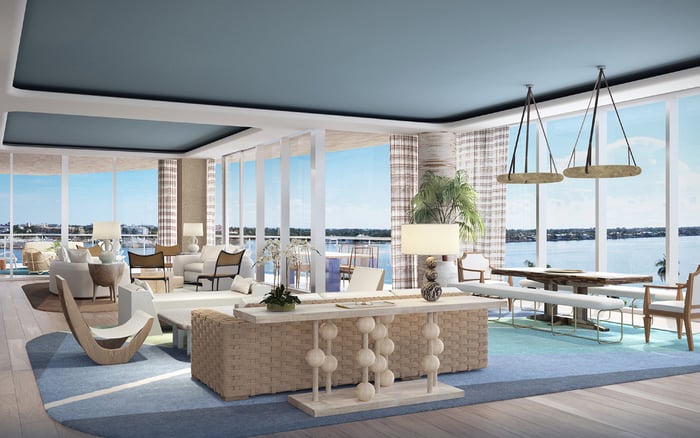
Seasonal buyers in South Florida need finish schedules that account for occupancy windows, building approvals, specialty materials, trades, and second-home logistics.

In South Florida, the purchase of a residence is often tied to a season rather than a single closing date. A buyer may be planning for winter family arrivals, spring entertaining, an extended yacht itinerary, or a quiet second-home rhythm that begins the moment the weather turns elsewhere. That calendar creates a different standard for finish schedules, because a residence that is technically owned is not always ready to be lived in.
For seasonal buyers, finish planning is not simply about selecting stone, millwork, lighting, window treatments, furnishings, and smart-home systems. It is about aligning those decisions with the exact moment when the property must feel complete. The distinction is subtle but consequential. A local owner can tolerate phased work across several months. A seasonal owner often cannot. The residence must function immediately, with privacy, comfort, storage, climate control, and service access already resolved.
This is why a luxury finish schedule should be treated as a strategic document, not a decorator’s calendar. It should clarify what must be completed before occupancy, what can be refined after the season, and which decisions carry the greatest risk if delayed. In markets such as Brickell, Miami Beach, and Palm Beach, the difference between a beautiful plan and a livable residence often comes down to sequencing.
Many finish schedules assume that time is flexible. They begin with broad design intent, then move through samples, approvals, fabrication, delivery, installation, punch work, and styling. That sequence may be reasonable for a primary resident who can visit weekly, answer questions quickly, and tolerate temporary disruption.
Seasonal buyers operate differently. They may be absent for long stretches, working across time zones, relying on representatives, or coordinating household staff before arrival. Decisions that seem minor on paper can become expensive delays when left open. A faucet finish, slab approval, AV location, shade pocket, closet accessory, or appliance panel can hold up other trades.
A more appropriate standard starts with the occupancy date and works backward. The schedule should identify the non-negotiables: beds ready, baths operational, kitchen functional, closets usable, shades installed, lighting scenes programmed, outdoor areas safe, and service pathways clear. Decorative enhancements can follow. Comfort cannot.
Luxury buyers often focus on the quality of the finish. That is understandable. Yet the greater schedule risk is usually dependency. One delayed decision can affect a chain of trades. Stone templates may depend on cabinetry. Cabinetry may depend on appliance specifications. Lighting trim may depend on ceiling work. Window treatments may depend on final measurements after installation.
For seasonal owners, these dependencies should be visible early. A refined schedule should show not only dates, but also decision gates. It should state when the buyer must approve each item, what information is needed, and what happens if the decision is not made. This is especially important for new-construction and pre-construction residences, where the promise of a new home can obscure the number of post-closing choices still required.
The best schedules also distinguish between reversible and irreversible decisions. A rug can be changed. A stone slab, recessed fixture location, or integrated system is more consequential. Seasonal buyers should spend their attention where delay or regret would be hardest to correct.
In South Florida condominium living, finish work is rarely controlled by the owner alone. Buildings may have protocols for contractor access, freight elevators, work hours, insurance documentation, noise, deliveries, protection of common areas, and approvals for specific scopes. These rules are part of the project timeline, not administrative clutter.
A seasonal buyer should request a finish schedule that incorporates building procedures from the beginning. If approvals are required before work can begin, those dates should appear before fabrication or mobilization. If deliveries must be coordinated through limited building access, that should shape procurement. If the residence sits in a high-service tower where discretion matters, the logistics plan should be as polished as the design.
This is particularly relevant for buyers who expect a turnkey arrival. A residence may look nearly complete in photographs, yet still require final access, testing, touch-ups, cleaning, and building coordination before it feels effortless. The finish schedule should allow time for that invisible work.
South Florida rewards decisiveness. Specialty materials, artisan trades, custom furnishings, and integrated systems all require lead time. Even when a product is available, the installation sequence may depend on the right crew at the right moment. Seasonal demand can compress calendars, especially when many owners want residences ready for the same social window.
The answer is not to rush taste. It is to prioritize. Buyers should ask which selections must be finalized immediately, which can be provisionally specified, and which can be deferred without compromising occupancy. A complete primary suite, functioning kitchen, installed shades, and reliable climate control may matter more than the final layer of accessories.
A sophisticated schedule should also include a closeout period. This is the buffer between construction completion and true readiness. It allows for punch-list corrections, cleaning, systems testing, furniture placement, art coordination, and household orientation. Without that buffer, the first days of ownership can become a series of appointments rather than an arrival.
A seasonal finish schedule should be judged by four qualities: clarity, realism, accountability, and livability.
Clarity means the buyer can see the path from acquisition to occupancy without deciphering trade jargon. Realism means the schedule reflects approvals, deliveries, inspections, elevator bookings, and human availability. Accountability means every decision has an owner, a deadline, and a consequence. Livability means the home is not merely photogenic, but ready for daily use.
This standard is especially valuable for buyers comparing different property types. A recently delivered residence may still require personalization. A resale may need selective modernization before the season. A waterfront home may involve exterior details, service systems, or specialty maintenance. A boutique condominium may offer intimacy but require careful coordination of access. Each property has its own rhythm, and the finish schedule should reveal it before the buyer commits to a timeline.
For an ultra-premium audience, this is not about avoiding complexity. It is about managing it gracefully. The right schedule protects the owner’s privacy, preserves design intent, and prevents the residence from becoming a project during the weeks it was meant to be enjoyed.
Before finalizing a purchase or post-closing improvement plan, seasonal buyers should ask direct questions. What must be complete before arrival? Which items could compromise occupancy if delayed? Who is responsible for approvals? How are building rules incorporated? Which selections have the longest lead times? What work can occur while the owner is absent, and what requires in-person review?
They should also ask for a phased plan. Phase one should be occupancy-critical. Phase two should focus on comfort and refinement. Phase three can address enhancement. This structure allows the owner to enjoy the residence on time while preserving ambition for the long term.
The most effective advisors understand that luxury is not just the finish itself. It is the absence of friction. When the elevator opens, the lighting should work, the rooms should feel composed, the closets should receive luggage, the terrace should be usable, and the household should understand how the residence functions. That is the standard seasonal buyers deserve.
There is a certain confidence in a residence finished at the right moment. Not overmanaged. Not hurried. Simply ready. For seasonal buyers, that readiness is a form of luxury as meaningful as architecture or view.
A better finish schedule allows owners to arrive without inheriting unresolved decisions. It acknowledges the realities of distance, building logistics, material timing, and seasonal expectations. It also respects the emotional purpose of the home. A South Florida residence is often where families gather, guests are hosted, and winter life becomes expansive again.
That experience should not be compromised by a missing shade motor, an unfinished closet, an untested lighting system, or a delivery that could have been planned weeks earlier. The correct standard is not perfection in the abstract. It is readiness for the life the buyer intends to live.
Why do seasonal buyers need a different finish schedule? Their occupancy window is often fixed, so the schedule must prioritize livability by the arrival date rather than general project completion.
What should be finished before a seasonal owner arrives? Bedrooms, baths, kitchen function, closets, shades, lighting, climate control, and basic service operations should be ready first.
Can decorative items wait until after the season begins? Yes, if they do not disrupt comfort, privacy, safety, or daily use of the residence.
Why are condo rules important to the schedule? Building procedures can affect contractor access, deliveries, work hours, elevator use, and documentation.
How early should a buyer make finish selections? The most dependent and longest-lead selections should be made as early as possible to protect the occupancy date.
What is a closeout period? It is the time reserved for punch work, cleaning, testing, furniture placement, and final readiness before arrival.
Is a turnkey residence always ready for seasonal use? Not necessarily. Buyers should confirm systems, furnishings, storage, window treatments, and building logistics.
How should absent owners manage decisions? They should appoint clear decision-makers, set approval deadlines, and require concise updates tied to the schedule.
What is the biggest mistake in finish scheduling? Treating all decisions equally, instead of identifying which ones can delay multiple trades or affect occupancy.
What defines a successful seasonal finish plan? The residence feels calm, functional, private, and complete when the owner arrives.
When you're ready to tour or underwrite the options, connect with MILLION.
If branded residences are on your mind — as a home or as an allocation — we would be glad to share what we are seeing, privately.
Begin a quiet conversation