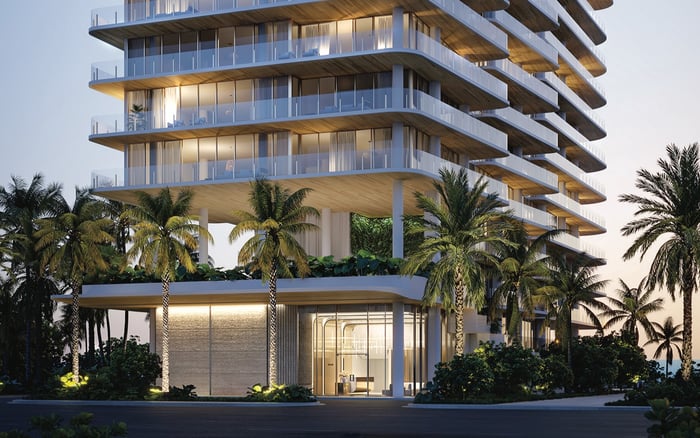
In Surfside, the most consequential luxury may be certainty. Serious buyers should examine local delivery history, insurance, financing, construction progress, sales absorption and contractual protections before giving decisive weight to finishes.
.jpg)
In Surfside, stone selections, custom millwork and private-elevator arrival sequences can establish the emotional case for a residence. Yet none addresses the threshold question: Will the building reach closing on the timetable and terms the buyer expects?
For serious purchasers, delivery certainty can outweigh finishes because insurance, financing, construction progress and sales absorption all influence execution. This is especially relevant in the Oceanfront market, where technically ambitious construction meets a coastal insurance environment that grew more cautious after the 2021 Surfside collapse.
That does not make design secondary. It makes design contingent. A beautifully specified residence has practical value only when the broader development plan supports construction, completion and closing.
A global portfolio can demonstrate access to talent, capital and sophisticated branding. It does not automatically establish mastery of South Florida's location-specific insurance, financing, entitlement and construction conditions. Buyers should distinguish international prominence from demonstrated local delivery.
DAMAC acquired the former Champlain Towers South property for $120 million in 2022 after emerging as the sole bidder. Identified as the Dubai developer's first United States real-estate expansion, the acquisition left prospective purchasers with less local execution history to examine than its international portfolio might suggest.
The project later stalled while the developer sought more than $1.5 billion in construction insurance. The lesson extends beyond any single development: public marketing can continue even when a critical prerequisite to construction remains unresolved. Brand stature does not eliminate project-level risk.
For context, buyers can compare the surrounding residential landscape, including Arte Surfside and Fendi Château Residences Surfside, while keeping the analysis disciplined. The objective is not to equate distinct properties, but to determine what can be physically inspected, what remains prospective and which party is responsible for each promise.
Fort Partners provides a completed local benchmark through The Surf Club Four Seasons Surfside at 9001 Collins Avenue. The development was completed, and condo closings began in March 2017. In 2018, Fort Partners secured a $56 million refinancing for the completed condo-hotel development.
A finished property allows a buyer to evaluate more than a presentation. Construction execution, final material quality, completed closings and operating performance become observable. An announced project, however compelling, cannot offer the same evidence.
This is why The Surf Club Four Seasons Surfside belongs in a serious comparison set-not simply as an aesthetic reference, but as proof of delivered work in the same submarket. Similarly, Ocean House Surfside merits consideration within a broader neighborhood review, with its documents, condition and project history evaluated independently.
A projected completion date should be treated as an assumption to verify, not a guaranteed outcome. Ask what insurance is in place, which financing conditions remain, what construction milestones have been reached and whether the capital plan depends on presale thresholds.
A 2026 status snapshot of the collapse-site development showed no unit sales since marketing began, while the stated 2029 completion remained in place. That combination does not, by itself, establish the ultimate outcome. It does demonstrate why publicity and luxury positioning should not be mistaken for absorption-and why absorption can matter when construction timing or capital is tied to presales.
The same discipline applies when reviewing The Delmore Surfside or any other Pre-Construction opportunity. Buyers should request current evidence rather than rely on launch-era statements, as insurance, financing, sales and construction status can change.
A rigorous Buyer's Guides approach begins with a project-specific file. It should identify the owner, developer, general contractor, lender, designer, operator and any luxury brand, then define the actual authority and obligations of each. A marketed participant may shape design or hospitality without controlling construction delivery.
Next, review the offering documents and purchase contract with qualified legal and financial advisers. Public information rarely reveals every financing condition, presale threshold, governance provision or buyer remedy. Examine the contract for deposit handling, permitted extensions, material changes, cancellation rights and the consequences of delayed delivery.
Finally, separate the evidence into three categories: completed, funded and aspirational. Completed work can be visited. Funding and insurance should be documented. Aspirational elements-from completion dates to amenity narratives-should receive an appropriate risk weight.
This framework is not anti-development. It is the essence of informed Developer News analysis in Surfside, where scarcity and architectural ambition can make a persuasive sales story especially powerful. The discerning buyer asks whether the delivery structure is equally persuasive.
Why can delivery risk matter more than finishes? Finishes influence enjoyment and value, but insurance, financing and construction determine whether the residence reaches closing as planned.
Does a famous global developer eliminate execution risk? No. Global recognition does not remove local insurance, entitlement, financing or construction challenges.
What does a completed local project prove? It provides observable evidence of execution, final quality, closings and operations that renderings cannot supply.
Why is construction insurance important? A development can be publicly marketed yet remain effectively stalled if required construction insurance has not been secured.
Should buyers rely on a projected completion date? No. Treat it as an assumption to test against current insurance, financing, sales and construction evidence.
Why does sales absorption matter? Weak absorption may raise questions when a project's capital plan or timetable depends on reaching presale targets.
Which project participants should be verified? Confirm the precise roles of the owner, developer, contractor, lender, designer, operator and luxury brand.
What should counsel review in the purchase contract? Counsel should examine deposit handling, extension rights, change provisions, cancellation rights and delay remedies.
Is a branded residence automatically safer? No. Branding may shape design or service, but buyers must verify who controls and guarantees delivery obligations.
What is the clearest comparison method? Compare completed local work with announced projects, then separate documented milestones from marketing expectations.
To compare the best-fit options with clarity, connect with MILLION.
If branded residences are on your mind — as a home or as an allocation — we would be glad to share what we are seeing, privately.
Begin a quiet conversation