For a frequent traveler buying in Key Biscayne, operational details can outweigh a modest price difference. The more revealing measure is door-to-terminal performance, tested under the owner's real schedule and supported by capable building operations.
A Key Biscayne residence can satisfy the conventional measures of luxury: water views, privacy, generous interiors, and proximity to the city. Yet for owners who fly frequently, host international guests, or divide their year among several homes, the decisive variable may be less photogenic: the sequence between closing the apartment door and reaching the airport terminal.
That sequence includes elevator response, vehicle retrieval, luggage handling, guest pickup, the Rickenbacker Causeway, the mainland road network, and airport curb conditions. A residence with a more attractive asking price can become the less elegant choice if every departure demands extra coordination. Conversely, a property that operates smoothly can protect time, reduce uncertainty, and make spontaneous travel feel genuinely effortless.
In luxury ownership, the most consequential amenity may be a departure that works exactly as planned.
For MILLION's Buyer's Guides, this is an important distinction: purchase price is paid at acquisition, while operational friction is experienced repeatedly. The comparison is particularly relevant for a second-home buyer whose stays may begin with a late arrival and end with a tightly timed flight.
Travel estimates between Key Biscayne and Miami International Airport vary widely. A low-friction drive may take about 22 minutes, while other planning figures fall near 32 or 33 minutes. Local transfer estimates can reach 35 to 45 minutes. Road distances also range from approximately 13.8 to 16 miles, confirming that mileage alone does not describe the experience.
The sensible benchmark is therefore not island-to-airport distance. It is door-to-terminal time under the conditions an owner actually encounters. A 7 a.m. international departure, a Friday evening arrival, and a Sunday afternoon pickup are distinct operational tests. Weekend beach traffic deserves particular attention because it can place added pressure on the island approach.
Buyers should time each component separately. Record the elevator wait, the interval between calling for the vehicle and receiving it, luggage-loading time, the causeway crossing, the airport approach, and curbside unloading. Repeating the exercise at representative hours turns a broad estimate of 22 to 45 minutes into property-specific intelligence.
Public transportation can serve as a contingency, but the combined bus-and-train journey takes about 1 hour and 1 minute, at an approximate cost of $5 to $6. For most time-sensitive luxury travel, disciplined vehicle planning is the more relevant focus.
The Rickenbacker Causeway is the only vehicular access to Key Biscayne. When congestion or an incident affects the approach, drivers have few practical alternatives. That network constraint elevates matters that might otherwise seem secondary during a showing.
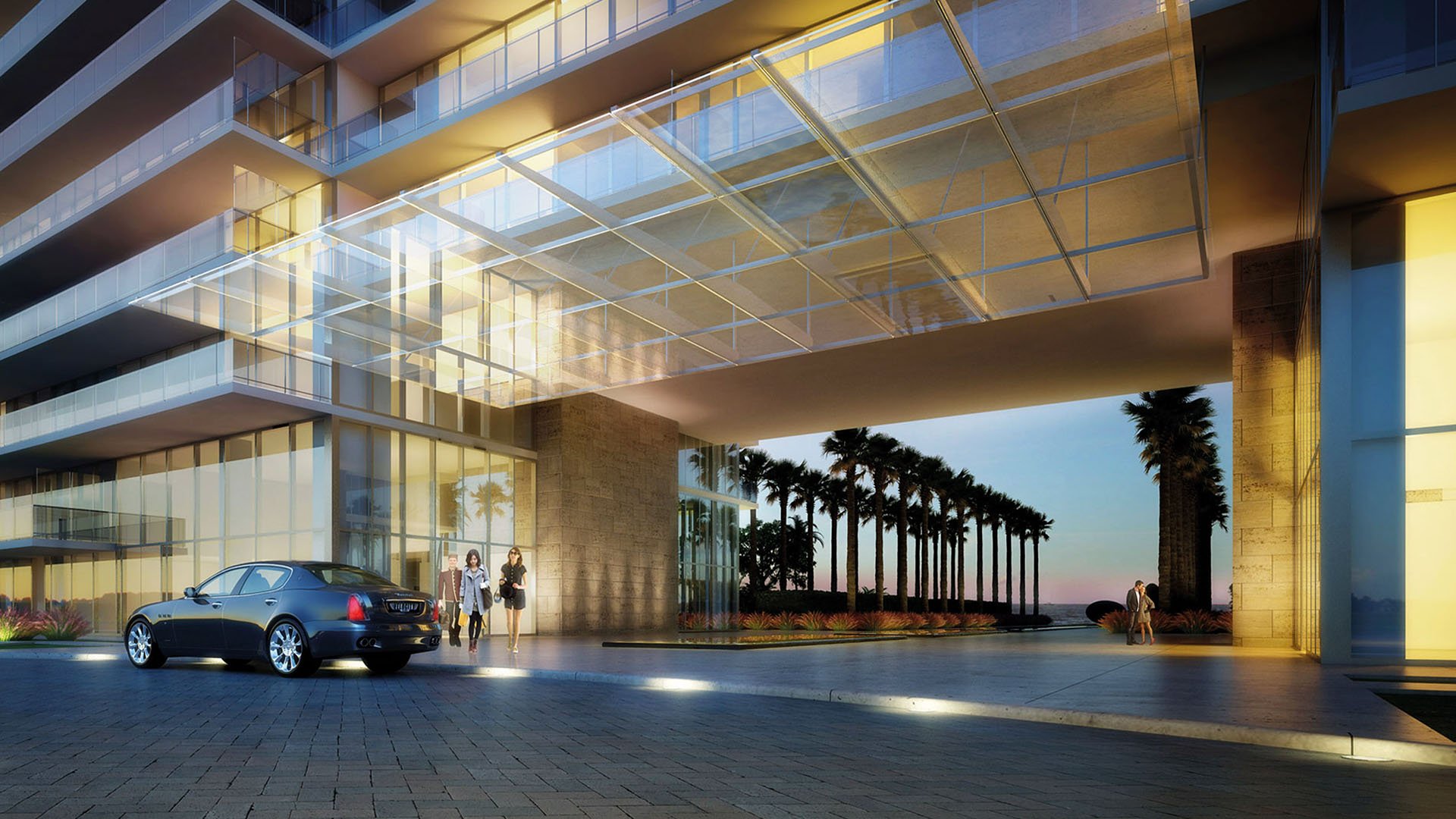
At a building such as Oceana Key Biscayne, a buyer should examine operations as carefully as finishes. The relevant questions are where a private driver may wait, whether ride-hail vehicles can circulate without blocking residents, how multiple cars queue, where luggage is staged, and what happens after normal valet hours. The project link identifies a residential option for consideration, not a substitute for property-specific verification.
A well-designed porte cochere is useful, but choreography matters more than appearance. Observe an active arrival period rather than an empty forecourt. Ask for written procedures governing guest vehicles, oversized luggage, service access, late-night returns, and vehicle handoffs. Efficient loading can preserve minutes before the causeway, while there is still some control over the schedule.
Key Biscayne's operational exposure does not stop at the causeway. Large events elsewhere in Miami can pressure the roads used by owners, chauffeurs, household staff, and arriving guests. During the March 15 to 29, 2026 Miami Open, for example, higher volumes were anticipated around the March 28 and 29 finals, with potential pressure across I-95, 95 Express, I-395, and the MacArthur Causeway.
The buyer's lesson extends beyond one tournament. Test travel during setup, event, and breakdown periods, not merely on the marquee date. A driver collecting guests at MIA may encounter conditions that never surface during a quiet midweek inspection. Airport traffic and construction updates, live flight information, and current operating conditions can help a household coordinate dispatch and adjust staging.
Comparative due diligence can also clarify what the island premium means in practice. Buyers considering Una Residences Brickell, Park Grove Coconut Grove, or Apogee South Beach should run the same door-to-terminal exercise rather than rely on neighborhood assumptions. Each location presents different route geometry, but the evaluation should remain consistent: retrieval, loading, road resilience, airport approach, and re-entry.
Lock-and-leave is not a standardized market metric. It is a use case that must be assessed property by property. For an owner absent for weeks or months, the critical issues include security, staffing coverage, maintenance coordination, package handling, parking procedures, and the protocol for returning outside conventional hours.
A true lock-and-leave residence should make absence uneventful and re-entry composed. Buyers can ask who holds access authority during an emergency, how vendors are supervised, where deliveries are stored, and whether management can coordinate maintenance without the owner present. They should also confirm how a vehicle is kept, retrieved, or transferred when travel plans change.
This operating standard is especially important in a waterfront setting, where a buyer may instinctively focus on outlook and amenities. Those qualities shape lifestyle, but dependable oversight determines whether the home remains easy to own from a distance. Review staffing and access in writing, and distinguish an informal courtesy from a defined service.
Begin with three airport runs at the hours most representative of actual travel. Include one weekday peak, one early-morning departure, and one weekend afternoon. Start the clock inside the residence and stop it at the relevant terminal curb. If private aviation or another airport is part of the owner's routine, repeat the same protocol for that destination rather than extrapolating from MIA.
Next, stage a realistic departure. Use the expected number of passengers, bags, and vehicles. Ask a driver to arrive as instructed and note where the vehicle waits, how staff communicate, and whether the loading area remains functional when another resident arrives simultaneously. Then test an after-hours return, including gate access, elevator availability, package retrieval, and parking.
Finally, request the operating rules that support what was observed. Confirm valet hours, guest pickup procedures, after-hours contacts, vehicle queuing, loading restrictions, and maintenance authorization. These details belong beside the financial review and physical inspection because they influence the lived value of ownership.
In Key Biscayne, a lower asking price does not automatically produce the better acquisition. For a frequent traveler, value may reside in recovered time, predictable departures, calm guest arrivals, and a home that can be left securely without elaborate intervention. The right comparison places recurring operational performance beside price, views, floor plan, and amenities.
That perspective does not diminish the island's appeal. It makes the purchase decision more exacting. When access is concentrated through one causeway and airport times can vary from roughly 22 to 45 minutes, operational excellence becomes part of the luxury proposition itself.
For discreet guidance on evaluating Key Biscayne ownership through both property and operational criteria, connect with MILLION.
If branded residences are on your mind — as a home or as an allocation — we would be glad to share what we are seeing, privately.
Begin a quiet conversationPublished planning estimates range from about 22 minutes without traffic to roughly 45 minutes under other assumptions. Buyers should test the trip at the hours they typically fly.
The route is relatively short, but causeway conditions, mainland congestion, construction, and airport curb traffic can materially change total travel time.
Record door-to-terminal time, including elevator waits, vehicle retrieval, loading, causeway travel, and curbside unloading.
It is Key Biscayne's only vehicular access, leaving drivers with few alternatives when congestion or incidents affect the approach.
Saturday and Sunday afternoons are important because beach-bound traffic can add pressure to the island approach.
Inspect vehicle queuing, driver waiting space, ride-hail circulation, luggage staging, communication procedures, and after-hours service.
Events can increase pressure on the wider road network used by owners, guests, chauffeurs, and service providers, even when the event is off the island.
It means the residence can be left and re-entered with dependable security, staffing, maintenance coordination, package handling, parking, and access procedures.
A combined bus and train journey has been estimated at about 1 hour and 1 minute, so it may be less suitable for time-sensitive travel.
Yes. For frequent travelers, recurring delays and coordination burdens may matter more than a modest acquisition-price difference.