For Hallandale Beach buyers, amenity value depends on usable access, not brochure length. A disciplined review pairs peak-season visits with unit-specific dues, access rules, operating budgets and capital planning.
In Hallandale Beach, a long amenity list can make ownership appear effortless: a pool, a spa, a fitness center, beach service. Yet the distinction that matters to a discerning buyer is not how many facilities exist. It is whether those facilities accommodate the household’s routine when seasonal demand is strongest.
Ownership cost has two dimensions: the association charges paid and the usefulness received. Waiting for equipment or rearranging a morning around reservations would diminish that usefulness, even without adding a line to the monthly statement. These are conditions to test, not findings about any particular building.
For buyers considering this part of Broward, the better question is simple: what does the assessment support, and how reliably can I enjoy it?
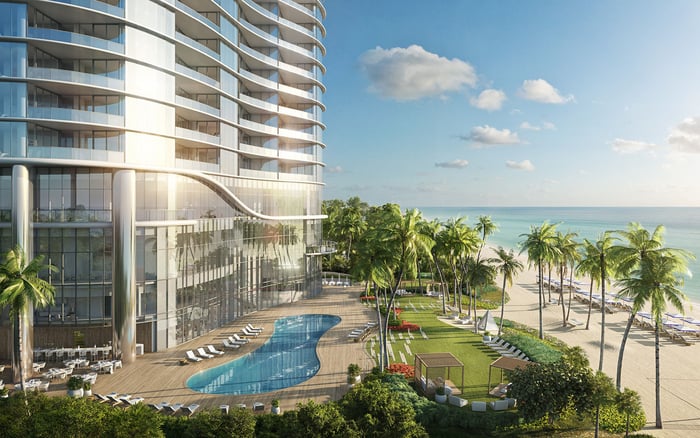
The Beach Club’s 50,000-square-foot spa and fitness center overlooks the Atlantic. Estimated monthly association dues are approximately $1.00 per square foot. Applied illustratively to a 2,000-square-foot residence, that means about $2,000 monthly, or $24,000 annually, in association dues alone.
Neither figure answers the capacity question. Square footage does not reveal how much space serves your preferred activity, how many residents arrive at once, or how reservations distribute access. Nor does the fee estimate establish the assessment for a specific residence.
The estimated dues also encompass building insurance, 24/7 security, campus maintenance, heated seaside pools, spas and towel services. Treating the entire payment as a recreation membership would misread the expense. The buyer is evaluating shared building operations as well as leisure amenities.
At Chelsea Bayview, estimated monthly dues are approximately $0.50 per square foot, including building insurance, a bayside heated pool, clubhouse and fitness center. That lower estimate does not, by itself, establish better value. Included services, unit-specific charges and usable access must be reconciled first.
Begin with the residence’s total recurring monthly association charges, including any separate association component. Divide that total by the residence’s square footage, using a consistent area basis across comparisons. Then place the included services beside the result.
Residence-specific figures show why precision matters. Beach Club II at 1830 S Ocean Drive, Unit 3003, carries stated monthly HOA dues of $1,059. At 1850 S Ocean Drive, Apartment 803, the stated figure is $1,697. These are snapshots, not interchangeable building schedules or evidence of different operating efficiency.
At 2000 Ocean Hallandale Beach, calculated total monthly association fees for 2000 S Ocean Drive, Unit 12A, are $4,760. Inclusions encompass insurance, structural maintenance, elevators and common areas, alongside pool and fitness amenities. A higher charge alone does not demonstrate an amenity deficit.
Ask for confirmation of current dues, separate charges and special assessments before relying on any comparison. If Shell Bay by Auberge Hallandale is also on the shortlist, apply the same unit-level discipline rather than assuming the fee structures are comparable.
Ask management when seasonal use is strongest and arrange visits during those periods, with permission to observe the relevant facilities. Choose times that match your intended routine. A quiet viewing at an unrelated hour cannot establish whether your preferred swimming or exercise window works.
Keep a simple observation record: date, time, available loungers, occupied equipment, observed queues, elevator waits and valet turnaround. Distinguish equipment in use from equipment unavailable for maintenance. Repeat the exercise at another relevant time rather than treating one visit as a verdict.
Match the observation to the experience you are buying. A free lounger is not necessarily a suitable place for a household that wants to sit together. An open gym does not guarantee access to the equipment central to your workout. Set your tolerances before touring, so an impressive setting does not displace practical judgment.
If the search extends to Turnberry Ocean Club Sunny Isles, use the same observation sheet in that evaluation. The purpose is consistency across candidates, not an unsupported ranking of their service quality.
Capacity has a denominator: the people entitled to use the space. Ask which towers share each amenity, how many residences have access, and whether renters or outside members participate. Do not assume every facility serves the same user base.
Request pool bather limits, fitness-room occupancy limits, class caps, reservation policies and guest restrictions. Separate formal limits from everyday availability. A reservation system may make access more predictable, but its booking window and cancellation rules still need to suit the owner’s schedule.
Hallandale Oasis amenities include a heated community pool, spa, cabanas, fitness center, rooftop deck, concierge, doorman, business center and party room. That breadth is a starting point for questions, not proof of simultaneous availability. For any candidate, ask which spaces require advance arrangements and whether activities compete for the same staff or facilities.
The next review belongs at the budget table. Request five to ten years of dues and assessment history, current budgets, reserve studies and planned work affecting pools, spas, decks and equipment. Historical documents help distinguish an isolated charge from a recurring obligation without presuming costs are rising.
Keep operating and capital expenses separate. Staffing, utilities, insurance and routine maintenance support daily operations. Major repairs and replacements require a different funding analysis. Ask how each planned project is classified, how it is expected to be funded and whether an assessment has been approved or merely discussed.
Anchor Bay Club Marina’s HOA coverage includes cable television, hot water, pool maintenance, roof upkeep, security and trash removal. It illustrates why visible amenities cannot explain the entire bill. Neither a beautifully presented pool nor an expensive assessment establishes reserve adequacy.
Evaluate a second residence against the weeks and hours its owner expects to occupy it. Identify the amenities essential to that stay, then connect each one to observed availability, written access rules and its operating or replacement obligations.
The final comparison should show three things clearly: what the residence pays, what the household can realistically use, and which future costs remain unresolved. That is more revealing than an amenity count. Luxury is not simply having a facility on the property; it is having an ownership arrangement that makes the intended experience dependable.
Explore a more considered approach to South Florida ownership with MILLION.
If branded residences are on your mind — as a home or as an allocation — we would be glad to share what we are seeing, privately.
Begin a quiet conversationA visit during management-identified peak periods helps test whether facilities suit your intended routine. An amenity list alone cannot establish availability at those times.
The building-level marketing estimate is approximately $1.00 per square foot monthly. It is not a verified current assessment for an individual residence.
At the quoted rate, association dues would be approximately $2,000 monthly or $24,000 annually. This is an illustration, not a unit-specific quote.
Its advertised 50,000-square-foot spa and fitness center establishes scale, not equipment availability, occupancy or wait times. Those require separate checks.
The listing gives calculated total monthly association fees of $4,760 for that residence. Confirm current charges and any separate assessments before relying on the figure.
Divide total recurring monthly association charges by residence square footage using a consistent area basis. Compare included services alongside that calculation.
Record available loungers, equipment availability, observed queues, elevator waits and valet turnaround, together with the date and time. Repeat observations during another relevant period.
Request occupancy limits, class caps, reservation policies and guest restrictions. Also confirm which towers, residences, renters or outside members have access.
Request five to ten years of dues and assessment history, current budgets, reserve studies and planned amenity work. Separate everyday operating expenses from major repair and replacement funding.
No. Fee differences alone establish neither service quality nor an operating deficit, and they do not demonstrate reserve adequacy.