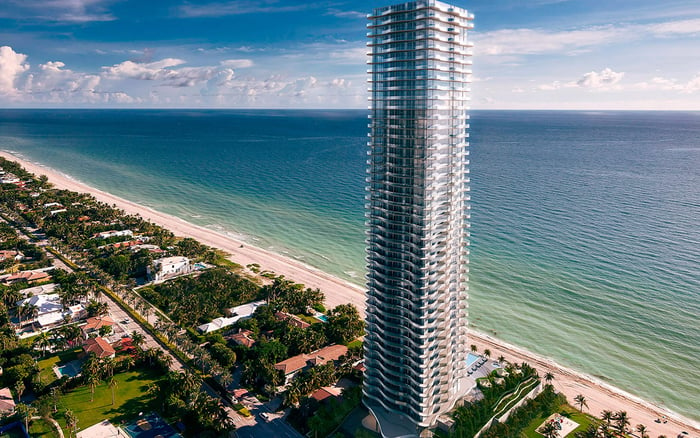
In a luxury tower, security is not a single amenity but a sequence of controls. Buyers should test the complete resident journey, unit-level monitoring, leasing procedures and emergency response before committing.

In Sunny Isles Beach, ocean views, private elevators and polished arrival experiences can dominate an initial tour. Yet for an owner who travels frequently, employs household staff or expects the residence to remain vacant for extended periods, security deserves consideration alongside architecture and amenities.
The useful question is not whether a tower advertises security, but how it maintains privacy across a sequence of moments: vehicle arrival, valet or garage entry, lobby access, elevator movement, deliveries, service visits, unit entry and emergency response. A staffed entrance may provide one layer, but it does not explain the full system.
This review should begin early enough for written answers to shape the choice of building, residence and ownership plan.
A buyer should walk every possible route to the residence, not merely the ceremonial path presented during a showing. Ask how residents, guests, vendors, contractors and household employees are authenticated at the valet, garage and pedestrian entrances. Then determine where credentials are checked again and how exceptions are authorized.
Buyers comparing Bentley Residences Sunny Isles and St. Regis® Residences Sunny Isles can place arrival protocols near the top of their building-specific diligence.
Written questions should address access during power, network or credential-system outages. Buyers should also clarify who can approve an override, whether the action is logged and how management communicates a temporary change in protocol.
Lock-and-leave ownership requires two related but distinct reviews. The first concerns common-area access; the second concerns what happens inside the residence when no one is present.
Confirm whether unit monitoring is provided, optional or entirely owner-arranged. Ask which conditions can be monitored, who receives an alert, what response follows and how authorized personnel gain entry when the owner cannot be reached.
A buyer considering The Ritz-Carlton Residences® Sunny Isles should obtain building-specific details rather than extrapolate from brand identity. For a new-construction purchase, determine which systems are delivered with the residence and which remain the owner’s responsibility.
Privacy can be weakened by routine exceptions rather than a dramatic breach. Household employees, assistants, caregivers, contractors and recurring vendors may each require different permissions. Buyers with elevated concerns should ask how credentials are issued, limited, reviewed and revoked, particularly after staff turnover.
A professional vulnerability assessment can extend beyond physical access by considering travel patterns, public exposure, family social-media activity and how frequently the home is unoccupied. In a waterfront setting, ocean or water access should form part of the exposure review rather than be treated solely as an amenity.
At Jade Signature Sunny Isles Beach or another oceanfront tower, the objective is not to solicit sensitive operational details in public. It is to obtain discreet, written clarity from the appropriate association or management representatives during diligence.
Rental flexibility is often evaluated as an investment feature, but it can also shape circulation through a building. Before purchasing, a prospective landlord should verify minimum lease terms, association approval, tenant registration, applicable fees and the process for acknowledging house rules.
The same review should address insurance requirements. Ask whether the association imposes coverage conditions for rented residences or requires documentation connected with the unit’s policy. The written response can inform both carrying-cost analysis and leasing plans.
Even buyers focused on long-term rentals should examine how tenants, occupants and their service providers gain access. A clear registration process can support privacy by making responsibility and authorization easier to identify.
Marketing descriptions such as “24/7 security” should be treated as a starting point, not a complete answer. Request the relevant association documents, management policies and written explanations covering staffing, monitoring, exceptions, outages, data retention and emergency escalation.
The final review should align the tower’s procedures with the owner’s actual life. Consider extended travel, household staffing, children, high-profile visitors, rental intentions and the need for rapid response. Counsel, insurance advisers and an independent security professional can then assess whether the documented layers fit the buyer’s risk profile.
Is a staffed lobby enough for a lock-and-leave residence? No. Buyers should also review garage, elevator, service, unit-monitoring and emergency-response procedures.
When should security diligence begin? It should begin during initial building comparisons, before branding and amenities narrow the decision too far.
What should buyers ask about guest access? Ask how guests are authenticated, who may authorize entry, how exceptions work and whether approvals are logged.
Why review outage procedures? Buyers need to understand fallback access and authorization procedures during power, network or system interruptions.
Does “24/7 security” describe a complete protocol? No. Buyers should request details about staffing, access layers, monitoring practices and response procedures.
What matters for a frequently vacant unit? Confirm monitoring options, alert recipients, escalation steps and authorized-entry procedures when the owner is unavailable.
How can household staff affect privacy? Staff access requires defined permissions, credential review and prompt revocation when authorization ends.
Why do rental rules matter to non-landlords? Leasing policies can influence resident turnover, visitor circulation, tenant registration and building access.
Should water access be included in a security review? Yes. Beachfront or waterfront exposure should be assessed alongside street, garage and service access.
What belongs in the buyer’s written security file? Include available policies and written answers covering access, monitoring, exceptions, outages, data retention, insurance requirements and emergency response.
For a confidential assessment and a building-by-building shortlist, connect with MILLION.
If branded residences are on your mind — as a home or as an allocation — we would be glad to share what we are seeing, privately.
Begin a quiet conversation