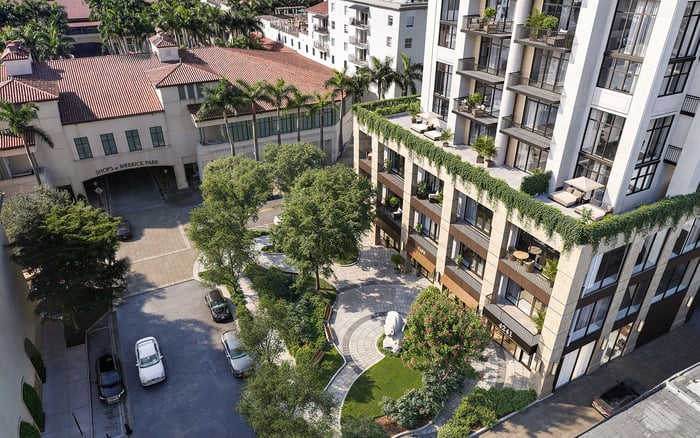
A disciplined insurance review helps Coral Gables luxury buyers compare residences on more than design and asking price. Wind terms, flood-zone information, deductibles, association coverage, and unit-owner obligations belong in the first phase of diligence.

In Coral Gables, the most compelling residences draw attention to architecture, privacy, landscape, services, and the quality of daily life. Insurance deserves an equally deliberate place in the opening conversation. For a newly built home or a luxury condominium residence, an early review of wind coverage, flood-zone information, policy structure, and deductibles can clarify how the property aligns with a buyer’s broader approach to ownership.
This is not simply a closing task. It is integral to comparing opportunities with precision. A buyer considering Cora Merrick Park, for example, can place insurance questions alongside residence selection, contract review, and financing discussions rather than allowing them to surface late in the process. This entry in MILLION's Buyer's Guides positions risk review as a core element of luxury-property diligence.
A useful early brief should distinguish among the building, the individual residence, personal property, improvements, liability, wind exposure, and flood considerations. The objective is not to assume that one document answers every question, but to understand which policy responds to each component of a potential loss, where exclusions may apply, and what remains the owner’s responsibility.
For vertical luxury, request the condominium’s relevant insurance materials and review them alongside a proposed unit-owner policy. For a single residence, request a proposal based on the property itself rather than a broad neighborhood estimate. New-construction status should not replace detailed review, and Pre-Construction purchasers should revisit early assumptions as documents, specifications, and closing requirements become available.
A focused discussion with the appropriate insurance, legal, tax, and lending advisers can address:
The scope and limits of proposed wind and flood protection
The basis on which deductibles are calculated
Exclusions, sublimits, waiting periods, and policy conditions
Coverage for interior improvements, furnishings, art, and equipment
The division of responsibility between an association and an owner
Any lender requirements and the timing for policy approval
The result should be a clear ownership map, not merely a premium quotation.
In a condominium purchase, the association’s program and the owner’s policy should be examined as complementary documents. Buyers can ask counsel and an insurance adviser to identify where the association’s responsibility ends, where the owner’s begins, and whether any gap could affect a customized interior.
That inquiry is especially relevant for residences with extensive millwork, stone, integrated systems, or bespoke finishes. The value of these elements may not be captured by a generic assumption about a standard interior. When considering Ponce Park Coral Gables, a purchaser can incorporate this review into the same diligence calendar used for contracts, specifications, and condominium materials.
The association’s deductible structure also merits close attention. The essential question is not only what the association insures, but how a loss, deductible, or uninsured portion could ultimately affect an individual owner under the governing documents.
Flood review should begin with the specific residence, building, or parcel under consideration. Buyers should not treat a city name, streetscape, impression of elevation, or upper-floor location as a substitute for documentation. An upper-floor condominium may present a different personal-property profile from a ground-oriented home, yet the broader building and ownership structure still require examination.
For buyers comparing condominium living with a lower-density setting such as The Village at Coral Gables, the disciplined approach is to request relevant information for each option and assess it on its own terms. That comparison should include coverage availability, limits, deductibles, exclusions, building responsibilities, and any effect on financing or closing logistics.
Flood-zone information is one input, not the entire conclusion. Qualified professionals should review the proposed policy language and physical property together.
A deductible is not an abstract percentage or line item. It represents the portion of risk an owner may retain before applicable coverage responds, subject to the policy’s terms. A luxury buyer should therefore ask for deductibles to be translated into clear monetary scenarios.
When possible, run more than one scenario. Consider a residence-specific claim, a building-level event, and a situation in which association and owner obligations intersect. Ask who pays first, what documentation is required, and whether separate deductibles could apply to different coverages. The purpose is not to predict an event, but to determine whether the retained risk is comfortable relative to liquidity, financing, and the intended holding structure.
Premium alone is an incomplete basis for comparison. A lower quotation may carry a different deductible, narrower protection, or distinct exclusions. Review the full structure before deciding which proposal genuinely aligns with the acquisition.
Before making an offer, identify the property and ownership format, then request preliminary insurance guidance. During contract diligence, obtain available building or property documents and commission residence-specific proposals. Before financing and closing milestones, confirm that the selected coverage, deductibles, named insureds, and ownership entity are coordinated.
This sequence preserves optionality. It gives advisers time to resolve questions while the buyer is still assessing the complete ownership proposition, including design, service, privacy, carrying costs, and retained risk. In a considered Coral Gables acquisition, insurance is neither a reason for alarm nor an administrative afterthought. It is part of buying well.
When should a Coral Gables buyer begin insurance review? Begin during the initial property shortlist, then refine the review as documents and residence-specific proposals become available.
Is a premium quotation enough for comparison? No. Compare limits, deductibles, exclusions, sublimits, conditions, and the responsibilities retained by the owner.
Should an upper-floor buyer still examine flood considerations? Yes. Review the particular residence, the building’s structure, and the relevant policy documents rather than relying on floor level alone.
What should condominium buyers request? Request relevant association insurance materials and governing documents, then review them alongside a proposed unit-owner policy.
Why review interior improvements separately? Customized finishes and integrated systems may warrant a more tailored evaluation than assumptions based on a standard interior.
How should a buyer interpret a wind deductible? Ask an adviser to express it as a monetary scenario and explain when it applies under the proposed policy.
Can association deductibles affect an individual owner? They may, depending on the governing documents and circumstances. Legal and insurance advisers should clarify the possible allocation.
What changes when financing is involved? Ask the lender for its requirements and deadlines early, then coordinate them with the proposed coverage and closing schedule.
Should cash buyers conduct the same review? Cash ownership does not remove retained risk. The buyer should still evaluate coverage, exclusions, deductibles, and liquidity preferences.
Who should participate in the diligence? The buyer’s insurance adviser, counsel, lender when applicable, and other relevant professionals should coordinate around the specific property.
For a tailored shortlist and next-step guidance, connect with MILLION.
If branded residences are on your mind — as a home or as an allocation — we would be glad to share what we are seeing, privately.
Begin a quiet conversation