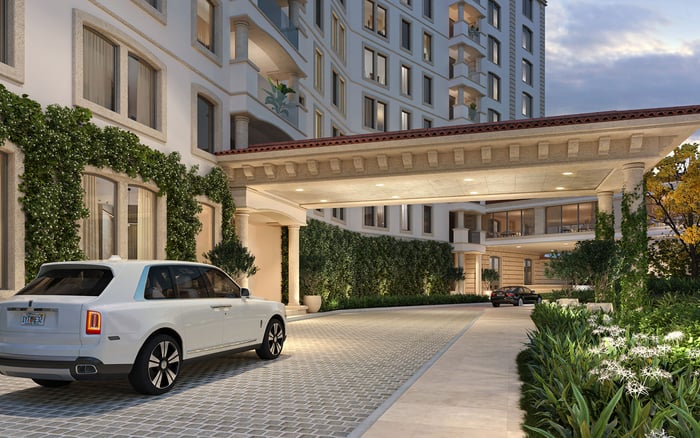
For seasonal owners at The Residences at Six Fisher Island, assigned parking is only the beginning. Verify the residence-specific parking rights, battery-care permissions, key-release controls, and operating responsibilities before treating vehicle readiness as an included service.

For a seasonal owner, the meaningful luxury is not simply leaving a vehicle behind. It is returning to one whose condition, accessibility, and custody have been handled as intended. At The Residences at Six Fisher Island, that distinction deserves attention before purchase.
Located at 6 Fisher Island Drive, Miami Beach, FL 33109, the development is described as comprising 50 residences. Its marketed parking allocation is specific: two automobile spaces and one for the provided golf cart. That does not mean three automobile spaces, nor does it establish a seasonal vehicle-care program.
Battery tending, routine vehicle starts, EV charging, and formal key custody remain matters to verify-not included services or confirmed omissions. The buyer's objective is a written arrangement that connects the parking right to the intended pattern of use.
Assigned parking is advertised, but a purchaser should obtain the assignment for the specific residence and the documents establishing the nature of that right. Ask counsel to distinguish among a deeded interest, assigned use, and a separately contracted arrangement. These terms are not interchangeable.
References to deeded parking and private garages do not establish that every residence includes an enclosed private garage. If enclosure matters, request the relevant plan and written confirmation of what the purchase includes.
The physical review should be equally precise. Request dimensions and clearance drawings, then compare them with the vehicles intended for the property. Clarify access routes, maneuvering space, restrictions on items stored beside a car, and whether the assignment can change. Obtain written rules for long-term unattended vehicles and arrangements for additional automobiles.
A buyer also considering Palazzo del Sol should apply the same residence-specific test there, without assuming that parking terminology or service obligations carry across properties.
Permission to connect equipment is not a commitment to maintain a vehicle. Before planning an extended absence, request written confirmation that battery-tending equipment is permitted in the assigned space and that suitable outlet access is available.
The response should address equipment approvals, installation requirements, fees, and responsibility for checking that the arrangement remains operational. If monitoring is offered, clarify who performs it, how it is recorded, and how the owner is notified of a failure. A powered outlet does not imply supervision.
Treat EV charging as a separate inquiry. Ask whether it is available to the specific residence, what approvals would be required, and how access and costs would work. The advertised parking allocation does not resolve those questions.
Routine starts also require explicit agreement, not an informal instruction. Ask whether anyone is authorized to start or move the vehicle, under what conditions, and how that activity is recorded. The proposed care plan should reflect guidance for the particular automobile, not a generic promise to check on it.
Document key custody as carefully as parking. Request terms identifying who may accept keys, where they are held, which personnel may access them, and how each release is logged.
Seasonal owners should distinguish permission to retrieve a car from permission to drive it, release it to a technician, or arrange transport. A named representative's authority should have a clear scope, a verification procedure, and a way for the owner to revoke it.
Ask how duplicate keys and remote fobs are controlled. Clarify what happens after a lost key, an unexplained access event, or suspected unauthorized use, including notification and responsibility for replacement costs. These are buyer-verification questions, not established building procedures.
For an owner away for months, the essential question is straightforward: can management explain who had access to the vehicle and why, without relying on memory?
Around-the-clock valet service and security are advertised. Neither description alone establishes storage conditions, vehicle-maintenance duties, or a formal key-handling protocol.
Request valet terms covering retrieval procedures, permitted driving routes, and authority to move a parked vehicle during an owner's absence. Ask whether handoff photographs and mileage records can be made, retained, and accessed if a dispute over the vehicle's condition arises.
The damage-claim process deserves the same scrutiny. Obtain the applicable reporting steps, relevant insurance information, and any contractual limits or exclusions for review with counsel and an insurance adviser. Clarify which party responds when an outside technician, transporter, or other authorized person takes custody.
The goal is not paperwork for its own sake. It is a clear record of responsibility at every handoff.
A useful seasonal plan begins before departure. Request a written schedule identifying any agreed checks, the responsible party, the owner's emergency contact, and the spending authority available if a vehicle becomes unusable.
Confirm whether third-party technicians may enter, who arranges access, and who may release the keys. If a vehicle needs a ferry transfer, establish responsibility for coordination, driving, and custody. Do not assume concierge availability covers the entire movement.
Before arrival, define the requested preparation and required notice. Any promised readiness check should specify its scope and cost, along with the procedure if the vehicle cannot be made ready.
When comparing Palazzo della Luna with Six Fisher Island, use the same departure-and-return scenario to request written answers. Compare actual commitments rather than the breadth of amenity language.
The advertised complimentary golf cart warrants separate questions about storage, charging permissions, maintenance, and unattended care. Its dedicated space does not answer them. Bicycle storage is also advertised, but does not imply a general-purpose vehicle-storage entitlement.
Three lobbies, each with a full-time concierge, describe a service setting-not a specific maintenance contract. Likewise, the association-owned and operated house car and boat do not establish care obligations for an owner's personal automobile.
Those association-operated amenities depend on the association continuing to bear their ownership and operating costs. That distinction matters when evaluating which conveniences are ongoing operating commitments and which expectations require a separate agreement.
Pre-construction and under-construction descriptions do not establish current completion, turnover, or final operating rules. Request the latest management information and confirm whether each proposed procedure is final, provisional, or still subject to approval.
Review written answers alongside the declaration, rules, parking agreements, and valet terms. Where seasonal vehicle readiness is essential to the purchase, have counsel assess how that expectation is reflected in the relevant documents. A named responsible party and a defined scope are more useful than a broad assurance of attentive service.
For a discreet perspective on matching a residence to your seasonal ownership needs, connect with MILLION.
If branded residences are on your mind — as a home or as an allocation — we would be glad to share what we are seeing, privately.
Begin a quiet conversationThe marketed allocation is two automobile spaces and one space for the provided golf cart, not three automobile spaces. Buyers should obtain the assignment for their specific residence.
References to private garages do not establish that every residence includes one. Request the residence-specific parking documents and plans.
Battery tending is not established as an included service. Verify equipment permissions, outlet access, monitoring responsibilities, and costs in writing.
EV charging remains a question to verify. Ask about availability for the specific residence, required approvals, access, and fees.
No. Advertised 24/7 valet service does not establish detailed key-storage, release, or access-logging procedures.
Confirm who may release keys, how authorization is checked and logged, and how duplicates and remote fobs are controlled. Document the scope of any representative's authority.
No routine-start service is established. Ask whether starting or moving the vehicle is permitted and offered, and document any agreed responsibilities.
A complimentary golf cart is advertised for all owners, with a dedicated parking space. Charging, maintenance, and unattended-care arrangements still require verification.
No personal-vehicle care obligation is established by the house-car offering. The disclosed association-operated amenities also depend on the association continuing to bear their ownership and operating costs.
Review the declaration, rules, residence-specific parking agreements, valet terms, and latest management information. Obtain written confirmation of any seasonal vehicle-care arrangement and whether its terms are final.