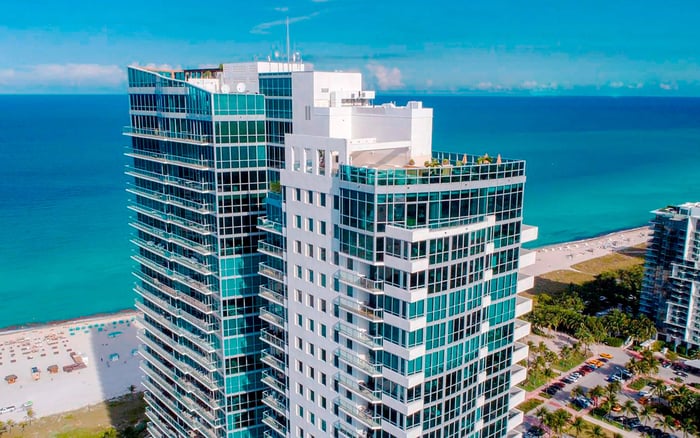
Before purchasing at Shore Club, distinguish digital convenience from documented governance. Verify the association’s identity, online-voting authorization, proxy controls, and separate procedures for remote board and owner participation.

For a buyer considering Shore Club Private Collections Miami Beach, the ability to participate from elsewhere deserves the same scrutiny as the residence itself. Second-home ownership should not mean uncertain voting access. Yet an attractive owner portal, a video invitation, and a legally authorized voting process are three distinct things.
The project address is 1901 Collins Avenue, Miami Beach, FL 33139. That identifies the destination-not the declaration, condominium parcel, or operating association governing a particular purchase. Begin by having counsel establish precisely which association controls the unit and which documents define its owner’s rights.
Request the recorded declaration, articles of incorporation, bylaws, amendments, rules, and current budget. These form the foundation for every subsequent technology question. Have condominium counsel confirm the statutory version and effective dates applicable to the purchase and any upcoming meeting, particularly when reviewing provisions labeled 2026. A proposed legislative change is not an operative rule.
Before examining software, ask association counsel when the buyer’s voting rights begin. For ownership through an entity or trust, or for jointly held property, establish the required authorization and who will be recognized as the voting representative. A successful login is no substitute for clear voting authority.
Request written procedures rather than a broad assurance that owners can participate remotely. Those procedures should distinguish owner votes, director elections, board meetings, and membership meetings. Each raises different questions about eligibility, attendance, notices, and how a decision is recorded.
For buyers also considering Setai Residences Miami Beach, use the same document-led comparison. The useful question is not which residence appears more digitally convenient, but whether the relevant association can demonstrate how an eligible owner participates. Do not infer one property’s practices from another’s.
Florida’s condominium online-voting provision is Section 718.128. Ask whether the association has adopted an authorizing board resolution and obtained the required owner consent. Request the resolution itself, along with written voting procedures that can be checked against the bylaws and applicable election rules.
The authorizing resolution must establish consent and opt-out procedures. The meeting considering that resolution requires at least 14 days’ advance notice, and evidence of notice must be retained in the official records. These are governance records, not optional details a technology demonstration can replace.
An owner’s consent generally continues until the owner opts out under the board’s adopted procedures. Review how consent is submitted, recorded, and withdrawn. Ask how a purchaser establishes their own participation after closing; do not assume the seller’s arrangements carry over.
An owner voting electronically under the statutory system counts as attending the meeting for quorum purposes. That rule does not establish unrestricted remote attendance or speaking access. Ask the association to explain those arrangements separately and in writing.
The online-voting system must authenticate each participating owner’s identity. Ask management to document the verification controls in use and explain how they connect the voter to the association’s ownership and authorization records.
Multifactor authentication, credential recovery, and changes to a registered email address are sensible subjects for diligence. Asking about them does not imply that Shore Club uses those features or that each technology is mandated. Request a practical explanation of how the association prevents an unauthorized person from exercising an owner’s vote.
A separate timing requirement also applies: the process must provide a way to confirm, at least 14 days before the voting deadline, that an owner’s device can communicate with the voting system. Do not confuse this with the 14-day notice for the meeting considering online-voting authorization.
Ask how the compatibility check is offered and whom the owner contacts if it fails. For an owner traveling during a voting period, the objective is straightforward: establish access before the deadline becomes urgent, with eligibility and consent already resolved.
Residential condominium owners generally may not vote by general proxy, subject to statutory exceptions. Where limited proxies are permitted, they must substantially conform to the state division’s adopted form. A general authorization to act for an owner is not an all-purpose voting solution.
Review the actual limited proxy form. It should identify the relevant meeting and the matters the proxyholder is authorized to address. Ask how the association handles revocations, substitutions, and conflicting submissions, including cases in which an owner later submits a different instruction.
Board elections require a separate check. Condominium elections generally require written ballots or voting machines, and proxies generally cannot be used in regular or vacancy elections unless a statutory exception applies. Any electronic election process should be reviewed under the applicable condominium voting rules-not justified merely by the convenience of electronic communication.
The buyer’s goal is a clear distinction among a permitted limited proxy, an election ballot, and a statutory electronic vote. Ask counsel to resolve any ambiguity before relying on them.
Directors participating by telephone, real-time videoconference, or similar technology may count toward board quorum and vote as though physically present. The arrangement must allow directors and owners attending in person to hear the conversation. Verify the speaker or equivalent audio setup, not merely the existence of a meeting link.
For any videoconference board meeting, ask counsel to confirm the applicable notice requirements, including whether the notice must identify that format and provide a hyperlink, conference telephone number, and physical attendance location. Then compare the association’s actual notices with the governing requirements.
Directors may communicate by email, but they may not cast votes on association matters by email. Board minutes must record each attending director’s vote or abstention. Recent notices and minutes offer a useful check on whether stated procedures match meeting practice.
Buyers comparing The Perigon Miami Beach should apply the same distinction without presuming identical arrangements. Permission for directors to join board meetings remotely does not itself establish owners’ remote attendance or voting procedures at membership meetings.
For a resale purchase, request available election materials, proxies, notices, resolutions, and voting policies through the seller or an authorized records-access process. Do not assume a prospective buyer has the inspection rights of an existing owner. For any purchase, have counsel identify the appropriate route to obtain the relevant records.
Before closing, seek written clarity on four matters: the governing association, voting eligibility, authorized voting methods, and the distinct arrangements for board and owner meetings. Where a procedure remains unclear, frame it as a specific diligence question rather than accepting a general promise of digital access.
For a discreet conversation about your Miami Beach property search, connect with MILLION.
If branded residences are on your mind — as a home or as an allocation — we would be glad to share what we are seeing, privately.
Begin a quiet conversationConfirm the exact condominium parcel and association governing the unit. The project address alone does not establish the applicable declaration, bylaws, or operating association.
Request the recorded declaration, articles of incorporation, bylaws, amendments, rules, and current budget. Have counsel review them alongside the association’s voting and meeting procedures.
Section 718.128 governs condominium online voting. Verify the association’s authorizing board resolution and required owner consent, with counsel confirming the applicable statutory version.
Do not assume it does. Request the authorizing resolution, consent procedures, and actual system controls before relying on electronic voting access.
The process must provide a way to confirm, at least 14 days before the voting deadline, that an owner’s device can communicate with the system. This is separate from notice for the meeting considering online-voting authorization.
The system must authenticate participating owners’ identities, but that requirement should not be equated with a specific multifactor authentication mandate. Ask counsel to confirm applicable requirements and management to explain the controls actually used.
Proxies generally cannot be used in regular or vacancy board elections unless a statutory exception applies. Review election procedures separately from permitted limited proxies for other matters.
Directors participating through qualifying real-time technology may count toward quorum and vote as though physically present. Directors and owners attending in person must be able to hear the conversation.
No. Verify owners’ remote attendance and voting arrangements for membership meetings separately from directors’ participation in board meetings.
Do not assume a prospective buyer has an owner’s inspection rights. Request records through the seller or an authorized records-access process.