For yacht owners relocating from Doha, West Palm Beach requires two coordinated decisions: a residence that suits life ashore and a vessel-specific operating plan. Here is how to assess dockage, crew arrangements, international relocation, and hurricane contingencies before committing.
For an owner choosing West Palm Beach after Doha, the most consequential luxury is operational ease: a yacht that can be accommodated, a captain with clear authority, and a residence that supports the household’s routine. A water view and a workable home port are separate purchases. Resolve them together, but never assume one delivers the other.
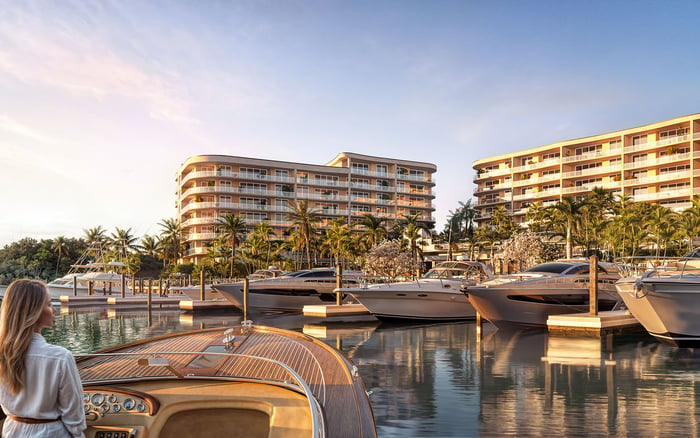
Palm Harbor Marina, Safe Harbor Rybovich, and Town of Palm Beach Marina form a regional superyacht cluster along the West Palm Beach and Palm Beach sides of Lake Worth Lagoon. Their presence creates alternatives, not interchangeable solutions. Downtown dockage, maintenance access, crew movements, and storm arrangements each require a separate decision.
Begin with a vessel dossier covering length overall, beam, draft, air draft, displacement, and shore-power requirements. Ask the captain to obtain written acceptance for the specific yacht and intended dates before the residential search becomes a commitment.
Palm Harbor Marina offers downtown dockage at 400 North Flagler Drive, with more than 200 slips accommodating yachts from 50 to 300 feet and transient overnight, monthly, and annual arrangements. Rates vary by vessel length, dockage arrangement, and season. Capacity is a starting point, not evidence that a compatible slip is available.
Safe Harbor Rybovich, at 4200 North Flagler Drive, combines a deep-water superyacht marina with a refit shipyard. It is a relevant candidate when maintenance is central to the relocation brief. Confirm dimensional limits and service scheduling directly; acceptance at another marina does not establish suitability here.
For Town of Palm Beach Marina, treat the approximately 294-foot maximum yacht length as preliminary and subject to vessel-specific berth and operating restrictions. Palm Beach Yacht Club’s public marina accommodates vessels up to 150 feet and operates on a first-come-first-served basis.
For buyers considering Alba West Palm Beach, proximity alone is not the useful comparison. The priority is a facility that can support the yacht’s actual calendar, including periods when owners are absent and maintenance takes precedence.
Request a written quotation tied to the yacht, dates, and intended use. Distinguish overnight flexibility from monthly or annual commitments, and clarify the services, deposits, and cancellation conditions that apply. A rate without its contractual obligations is an incomplete budget.
Annual wet-slip dockage at Palm Beach Yacht Club is $2 per foot per day, with a two-month escrow deposit and additional requirements. Confirm current terms before using that figure in a relocation budget. It is neither a market-wide benchmark nor evidence of availability.
Apply the same discipline to the residence. When evaluating Forté on Flagler West Palm Beach, assess the proposed home-to-berth journey independently of the property presentation. Clarify any claimed dockage rights or marina relationship rather than inferring them from a waterfront address.
A relocation to West Palm Beach after Doha has several administrative components. Treat departure clearance, the yacht’s passage or transport arrangements, U.S. vessel formalities, and each crew member’s entry status as separate workstreams. A berth reservation settles none of them.
For arrival in South Florida, obtain vessel-specific advice on applicable reporting, customs, and cruising permissions, alongside individual advice on crew entry and employment arrangements. Do not build the schedule around an assumed visa category or permit eligibility.
Do not fix a passage duration in the household calendar until the captain or transport specialist has assessed the proposed movement. Keep residential handover, owner travel, and yacht arrival independently adjustable wherever contracts allow.
Palm Harbor offers dockage assistance and golf-cart porter services and can arrange ground transportation to local airports. These services support coordination; they do not establish flight connections, transfer times, or immigration entitlements.
Its operating hours are 8 a.m. to 6 p.m. daily. Those hours do not guarantee assistance outside that window. Confirm arrival procedures, the contact for delays, and arrangements for an arrival that slips beyond the agreed time.
Ask the captain to maintain a crew movement plan covering relief dates, document checks, accommodation needs, provisioning access, and ground transport. Identify who can authorize unexpected expenses and who receives updates when owners are abroad.
A household considering Mr. C Residences West Palm Beach should test this daily routine alongside the residence itself. Establish building access, delivery procedures, and any proposed staff arrangements directly. Do not presume residential services extend to yacht operations.
A marina berth is not a hurricane-protection guarantee. Before signing, review the lease alongside the facility’s disaster plan, hurricane plan, or operating procedures. Ask who makes storm decisions, whether the yacht may remain, and what obligations arise if it must move.
The three broad responses are to secure the vessel in its berth, move it to a previously identified protected location, or haul it out. None should be selected merely because it sounds reassuring. The captain must establish suitability, access, timing, and actual availability for the yacht concerned.
Do not make an improvised offshore departure the default contingency for a private yacht. Agree on decision triggers and alternatives well before a storm threatens.
Maintain current emergency contacts and an updated hurricane worksheet. Review insurance coverage, document the vessel’s inventory with current photographs and videos, and confirm applicable storm conditions with the insurer. Neither a prestigious marina name nor a proposed haul-out arrangement establishes insurer acceptance.
Before committing, bring the berth acceptance, dockage contract, relocation schedule, crew plan, and hurricane arrangements into one review. The residence should complement that operating framework, not compensate for unresolved yacht logistics.
West Palm Beach becomes a considered choice when the household’s expectations and the captain’s practical requirements align. The right address works during maintenance, crew changes, and owner absences-not only on arrival day.
Explore a residence that complements your West Palm Beach plans with MILLION.
If branded residences are on your mind — as a home or as an allocation — we would be glad to share what we are seeing, privately.
Begin a quiet conversationObtain vessel-specific berth acceptance for the intended dates and review dockage terms, crew logistics, and hurricane arrangements. A residential address does not establish marina access.
Palm Harbor has more than 200 slips accommodating yachts from 50 to 300 feet. Actual suitability and availability require confirmation for the yacht’s dimensions and operating requirements.
It offers transient overnight, monthly, and annual dockage. Rates vary by vessel length, dockage arrangement, and season.
It combines a deep-water superyacht marina with a refit shipyard. Confirm berth suitability and service scheduling for the specific yacht.
The preliminary maximum is approximately 294 feet. Confirm vessel-specific berth and operating restrictions before relying on that limit.
Yes, its marina is open to the public, operates on a first-come-first-served basis, and accommodates vessels up to 150 feet.
Confirm the annual wet-slip rate of $2 per foot per day, the two-month escrow deposit, and any additional requirements. Verify current terms and availability before budgeting.
Palm Harbor can arrange ground transportation to local airports. Confirm timing separately; the service does not establish flight connections or crew entry eligibility.
No, vessel reporting, customs, cruising permissions, and individual crew entry arrangements require separate review. Obtain advice specific to the yacht and each crew member before fixing arrival plans.
The broad options are securing the yacht in its berth, moving it to a previously identified protected location, or hauling it out. Suitability, availability, marina rules, and insurance conditions require advance confirmation.