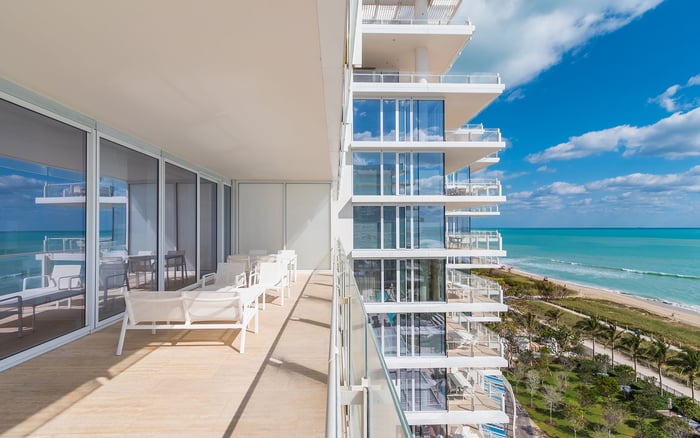
A buyer’s guide to verifying residence-level climate controls, vacancy settings, humidity monitoring, and water-response arrangements at Fendi Château Residences Surfside.

For a seasonal residence, the most consequential inspection may focus on what happens when nobody is home. At Fendi Château Residences Surfside, the 12-story condominium designed by Arquitectonica at 9365 Collins Avenue, that means looking beyond the thermostat to the equipment, controls, and response arrangements that manage moisture during vacancy.
Second-home ownership should feel effortless, but that ease requires a documented operating plan. Before buying, establish how the individual residence controls relative humidity, who maintains its systems, and who can act if readings rise. A comfortable temperature during a showing does not establish how the home will perform through an extended absence.
The essential distinction is simple: temperature control is not proof of humidity control. This checklist is not an indication of a moisture problem at the property. It is a framework for verifying the residence you intend to purchase.
Even with central cooling and central heating, buyers should not assume identical equipment or controls throughout the building. Ask an AC contractor to identify the installed system and explain how it operates during vacancy.
The inspection should answer several practical questions:
Does the residence have temperature-only control, humidity-based control, or both?
Which device measures relative humidity, and where is that measurement taken?
Who services the equipment and maintains the humidity control?
What maintenance documentation can the seller provide?
Request a demonstration rather than relying on a device’s appearance. A digital display can show temperature without measuring humidity, and a humidity reading does not necessarily mean the system responds to it. Ask the contractor to distinguish what the equipment senses, what it controls, and what requires owner intervention.
Below 60% relative humidity is a useful general mold-prevention benchmark for a vacant Florida home. It is not a guarantee against localized moisture from a leak or condensation. The objective is to verify actual conditions, not merely select a number on a screen.
Cooling settings of 76-78°F offer a general starting point for vacancy. For a condominium, approximately 78°F paired with a dehumidistat target of 55-60% RH is another starting point. Neither is a substitute for a residence-specific plan, Fendi Château’s operating policy, or a promise that every room will remain adequately dry.
Ask the contractor to recommend settings based on the installed equipment and measured performance. If the thermostat reads 78°F while humidity remains elevated, the temperature setting alone has not resolved the moisture-control question. A target range reaching 60% is not evidence that actual humidity stays below it.
Sensor accuracy matters, too. A displayed set point is an instruction to the system, not independent confirmation of room conditions. Request a sensor-accuracy check and an explanation of how actual readings will be verified during vacancy.
AUTO, rather than continuously ON, is generally the preferred vacancy setting for the cooling-system fan. Continuous fan operation can re-evaporate moisture remaining on cooling components. Ask the contractor to confirm how the installed fan operates and whether the proposed vacancy configuration follows that principle.
Turning the AC off entirely is not a sound default for an unattended Florida residence. Before departure, arrange to clean or replace filters and establish an appropriate airflow plan. Leaving interior doors, closets, and cabinets open can improve circulation in otherwise stagnant spaces.
Put these preparations in writing for the person overseeing the residence. Specify the approved temperature and humidity settings, fan mode, filter arrangements, and interior-door configuration. This reduces the chance that a well-intentioned visitor changes the operating plan without checking moisture conditions.
The ability to adjust a thermostat from another city is convenient. It is not equivalent to humidity-based control, nor does it establish that someone will respond to an alert.
Before assuming a Wi-Fi thermostat can be added, verify equipment compatibility and installation permission. Confirm that internet service will remain active during vacancy. Then request a demonstration of three distinct capabilities: current humidity readings, historical logging, and high-humidity alerts.
A useful handover should establish who receives notifications and who is authorized to arrange access and service. Ask what happens when the owner is unavailable and how a responder confirms that conditions have returned to the agreed range. Have the contractor recommend alert thresholds rather than treating a factory default as a tailored vacancy plan.
For buyers also considering Arte Surfside, the same distinction belongs in the comparison: remote convenience and a documented moisture-response arrangement are separate questions, each requiring residence-specific answers.
If cooling alone does not adequately control humidity, supplemental dehumidification may be an option. Establish feasibility before treating it as the solution to a purchase concern.
Ask the association whether the proposed equipment is permitted, and confirm an acceptable drainage route with the appropriate contractor. Continuous drainage is recommended for unattended operation; a collection tank should not be the basis of an extended-vacancy plan.
Establish who maintains the supplemental equipment and how its performance will be checked. Another appliance does not remove the need for measured humidity, clear responsibility, and access when something requires attention. The objective is a workable arrangement, not simply permission to place a dehumidifier in a room.
A distinguished address does not answer the operational questions inside an individual home. Whether evaluating Fendi Château or The Surf Club Four Seasons Surfside, ask for written clarification of the association’s responsibilities and the owner’s obligations. Do not assume a particular vacancy service is included.
Request available records of prior water intrusion affecting the residence or its stack, together with the association’s leak-response and mold-remediation procedures. Ask how an event is communicated, who can enter during an absence, and how remediation is coordinated.
Humidity monitoring and water-event diligence serve different purposes. Even acceptable room humidity does not rule out moisture at a localized leak. The review should address both normal vacancy operation and the response to an unexpected water event.
Before closing, seek a concise operating file: identified equipment, contractor-recommended settings, demonstrated monitoring capabilities, any necessary permissions, and named response contacts. Keep unresolved questions visible rather than accepting broad assurances that the home is easy to leave unattended.
The strongest purchase decision pairs the residence’s design appeal with a credible plan for its care. Verify the controls, observe the readings, and establish who acts when conditions change. That is the practical foundation for enjoying a seasonal home with confidence.
For a considered approach to South Florida second-home ownership, explore MILLION.
If branded residences are on your mind — as a home or as an allocation — we would be glad to share what we are seeing, privately.
Begin a quiet conversationThe property is at 9365 Collins Avenue, Surfside, FL 33154. It is a 12-story luxury condominium designed by Arquitectonica.
Below 60% relative humidity is a useful general mold-prevention benchmark. It does not rule out localized moisture from leaks or condensation.
General recommendations include 76–78°F, with approximately 78°F appearing in condo-focused guidance. Have an AC contractor confirm appropriate settings for the specific residence.
No building-specific policy is established here. Confirm association requirements and obtain residence-specific operating instructions before relying on general settings.
General vacancy guidance favors AUTO because continuous fan operation can re-evaporate moisture remaining on cooling components. Have the contractor verify the installed system’s operation.
No. Remote temperature access, humidity measurement, and humidity-based control are distinct capabilities that should each be demonstrated.
Request current humidity readings, historical logging, and high-humidity alerts. Confirm active internet service, notification recipients, and who can arrange an on-site response.
It may be an option if cooling alone does not adequately control humidity. Confirm association permission and an acceptable continuous-drainage route rather than relying on a collection tank.
Clean or replace AC filters and establish an airflow plan. Leaving interior doors, closets, and cabinets open can improve circulation in stagnant spaces.
Request available records of prior water intrusion affecting the residence or its stack, along with association leak-response and mold-remediation procedures. Clarify access and communication arrangements during vacancy.