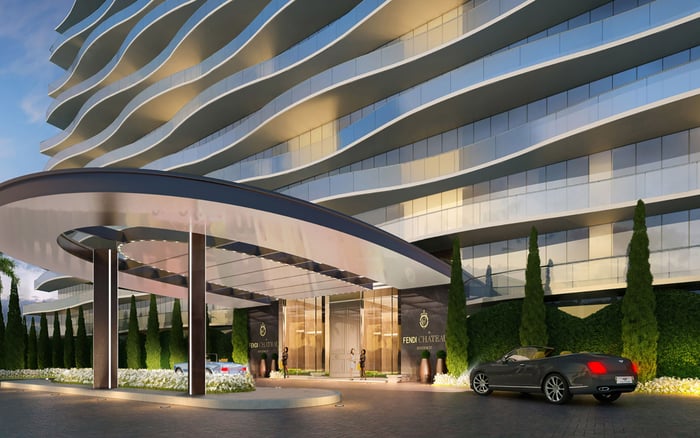
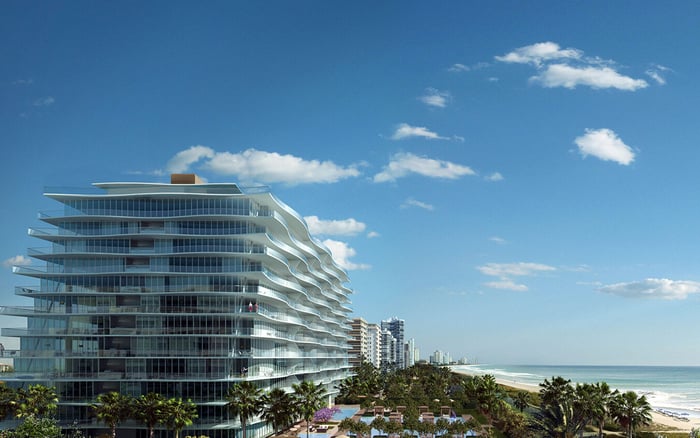
A second-home review of Fendi Château Residences focused on what is publicly disclosed about cooling, what remains unconfirmed about filtration, and the records buyers should request before closing.

For a second-home buyer, the most persuasive luxury is a residence that remains carefully managed between visits. At Fendi Château Residences Surfside, an air-quality review should move beyond the interiors to three practical questions: what filtration equipment serves the specific residence, how replacement filters are supplied, and which testing or commissioning records can be examined before purchase.
The property is listed at 9349 Collins Avenue, Surfside, Florida 33154, as a 12-story condominium with 58 residences. Confirm the specific residence’s address in transaction documents, given the alternate address of 9365 Collins Avenue. These particulars establish the setting, not the air-quality specification. Central cooling is documented; enhanced filtration and an independently documented indoor-air-quality program remain unconfirmed.
That distinction is not a negative judgment. A detail absent from public disclosures may still be documented privately. The buyer’s task is to support the ownership decision with residence-specific records and clear service responsibilities.
Residence #1004 is described as having central air conditioning and central heating. Residence #303 identifies central air conditioning and electric heating. Linear diffusers are mentioned for #1101, but an enhanced-filtration specification is not established.
These details apply to their respective residences. They do not establish identical equipment across all 58 homes or identify the filtration performance of the residence under consideration. The air-handler manufacturer and model for #1004 remain unidentified in the reviewed HVAC details.
A project-specific MERV rating or equivalent filter particle-capture performance is not publicly disclosed. Nor is the residences’ dedicated outdoor-air supply or ventilation arrangement. Central cooling is therefore the supported starting point, not a substitute for a complete mechanical specification.
For a buyer also considering Arte Surfside, the useful comparison is documentary: request the same equipment and filtration information for each candidate residence rather than treating design language as evidence of air-quality performance. No technical superiority between the properties is established here.
Before selecting an upgrade or ordering replacements, request the mechanical as-builts and the manufacturer and model number of each relevant air handler. Ask the seller or management to identify the installed filter and provide its dimensions, thickness, and documented performance rating.
Filter dimensions and thickness remain undisclosed for the reviewed residences, leaving the correct replacement for a particular unit unconfirmed. A buying decision should not rest on an assumed building-wide filter size or a product selected solely because its packaging promises stronger filtration.
Ask the servicing professional to confirm the equipment’s approved filtration range and provide written approval for any proposed change. Keep that approval tied to the residence’s actual equipment and filter arrangement. If the seller has made modifications, request the corresponding documentation rather than assuming the current installation matches the original design.
The ventilation question belongs in the same file. Ask how outdoor air reaches the residence and which components require maintenance. Because that arrangement is not publicly established, confirm any proposed description through mechanical records and a qualified review.
A filter specification is useful only if the correct replacement can be obtained and installed consistently. A building-approved replacement-filter brand or supplier is not publicly identified. A recurring replacement service and replacement schedule are also undisclosed.
Ask management who supplies filters, who installs them, where replacements are purchased, and whether service continues during owner absences. Request a written scope separating association responsibilities from the owner’s obligations. If an outside contractor is involved, confirm access arrangements and who authorizes work while the owner is away.
The essential deliverable is straightforward: an identified replacement product, a purchasing route, a service interval approved for the equipment, and a named person responsible for completion. Ask how completed visits are recorded and how exceptions are communicated. These are proposed ownership arrangements, not verified building services.
A buyer weighing The Surf Club Four Seasons Surfside alongside Fendi Château can use the same questions. Focus the comparison on the service commitment available for the particular residence, not an assumption that a hospitality-associated name establishes filter maintenance terms.
Building-wide and unit-specific post-construction indoor-air-quality test results are not publicly disclosed. Commissioning, HVAC balancing, and duct-cleanliness records are also absent from the reviewed disclosures. This does not establish that testing was never performed or that relevant documentation is unavailable privately.
Start by requesting any existing commissioning and balancing records, indoor-air testing, maintenance history, and water-intrusion or remediation documentation relevant to the residence. Ask which records concern the individual unit, which concern common systems, and what work or conditions they address.
If documents are supplied, have a qualified professional assess their relevance to the residence’s present condition. Ask whether subsequent alterations or maintenance events warrant further review. An original post-construction document and a current inspection address different questions; neither is an automatic substitute for the other.
If independent testing is under consideration, define its purpose with the professional before proceeding. The objective should be to resolve a specific unanswered question, not to produce a reassuring label. Limit any conclusions to what was actually examined.
Second-home diligence should connect the mechanical file to an absence plan. Confirm whether remote monitoring is available, who establishes vacant-unit humidity settings, and who receives and responds to condensate or leak alarms. None of these features is publicly verified in the reviewed disclosures.
Ask for a written division of responsibility among the owner, management, and any private caretaker. Specify who can enter the residence, who can authorize service, and how the owner receives confirmation that an issue has been resolved.
The same discipline is useful when evaluating Ocean House Surfside: compare documented operating arrangements rather than assuming that any project provides a particular monitoring or maintenance package.
Fendi Château’s disclosed HVAC details support central cooling. Enhanced filtration, replacement-filter logistics, and post-construction air-quality testing remain publicly unconfirmed. For a second-home purchase, the sensible next step is neither to presume exceptional performance nor to interpret nondisclosure as a defect.
Instead, seek a residence-specific equipment file, a dependable replacement-filter arrangement, relevant testing and maintenance records, and a clear absence plan. Together, those answers make the decision more precise and ownership less dependent on assumptions.
For a discreet perspective on South Florida second-home ownership, explore MILLION.
If branded residences are on your mind — as a home or as an allocation — we would be glad to share what we are seeing, privately.
Begin a quiet conversationThe property is listed at 9349 Collins Avenue, Surfside, Florida 33154. Confirm the specific residence’s address in transaction documents because some directory entries use 9365 Collins Avenue.
Public building descriptions identify a 12-story condominium with 58 residences.
The descriptions for residences 1004 and 303 identify central air conditioning. These unit-specific details do not establish identical equipment throughout the building.
The reviewed public materials do not establish an enhanced-filtration system or disclose a project-specific MERV rating or equivalent particle-capture performance.
The mention of linear diffusers in marketing for 1101 does not establish an enhanced-filtration specification.
Request the equipment model, current filter dimensions and thickness, and approved filtration range. The reviewed residence descriptions do not establish which replacement filter fits a particular unit.
The reviewed public building materials do not identify a building-approved replacement-filter brand or supplier. Ask management to confirm purchasing and installation arrangements.
The reviewed public materials do not disclose a recurring replacement service or schedule. Confirm who performs the work and whether service continues while the owner is away.
The reviewed materials do not disclose building-wide or unit-specific post-construction indoor-air-quality results. That does not mean testing or private records do not exist.
Request existing commissioning, balancing, indoor-air testing, maintenance, water-intrusion, and remediation records. Have a qualified professional assess which unanswered questions, if any, warrant additional testing.