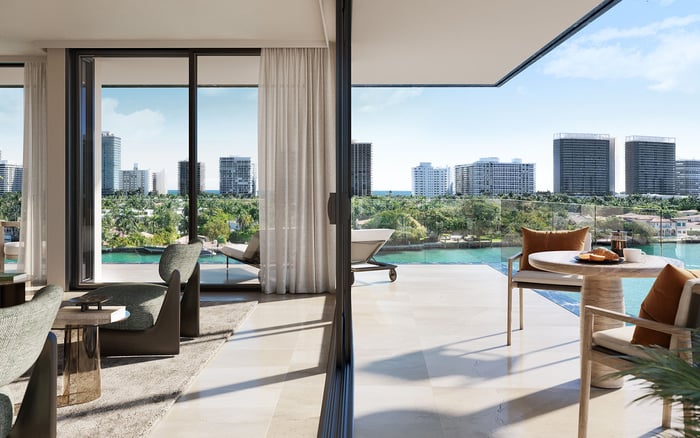
For turnkey-minded buyers at LILLI Miami Edgewater, the essential diligence is not simply the projected delivery date. It is the documented relationship between finishes, alteration permissions, approval timelines and the date a residence can genuinely support their lifestyle.

For a buyer seeking an effortless Miami arrival, turnkey should describe more than an attractive interior. It should mean a residence ready to support the intended lifestyle, without an unresolved sequence of approvals, installations and access arrangements. At Lilli Miami Edgewater, that distinction belongs at the outset of purchase diligence, not after furniture has been ordered.
LILLI is a planned waterfront condominium at 717 NE 27th Street in Miami’s Edgewater neighborhood. The proposed development comprises 53 stories and 117 residences, with OKO Group, led by Vlad Doronin, as developer and Adrian Smith + Gordon Gill Architecture identified as architect. It is a pre-construction offering, not a completed building available for immediate occupancy.
A LILLI-specific renovation moratorium is not established, nor is a fixed alteration-approval turnaround. Neither omission establishes unrestricted customization. Buyers should treat both subjects as questions requiring written answers, not assume either a prohibition or permission.
The practical issue is the interval between receiving a residence and enjoying it as intended.
Delivery estimates have included 2029 and December 2030. Neither should be treated as a guaranteed delivery date. Ask counsel to identify the purchase agreement’s delivery provisions, extension rights, closing requirements and any remedies for delay.
Keep municipal review separate from contractual delivery. Plans were scheduled for City of Miami Urban Development Review Board consideration on July 15, 2026. A scheduled review is not evidence of approval, nor does it establish a construction calendar or occupancy date.
For personal planning, distinguish four milestones: contractual delivery, closing, access for installations and actual household occupancy. Ask which are documented, which remain estimates and which depend on additional permissions. Do not collapse them into one date under the label of completion.
A buyer comparing LILLI with Aria Reserve Miami should apply the same distinction to each property’s documents. This is a comparison framework, not an assumption that the projects share delivery terms or operating rules.
The architectural vision and the contractual finish package answer different questions. Before calling a residence turnkey, obtain the specifications and exhibits for the exact home under consideration. Confirm what is included, what is optional and what remains the owner’s responsibility.
Ask specifically about flooring, closets, lighting, window treatments, appliances, technology and furniture. These are verification categories, not confirmed inclusions or exclusions at LILLI. Neither furnished delivery nor an unrestricted right to customize is established.
Then have the interior designer prepare a concise scope of intended work. Distinguish movable furnishings from attached cabinetry, electrical changes, plumbing changes and work affecting shared systems. Ask the project team to classify each item under the applicable rules rather than relying on a broad assurance that decorating is allowed.
The useful question is not whether the home can eventually look finished. It is whether the contracted delivery condition meets the buyer’s needs before any discretionary work begins. If it does not, the additional work belongs in the acquisition schedule and budget.
A renovation moratorium would prohibit some category of owner work for a defined period. Its significance would depend on its scope, trigger and exceptions. No duration should be assigned to LILLI without supporting project documentation.
Request the applicable condominium documents, proposed rules, alteration agreement and any initial-occupancy restrictions, to the extent available. Have counsel identify which provisions are binding, which are drafts and who has authority to revise or interpret them.
Ask whether any restriction applies to all owner work or only particular activities. Would furniture placement be treated differently from drilling, flooring replacement or built-in installation? Would developer punch-list corrections be treated differently from owner-requested changes? Obtain those distinctions in writing.
The start and end points also matter. Ask whether any restricted period would run from a unit closing, a building milestone or another defined event. Clarify who can authorize exceptions and whether those exceptions would be discretionary. An informal assurance of flexibility is not a documented right to proceed.
Even without a moratorium, alteration review could affect the schedule. LILLI’s alteration-approval deadline and turnaround remain unresolved. Buyers should not substitute a familiar timeline from another condominium.
Ask who would review a proposed scope and what constitutes a complete submission. Depending on the work, questions may concern drawings, contractor credentials, insurance, deposits, engineering review or governmental permits. Confirm which requirements apply rather than treating this diligence checklist as existing LILLI policy.
Then distinguish an acknowledgment from a substantive decision. Does any stated review period begin with the first submission or only after the application is deemed complete? What happens after revisions? Is there a written escalation procedure? Who communicates permission to begin work?
When considering EDITION Edgewater alongside LILLI, use the same proposed interior scope to request project-specific answers. Comparable questions reveal more than an assumption that similarly positioned residences offer equivalent installation freedom.
Permission to perform work and permission to access the building for deliveries require separate checks. LILLI’s restricted move-in windows and construction calendar are not established. Ask about elevator reservations, loading arrangements, delivery hours, contractor access and any limitations during initial occupancy.
Build a sequence around the answers: approve the scope, secure required permissions, confirm access, release orders and schedule installation. Before committing to nonrefundable deliveries, identify who bears storage, redelivery and rescheduling costs if access changes.
For a seasonal household, test the plan against the intended arrival date, not the most optimistic completion estimate. A residence that needs essential installations may not meet a turnkey requirement simply because closing has occurred.
For a waterfront purchase, views and design may lead the shortlist, but documentary clarity should help determine the final choice. A useful comparison records each residence’s promised delivery condition, required owner work, applicable approvals and remaining uncertainties.
If leasing is part of the plan, verify that separately. LILLI’s rental frequency limits and minimum lease terms are not established here by governing condominium documentation. Do not underwrite rental income on assumptions about those rules.
Before committing, have the purchase team reconcile the contract, finish specifications, intended alterations and occupancy schedule. Where an answer remains open, preserve that uncertainty in the plan rather than converting it into assumed permission or a deadline. For a turnkey buyer, confidence comes from knowing what can happen, who must authorize it and when the residence can serve its purpose.
For a discreet assessment of how delivery terms and ownership logistics fit your South Florida plans, connect with MILLION.
If branded residences are on your mind — as a home or as an allocation — we would be glad to share what we are seeing, privately.
Begin a quiet conversationLILLI is planned at 717 NE 27th Street in Miami’s Edgewater neighborhood.
No. It is a pre-construction offering rather than a completed building available for immediate occupancy.
Plans call for a 53-story tower with 117 residences.
The developer is OKO Group, led by Vlad Doronin. Adrian Smith + Gordon Gill Architecture is identified as the architect.
A LILLI-specific renovation moratorium is not established. Buyers should request written rules addressing whether any restriction applies, its scope and its duration.
A fixed LILLI alteration-review turnaround is not established. Ask who reviews applications, when the review period begins and how revisions affect timing.
Furnished delivery is not established. Buyers should verify the contractual finish and furniture package for their specific residence.
Estimates have included 2029 and December 2030, neither of which is a guaranteed delivery commitment. Counsel should review the purchase agreement’s delivery and extension provisions.
No. The scheduled July 15, 2026 Urban Development Review Board consideration does not itself establish approval or an occupancy date.
Verify rental frequency limits and minimum lease terms in the applicable condominium documents. Those rules are not established here and should not be assumed when planning rental income.