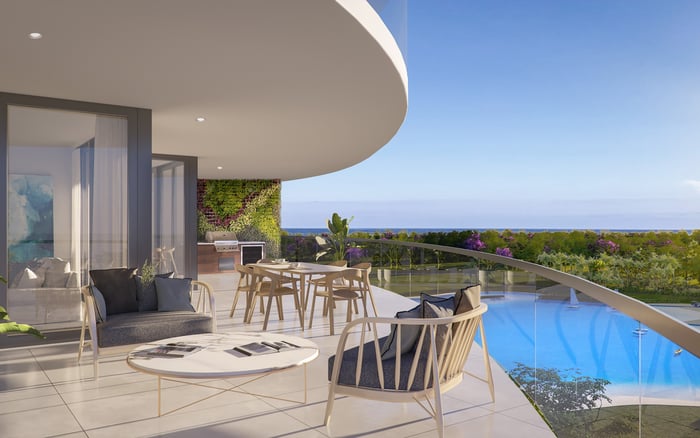
A staff-ready North Miami residence should be evaluated as an operating platform, not only a beautiful home, with privacy, service circulation, storage, security, and future flexibility driving long-term value.

A serious long-term purchase in North Miami is not judged only by architecture, arrival sequence, or the immediate pleasure of a beautiful room. For a household that relies on regular support from a house manager, chef, nanny, driver, security team, wellness practitioner, or seasonal service staff, the residence has to perform like an operating system. It must allow private life to remain private while the daily work of the home continues smoothly in the background.
That distinction separates a merely large residence from a genuinely staff-ready one. Space alone is not enough. The more important question is whether the plan gives each function its proper path. Owners, children, guests, deliveries, service providers, pets, cars, and storage should not all be forced through the same front-door logic. When those flows are poorly handled, the home can feel busy even when it is not full.
For buyers comparing North Miami with nearby waterfront and urban options, projects such as One Park Tower by Turnberry North Miami can serve as useful reference points for amenity depth, service expectations, and the way a newer residential environment frames long-horizon ownership.
The most persuasive staff-ready residences have a clear hierarchy. Owner areas should feel calm and protected. Guest areas should be welcoming without becoming intrusive. Working areas should be practical, durable, and close to the functions they support. This is not about hiding people. It is about allowing a household to function gracefully.
A strong plan often begins with separation. A service entry, secondary corridor, mudroom, pantry zone, laundry area, or staff bath can be more valuable in daily life than a decorative room that photographs well but solves little. If a chef has to cross the main entertaining space with provisions, or housekeeping must move linens through a formal entry, the home is signaling that it was designed more for display than sustained use.
Long-term buyers should walk the property as if it were already occupied. Where do groceries arrive? Where does luggage go after a late flight? Where are beach towels, sports gear, pet supplies, uniforms, guest bedding, and hurricane-season necessities stored? A residence that answers these questions quietly is often the one that holds its appeal after the novelty fades.
A staff-ready residence does not have to feel institutional. In the best homes, support spaces are designed with the same seriousness as the owner suite, but for different priorities. Comfortable rest areas, appropriate bathrooms, efficient storage, and a place to manage household administration can make the difference between a home that functions for a weekend and one that supports a family over many years.
For households with rotating or part-time staff, flexibility matters. A secondary bedroom that can function as a staff room today, a guest suite tomorrow, and a caregiver suite later can strengthen the purchase case. A den near a service zone may become a household office. A discreet secondary kitchen or expanded pantry area may reduce pressure on the main kitchen during events or extended family visits.
This flexibility is central to investment thinking at the high end. The residence should not be so narrowly programmed that it only fits one phase of ownership. A well-considered plan can adapt as children grow, parents visit more often, remote work patterns change, or a family begins to spend longer seasons in South Florida.
In a staff-ready home, the arrival sequence is not only ceremonial. It is logistical. The front entry may need to receive guests with poise, but the residence also needs a separate logic for drivers, vendors, maintenance teams, packages, catering, and household employees. If every arrival feels public, the property will not feel restful.
Parking, covered drop-off, garage adjacency, and storage near the point of entry all deserve close attention. A driver should not have to improvise. A house manager should not have to stage packages in an elegant foyer. A catering team should be able to reach the correct part of the home without passing through intimate family zones.
Buyers looking across the broader northern corridor may compare North Miami with Aventura, where Avenia Aventura offers another lens on how residential convenience, access, and daily movement influence purchase decisions. The lesson is less about choosing one address over another and more about testing whether the home supports the owner’s actual rhythm.
In South Florida, outdoor living can be the emotional center of the home. A waterview, pool terrace, summer kitchen, or dockside environment may be what first captures attention. Yet these features require planning if they are to remain pleasurable over time. Towels, glassware, outdoor cushions, marine supplies, pool equipment, landscaping access, and guest circulation all need a place in the plan.
A marina-oriented lifestyle adds another layer. Even when a residence is not directly on a marina, buyers who boat or entertain near the water should consider how the home receives wet gear, provisions, guests, and maintenance. The most durable luxury is not fragile. It anticipates use.
Nearby waterfront references such as Onda Bay Harbor and Continuum Club & Residences North Bay Village can help buyers think about the balance between water-facing lifestyle and managed residential convenience. In a staff-ready purchase, the view is only one part of the equation. The home must also make waterfront life easy to maintain.
New construction can offer advantages in systems, security expectations, parking design, elevators, amenity integration, and contemporary layouts. But new does not automatically mean operationally excellent. A buyer still has to study how the residence handles service circulation, acoustic separation, storage, mechanical access, and privacy.
The same discipline applies when comparing North Miami with coastal alternatives such as Sunny Isles. A project like The Ritz-Carlton Residences® Sunny Isles may shape expectations around service culture and residential polish, but the buyer’s own residence must still be tested room by room. Brand, architecture, and finish quality do not replace practical due diligence.
The best long-term purchase is the one where invisible decisions are strong: where staff can work without interrupting family life, where maintenance does not disrupt the day, where storage is sufficient, and where security feels embedded rather than theatrical.
A staff-ready North Miami residence works as a serious long-term purchase when it can absorb change. Today’s household may need child care and entertaining support. Tomorrow’s may need elder care, wellness routines, remote offices, more privacy for older children, or a simpler lock-and-leave rhythm. The home should not punish those transitions.
Before purchasing, buyers should ask whether the residence can be managed easily during travel, whether service providers can access the correct areas without compromising privacy, whether household systems are understandable, and whether the plan can flex without expensive reinvention. A beautiful home that is hard to run becomes a burden. A beautiful home that is easy to run becomes an asset.
That is the central measure of staff-ready luxury in North Miami: discretion, adaptability, and operational calm. The purchase is not only about what the residence offers on day one. It is about whether it will still feel intelligent after years of real life.
What does staff-ready mean in a luxury residence? It means the home is planned for household support, with thoughtful circulation, storage, privacy, and service access that make daily operations smooth.
Is a larger home always better for staff readiness? No. Layout matters more than raw size, especially when owner areas, guest areas, and work areas need to function separately.
Why does service circulation matter so much? It allows staff, deliveries, catering, and maintenance to move through the home without disrupting private family life or formal entertaining.
Should buyers prioritize a separate staff suite? A dedicated suite can be valuable, but flexible rooms that can adapt to staff, guests, or caregiving may be equally important.
How should outdoor areas be evaluated? Buyers should consider storage, towel service, maintenance access, guest flow, and how the outdoor lifestyle will operate during frequent use.
Does new construction guarantee better functionality? Not necessarily. New construction may help, but the actual plan, storage, acoustics, and service paths still need close review.
What role does security play in staff-ready ownership? Security should feel integrated and discreet, supporting privacy without making the residence feel overly formal or difficult to use.
Why is flexibility important for long-term value? A household changes over time, so rooms that can shift between staff, guests, work, wellness, or caregiving strengthen the ownership case.
How should buyers compare North Miami with nearby areas? They should compare lifestyle, access, privacy, service expectations, and operational ease rather than focusing only on finishes or views.
What is the simplest test before buying? Walk the home as if it is already occupied and trace how people, packages, food, linens, cars, pets, and service providers will move.
For a discreet conversation and a curated building-by-building shortlist, connect with MILLION.
If branded residences are on your mind — as a home or as an allocation — we would be glad to share what we are seeing, privately.
Begin a quiet conversation