For South Florida families, valet queuing is not a decorative amenity. It is daily infrastructure that affects safety, school-run timing, bad-weather arrivals, emergency access, EV charging, and the real experience of living in a luxury tower.
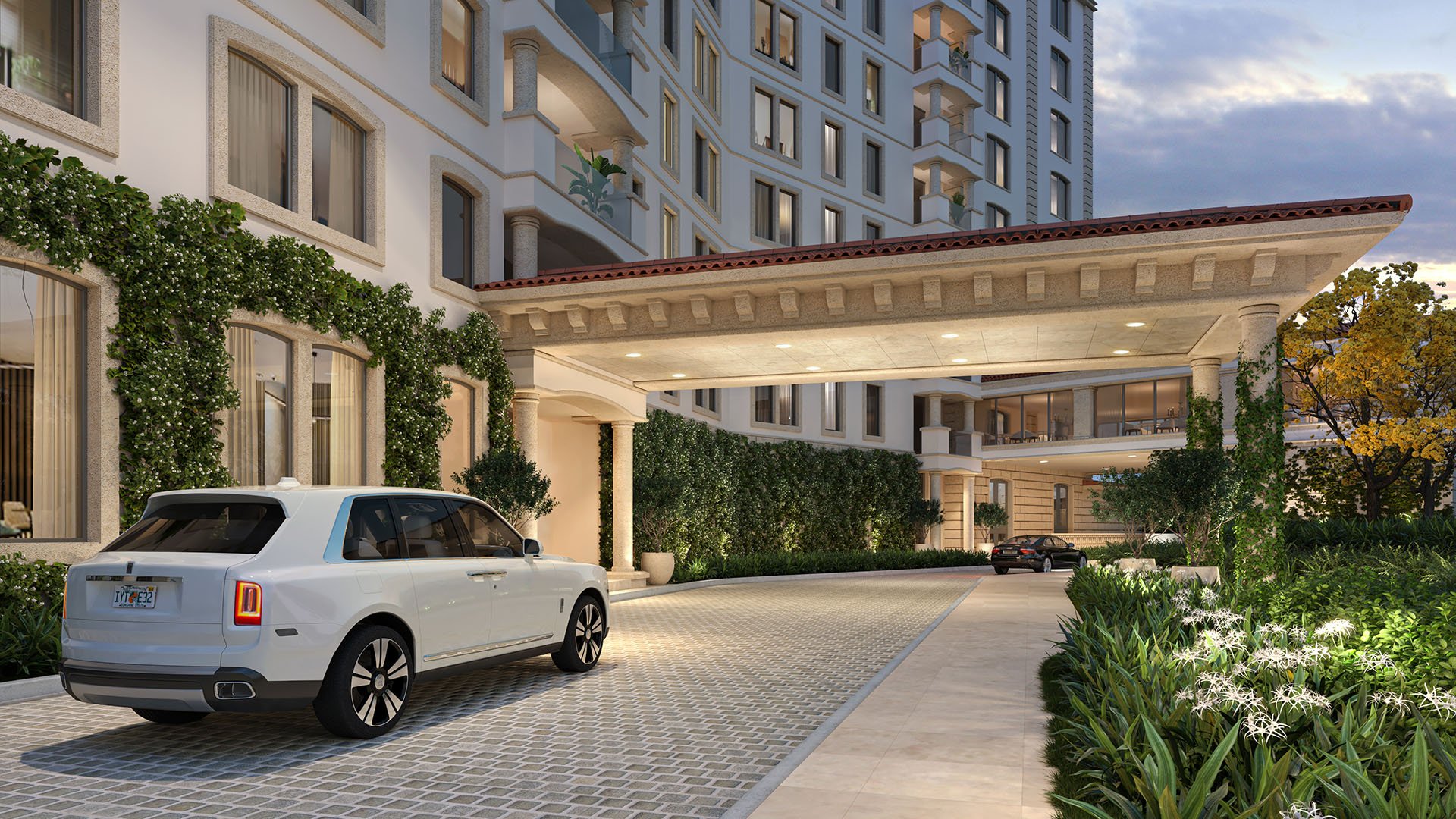
For family buyers in South Florida, valet queuing deserves the same scrutiny as elevators, security, flood planning, and emergency systems. It is not simply the first impression at the porte-cochère. It is the point where children, caregivers, pets, grandparents, luggage carts, SUVs, deliveries, and storm-season weather all meet.
Across Miami-Dade, Broward, and Palm Beach, daily life remains deeply car dependent. Even buyers who prize walkable neighborhoods often rely on vehicles for school runs, medical appointments, groceries, sports practices, airports, and weekend plans. In that context, the question is not whether a building offers valet. The sharper question is whether the valet system has been designed, staffed, and governed for actual family use.
In new-construction due diligence, even the most elegant lobby cannot compensate for a queue that backs into the street at 7:45 a.m.
A family buyer should ask for a written valet and parking demand study that models arrivals and departures, not just total parking spaces. Peak movement matters more than inventory. A tower may have sufficient parking on paper and still perform poorly when several households request vehicles at the same time.
The study should account for school runs, early caregiver arrivals, after-school activities, grocery and package deliveries, ride-share conflicts, multiple household vehicles, and weekend guest turnover. In Brickell, for example, a buyer considering 2200 Brickell should look beyond the residence itself and ask how the building handles concentrated family departures in an already active urban setting.
Buyers should request practical service standards: target retrieval times, maximum acceptable queue length, staffing by time of day, and escalation procedures when delays occur. A promise of white-glove service is less valuable than a written operating plan.
The porte-cochère should have enough on-site queue depth to keep waiting vehicles from spilling into public streets, blocking sidewalks, or trapping pedestrians between moving cars. This is especially important for family buyers because loading is rarely instant. Children need buckling. Strollers need folding. Sports bags, backpacks, diaper bags, pets, and elderly relatives all require time and space.
Covered loading is not decorative in South Florida. Heavy rain, flooding conditions, and hurricane-season surges can make exposed curbside loading unsafe or impractical. The strongest drop-off zones allow families to pause without feeling rushed into active traffic lanes.
Safe pedestrian routes should be visible and separated from vehicle movement wherever possible. Accessible passenger loading should include a proper vehicle pull-up space and adjacent access aisle. At a coastal property such as The Perigon Miami Beach, buyers should pay particular attention to how arrival choreography works during rain, beach-day returns, guest traffic, and high-season congestion.
Family buyers should ask direct questions about backover prevention. Valet zones often combine SUVs, strollers, luggage carts, children below a driver’s sightline, and staff moving quickly under pressure. A luxury building should be able to explain its procedures for reversing, spotters, lighting, mirrors, traffic flow, staff training, and pedestrian separation.
Vehicle size matters as well. Many South Florida families use larger SUVs or minivans, especially households with car seats, multiple children, sports gear, or visiting relatives. A valet plan that assumes compact-car maneuvering may create daily friction. For buyers weighing high-service towers such as Bentley Residences Sunny Isles, the practical question is whether the system accommodates real family vehicles with calm, repeatable efficiency.
The building should also show how emergency access, fire lanes, and main entrances remain clear during peak queues and bad-weather surges. A blocked fire lane is not an inconvenience. It is an operational failure.
The modern valet platform should do more than generate a ticket. Buyers should ask whether residents can request vehicles in advance, receive text or app notifications, track key custody, and access an audit trail showing who handled the vehicle and when. This is particularly relevant for families coordinating caregivers, older children, household staff, and multiple cars.
EV owners need a separate conversation. Ask how the operator manages charging priority, charger access, idle time, handoff procedures, and what happens if a vehicle is needed before it reaches the desired charge level. The issue is not merely whether chargers exist. It is whether the valet team has a clear, fair, documented process for using them.
A strong agreement should also address insurance, damage reporting, claims handling, employee screening, and responsibility for vehicles while in the operator’s custody. Buildings that aspire to the family buyer must make accountability feel routine, not adversarial.
Hurricane and severe-weather protocols should be written, not improvised. Families should ask when valet operations pause, where vehicles are stored, how flood risk is handled, and how residents retrieve cars before or after a storm. The answer should be specific enough for a parent to make decisions under pressure.
In Fort Lauderdale, Miami, Palm Beach, and the barrier-island markets, bad weather is not an abstraction. It is part of ownership. At buildings such as St. Regis® Residences Bahia Mar Fort Lauderdale, arrival planning should be treated as part of the broader residential operating standard, alongside security, access control, and resilience.
Before signing, visit during a realistic time window if possible. Watch where vehicles pause, where pedestrians cross, how staff communicate, and whether the lobby approach feels intuitive with children in tow. Ask where a caregiver waits, where a grandparent exits, where a stroller unfolds, and where an SUV can dwell without pressure.
Boutique, wellness-oriented, and village-style addresses can have different arrival rhythms. A buyer exploring The Well Coconut Grove should still apply the same discipline: queue depth, covered loading, safe walking paths, staffing standards, technology, emergency access, and weather protocols.
The best valet experience is almost invisible. It feels calm because the building has already planned for the messiness of family life.
What is the first valet question a family buyer should ask? Ask for the written demand study showing peak arrivals and departures. Space count alone does not prove the system will function well.
Why does queue depth matter? Queue depth keeps waiting vehicles on-site instead of spilling into streets, sidewalks, or fire lanes. It protects both circulation and safety.
Should buyers ask about school-run timing? Yes. School departures, caregiver arrivals, and after-school pickups create concentrated demand that should be modeled in advance.
Is covered loading really necessary in South Florida? For families, yes. Heavy rain and storm conditions can make exposed curbside loading difficult, unsafe, or impractical.
What should an accessible loading area include? It should provide a proper pull-up area and adjacent access aisle. Families should also look for a clear route to the lobby.
How should valet handle larger family vehicles? The plan should account for SUVs and minivans, not only compact vehicles. Maneuvering, storage, and loading time all change with size.
What technology should a luxury valet system offer? Useful systems support advance requests, notifications, key tracking, and audit trails. The goal is accountability as well as convenience.
What should EV owners ask? Ask how charging priority, charger access, idle time, and vehicle handoff are handled. A charger is only useful with a clear operating policy.
Why is backover prevention important? Valet zones often mix children, strollers, carts, and large vehicles. Staff training and controlled circulation are essential.
What storm questions should buyers raise? Ask when valet pauses, where vehicles are stored, and how cars are retrieved before or after severe weather. The answer should be written.
To compare the best-fit options with clarity, connect with MILLION.
If branded residences are on your mind — as a home or as an allocation — we would be glad to share what we are seeing, privately.
Begin a quiet conversation