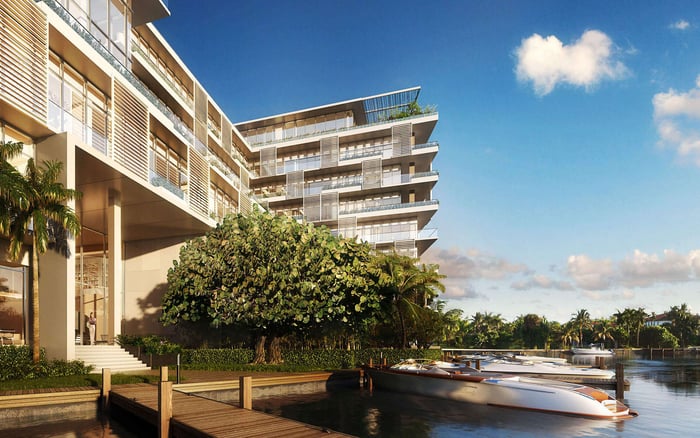
For trust and entity purchasers, a Miami Beach waterfront condominium deserves financial scrutiny beyond the monthly assessment. Review the assumptions behind staffing, utilities, insurance and reserves, then align ownership documents, coverage and financing before closing.

A Miami Beach waterfront residence should offer confidence as well as an exceptional setting. For a purchaser using a trust or entity, that confidence requires two parallel reviews: whether the ownership arrangement fits the condominium’s governing documents, and whether the association’s financial assumptions support the ownership experience being purchased.
The monthly assessment is a starting point, not a complete cost analysis. Buyers considering 57 Ocean Miami Beach should apply the same discipline as elsewhere: request the underlying documents rather than infer financial strength from the setting or presentation.
This checklist concerns condominium associations. Association-budget rules, Structural Integrity Reserve Studies and milestone inspections should not automatically be applied to standalone waterfront homes. Treat these as due-diligence requests to coordinate through the seller, management and counsel-not as unrestricted purchaser access rights.
Ask counsel to examine the declaration and bylaws for permitted ownership structures, approval paperwork, voting arrangements, board eligibility and assessment-enforcement provisions. A trust or entity purchase requires a review of how the proposed owner will participate in the association, not simply how title will be recorded.
Coordinate that review with the insurance adviser. The purchasing trust or entity should be correctly identified in the policy, with coverage aligned to applicable lender requirements. For a financed acquisition, obtain lender confirmation that the association’s reserves and insurance satisfy its project-underwriting requirements.
These decisions are related but distinct. Association approval, insurance placement and financing should each be resolved on their own terms, not treated as interchangeable confirmations.
Obtain the current adopted annual budget with separate lines for payroll, utilities, insurance, reserves and contracted services. Request prior-year budget-to-actual financials alongside it. Recurring overruns warrant explanation, particularly when the current budget assumes those same expenses will remain stable.
Ask management to identify the assumed year-over-year increases for insurance, electricity and water/sewer separately. A single overall growth figure can obscure very different assumptions across major expenses. The question is not merely how much the budget increased, but what supports each material line.
For buyers evaluating Faena House Miami Beach, this is a framework for inquiry, not a conclusion about the association’s finances. Request the documents specific to the purchase and distinguish adopted figures from estimates or unresolved proposals.
Request a payroll schedule showing staffing by role, headcount, wages, benefits and overtime. Focus on the coverage planned for concierge, security, valet and maintenance. The objective is to determine whether the budget funds the service level you expect-not simply to identify the lowest staffing expense.
Review major management, security, valet, elevator, cleaning and landscaping contracts for automatic annual increases or adjustments linked to the consumer price index. Ask how those escalations are reflected in the adopted budget.
For utilities, request separate electricity and water/sewer budgets. Identify the relevant consumption drivers, including elevators, common-area air conditioning, pool equipment and irrigation. Confirm which amenities and services are funded through regular assessments and which require separate user fees. That distinction belongs in the purchaser’s ownership-cost analysis, even when the additional charges are discretionary.
Request declarations for the association’s master property, applicable flood, windstorm/hurricane, liability and directors-and-officers coverage. Pair those documents with a three-to-five-year claims summary so the insurance adviser can assess coverage and claims exposure together.
Establish the boundary between association coverage and the purchaser’s separate obligations for interiors, personal property and liability. Neither the master-policy premium nor a statewide homeowners-insurance average substitutes for an individual coverage review and quote.
Have the adviser reconcile the proposed ownership name with the policy and any lender requirements. Review the association’s insurance budget and the purchaser’s own coverage cost separately before combining them in an ownership forecast. Ask management to explain the insurance increase assumed in the budget; do not treat the current premium as a promise of future pricing.
Request the reserve schedule and, where applicable, the latest Structural Integrity Reserve Study, or SIRS, with its funding recommendations. Florida’s condominium budget rule generally calls for component-level disclosures covering useful life, remaining life, replacement cost and beginning balance, with different provisions for pooled reserves.
Compare actual reserve balances and annual contributions with the study’s funding plan. Ask how projections account for replacement-cost escalation, and request updated vendor estimates for projects already underway. A scheduled contribution is meaningful only when assessed against the work it is intended to fund.
There is no universal safe reserve percentage or inflation assumption for every Miami Beach waterfront building. Have counsel determine the current structural-reserve funding restrictions and exceptions applicable to the association. Do not assume owners can vote to waive or reduce contributions, or rely on the original building-safety legislation as a complete statement of current obligations.
Request the latest applicable milestone inspection report and related board minutes. Review recent budget and reserve resolutions for required work, insurance shortfalls, deferred maintenance and unresolved funding decisions.
Ask for five-to-ten years of special assessments, including their purposes, outstanding financed balances and anticipated new assessments. Read that history alongside the reserve plan rather than assessing past assessments in isolation.
Use the latest balance sheet to calculate operating cash days: operating cash ÷ (annual operating expenses ÷ 365). This measures liquidity; it is not a universal pass-or-fail threshold. Do not count reserve money as freely available operating cash. Where operating and reserve funds are commingled, Florida law requires separate accounting, and the combined account cannot fall below the amount identified as reserves.
When a purchase involves a required statutory prospectus or offering circular, request it and its amendments. Its budget must be described as a “good faith estimate only,” not a guarantee of future expenses. For a buyer considering The Perigon Miami Beach, the relevant questions are which disclosures apply to the transaction and what assumptions support the budget presented.
Before closing, bring the ownership review, operating assumptions, insurance analysis and reserve funding picture into one decision. Separate adopted expenses from projected increases, funded work from unresolved obligations, and association coverage from purchaser coverage. The goal is not the smallest monthly fee. It is a clear understanding of what that fee funds and what additional exposure remains.
For a discreet conversation about your Miami Beach waterfront search, connect with MILLION.
If branded residences are on your mind — as a home or as an allocation — we would be glad to share what we are seeing, privately.
Begin a quiet conversationRequest the current adopted annual budget with separate expense and reserve lines, plus prior-year budget-to-actual financials. Compare recurring overruns with the assumptions used in the current budget.
Have counsel review permitted ownership structures, approval paperwork, voting arrangements, board eligibility and assessment-enforcement provisions. Coordinate the ownership name with the insurance adviser and, when financing, the lender.
Request staffing by role, headcount, wages, benefits and overtime, particularly for concierge, security, valet and maintenance. Check whether those assumptions support the service coverage you expect.
Request separate electricity and water/sewer budgets and their assumed year-over-year increases. Ask management to identify major consumption drivers rather than rely on one overall budget-growth figure.
Request declarations for master property, applicable flood, windstorm/hurricane, liability and directors-and-officers coverage. Include a three-to-five-year claims summary for the insurance adviser’s review.
Do not assume it does. Have an insurance adviser establish what the association covers and what the purchaser must insure separately, including interiors, personal property and liability.
Compare reserve balances and contributions with the reserve study’s funding plan, and ask how replacement-cost escalation is reflected. Request updated vendor estimates for projects already underway.
Buyers should not assume that option is available. Counsel should determine the current funding restrictions and exceptions that apply to the particular association.
It expresses operating cash relative to average daily operating expenses, calculated as operating cash divided by annual operating expenses divided by 365. It is a liquidity measure, not a universal safety threshold, and reserve money should not be treated as freely available operating cash.
No. Association-budget, SIRS and milestone-inspection requirements should not automatically be applied to standalone waterfront homes; the review should reflect the property’s actual ownership and governance structure.