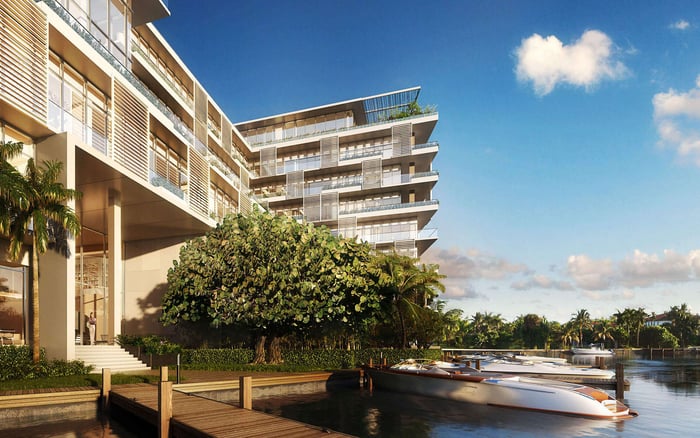
In North Bay Village, the most consequential waterfront costs may sit outside the residence itself. Seawall condition, lawful dredging depth, flood elevation, insurance terms, and the sequencing of future shoreline work can reshape both ownership costs and utility.

A waterfront acquisition in North Bay Village can appear deceptively simple: assess the residence, study the view, confirm the dock, and negotiate the price. Yet the more consequential calculation often begins where the finished interiors end. Seawall condition, site elevation, drainage, insurance terms, lawful water depth, and responsibility for future marine work can shape both the cost and utility of ownership.
A seemingly attractive basis may prove less compelling once deferred shoreline work, constrained vessel access, or unfavorable insurance terms enter the analysis. These issues deserve attention before a buyer treats the negotiated price as the complete measure of value.
The finest waterfront purchase is one whose shoreline obligations are understood before closing.
Luxury buyers considering Continuum Club & Residences North Bay Village, Shoma Bay North Bay Village, or Tula Residences North Bay Village should apply the same discipline used for a private home: distinguish the quality of the residence from the obligations attached to its waterfront setting. In a condominium, that means examining how governing documents allocate shared shoreline assets, reserves, maintenance duties, and future projects.
A seawall is not merely a visual boundary between a property and Biscayne Bay. Its physical condition can affect shoreline stability, drainage coordination, adjacent improvements, renovation planning, and future capital needs.
A marine engineer can inspect the cap, panels, tie-backs, piles, drainage, cracking, and settlement beside the wall. The objective is not simply to determine whether the structure appears serviceable today, but to understand its remaining useful life, signs of movement, permitting history, future adaptability, and relationship to nearby improvements.
Buyers should also determine whether contemplated work may require the shoreline to be evaluated as part of a broader development or renovation plan. A pool, terrace, landscape redesign, dock, lift, or substantial renovation can interact with seawall design and site elevations. Reviewing these elements separately may leave conflicts unresolved until after closing.
For an investment purchase, the review should establish who pays. In a single-family property, ownership documents, easements, or shared conditions may affect responsibility. In a condominium, the declaration, budget, reserves, engineering reports, meeting records, and assessment history can reveal exposure not reflected in the unit’s asking price.
A dock and an open-water view do not establish that a buyer’s intended vessel can reach, turn, berth, or remain afloat across representative tides. Measured depth is only one component; authorized depth, permit history, submerged-land rights, and access outside the immediate berth can be equally important.
Before matching a property to a vessel, buyers should request available permits and records for the dock, lift, seawall, berth, and prior dredging. Any contemplated marine work should be reviewed with qualified professionals who can identify the applicable municipal, county, state, and federal requirements without assuming that a previous approval permits a new or expanded scope.
Maintenance dredging should not be treated as automatic authorization to deepen a berth for a larger vessel. A due-diligence review should establish the dimensions previously authorized, the area covered by those approvals, the party entitled to seek future authorization, and any requirements governing the handling of dredged material.
The practical approach is to measure depth at representative tides, compare those observations with the vessel’s draft and operating margin, and review the legal record. Buyers should also confirm who controls the relevant submerged area, who bears the expense of future work, and whether usable access depends on a channel or basin beyond the property line.
Waterfront work should not be designed piecemeal. Changes to a seawall can affect deck transitions, drainage, landscaping, pool geometry, views, and dock access. A new lift may depend on lawful water depth and permitted structures. Drainage decisions may influence how water moves across the site and toward the shoreline.
The preferable sequence is to establish survey and elevation conditions, complete marine and structural reviews, retrieve available permits, define the boating requirement, and then coordinate shoreline protection with the architectural plan. Pools, decks, docks, lifts, drainage, landscaping, and seawall improvements should be considered together before a buyer commits to a construction vision.
This integrated approach is relevant when comparing waterfront properties across South Florida, but local requirements should not be transferred from one municipality to another. A purchaser comparing North Bay Village with The Ritz-Carlton Residences® Miami Beach should evaluate each property under its own jurisdiction, ownership structure, site conditions, insurance profile, and governing documents.
A long-view plan should also account for the possibility that shoreline protection and drainage needs will evolve. The purpose is not to predict a specific future requirement, but to avoid creating improvements that are difficult to adapt or that obstruct access to critical shoreline components.
A flood-zone description is a starting point rather than a complete insurance analysis. A building’s elevation, configuration, insurable improvements, coverage choices, deductibles, exclusions, and underwriting terms can distinguish properties that appear similar on a map.
A buyer should request a property-specific elevation certificate and insurance indication rather than rely on listing language alone. The review should connect the survey and elevation information with the current building configuration and the buyer’s proposed improvements.
For a condominium, due diligence should encompass both unit-level needs and the association’s coverage. Buyers should review available information about deductibles, exclusions, claims, reserves, and the allocation of uninsured losses under the governing documents. The essential question is not merely whether coverage may be available, but what financial exposure remains with the owner after policy terms are applied.
Insurance should also be coordinated with the renovation concept. Changes to enclosed areas, building systems, finishes, exterior improvements, or shoreline features may affect the scope of coverage needed. Obtaining professional guidance before finalizing a design can help prevent a mismatch between the planned property and the contemplated insurance structure.
The most useful comparison sheet places the negotiated price beside foreseeable capital and operating obligations. It should account for seawall work, drainage coordination, engineering, permitting, dredging logistics, insurance, and possible improvements to waterfront infrastructure. Timing matters as well: work that depends on surveys, design coordination, permits, and specialized contractors can affect renovation plans and enjoyment even when its direct cost appears manageable.
Before closing, buyers should obtain the available elevation certificate, property-specific insurance indications, marine engineering findings, surveys, and permits for the seawall, dock, lift, and prior dredging. They should verify observed and authorized depths, review responsibility for shared waterfront elements, and examine reserve and assessment exposure where applicable.
The complete renovation concept should then be tested against shoreline, access, drainage, and permitting constraints rather than assuming approvals will follow design. Any unresolved issue should be reflected in the buyer’s risk assessment, proposed timeline, and evaluation of total ownership exposure.
The asking price remains important, but it is only the visible entry point. Waterfront value in North Bay Village is better judged through physical durability, lawful utility, insurability, clearly allocated responsibilities, and the ability to adapt the shoreline coherently over time.
For discreet guidance on South Florida waterfront opportunities and due-diligence priorities, connect with MILLION.
If branded residences are on your mind — as a home or as an allocation — we would be glad to share what we are seeing, privately.
Begin a quiet conversationIts condition can introduce engineering, permitting, maintenance, and capital obligations that change total ownership exposure.
The review can cover the seawall cap, panels, tie-backs, piles, drainage, cracking, settlement, and nearby improvements.
No. Buyers should verify depth at representative tides, vessel draft, turning room, permitted structures, and access beyond the berth.
Those records may clarify the authorized dimensions, covered area, responsible party, and limits affecting future work.
It should not be assumed to authorize unrestricted deepening. The prior approvals and proposed scope require professional review.
Pools, decks, docks, lifts, drainage, landscaping, and seawall work should be coordinated as one waterfront system.
They should examine governing documents, budgets, reserves, engineering reports, meeting records, and assessment history.
Elevation, building configuration, coverage terms, deductibles, exclusions, and planned improvements can affect an owner’s exposure.
Relevant items include surveys, elevation records, insurance indications, engineering findings, and permits for marine structures and prior work.
They should compare total ownership exposure, lawful water access, shoreline condition, insurance terms, responsibilities, and renovation constraints.