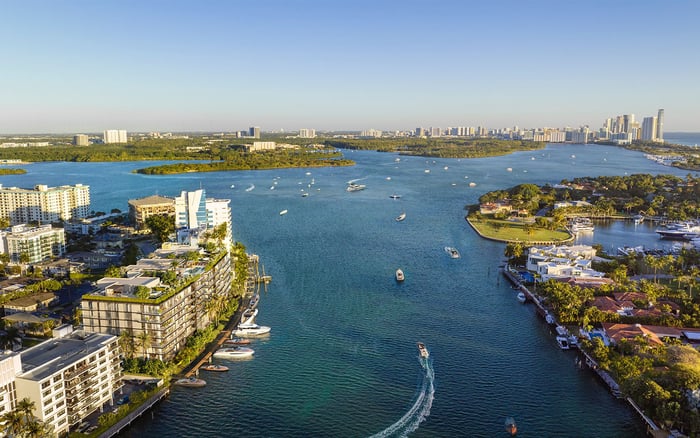
For buyers making Bal Harbour their Florida base, wine-storage diligence should connect three things: documented backup-power coverage, accountable delivery handling, and readable climate records. Treat each as a property-operation question, separate from legal domicile or tax eligibility.

For a buyer making Bal Harbour a Florida base, a wine collection brings precise questions to the residence search. The issue is not simply whether bottles have an elegant place to rest. It is whether cooling continues during an interruption, deliveries reach an appropriate holding location, and someone can document what happened while the owner was away.
Effective diligence connects those questions rather than treating them as separate amenities. A receiving policy means little if a shipment waits somewhere unsuitable. A generator description is incomplete without identifying the circuit that serves the cooling equipment. A climate dashboard offers less reassurance without a designated person responsible for responding to alarms.
Buyers considering Oceana Bal Harbour should frame these as requests for the particular residence and storage arrangement under consideration, not assumptions about the project. This review addresses property operations. It does not establish Florida domicile, determine tax eligibility, or replace advice from qualified legal and tax advisers.
Begin by identifying where the collection would be stored: inside the residence, in a dedicated room, or in another space offered for the owner's use. Then request a protected-circuit schedule showing whether the relevant cooling equipment receives backup power. Ask separately about controls, monitoring devices, and any supporting equipment the storage system needs to function.
Request generator and transfer-switch records, maintenance documentation, fuel-runtime information, and a written emergency-cooling plan. The answer should be specific to the proposed installation. A statement that a building has emergency power does not confirm that a private wine refrigerator or storage room is covered.
For a residence being evaluated at Rivage Bal Harbour, apply the same discipline: distinguish written commitments, equipment documentation, and operating records. Where a system has not yet generated a service history, ask what can be documented now and what must be confirmed before relying on it.
Have an appropriately qualified professional interpret the technical records and identify unresolved questions. Generator connections to residential circuits in Bal Harbour require approved automatic-interrupt devices; improper connections can create fire hazards and endanger utility workers. An improvised connection is not an acceptable substitute for a documented backup arrangement.
Coverage is only the first question. Ask management to explain the expected sequence after utility power fails: how the cooling system transfers, who checks its operation, and how the owner learns of the interruption. Request the assumptions behind any stated runtime, including operating load and refueling arrangements.
The emergency-cooling plan should also address failure of the cooling equipment itself. Ask whether an alternative holding location is contemplated, who can authorize movement of the collection, and what access would be required. Do not assume that a powered outlet guarantees a functioning storage environment.
Keep fuel safety separate from performance claims. Household gasoline-storage guidance does not establish a condominium generator's fuel capacity, operating duration, or ability to receive fuel during an emergency. Those questions require documentation for the actual system. Likewise, ask how any proposed response would comply with emergency instructions rather than presuming staff or contractors can always reach the property.
Wine delivery deserves a written procedure, especially when the buyer divides time between residences. Request receiving hours, signature requirements, the designated holding location, and owner-notification procedures. Ask who accepts a shipment and who is responsible for moving it from the receiving point to its intended storage space.
The policy should distinguish receipt from completed placement. Ask whether staff may enter the residence, what authorization is needed, and how handling works when the owner or a representative is absent. Confirm what happens to deliveries arriving outside receiving hours or during a disruption, including whether acceptance can be suspended.
If the search also includes Surfside and Fendi Château Residences Surfside, use the same written questions to compare options. Project identity is not evidence of a particular receiving service. Ask for the arrangement that would apply to the buyer's own shipment, storage location, and absence schedule.
Walk through one hypothetical delivery from arrival to final placement. Clarify notification timing, documentation of receipt, and escalation if the owner cannot be reached. Resolve any responsibility left between departments before scheduling the first shipment.
Request timestamped temperature and humidity exports for the storage environment, together with alarm history, sensor-maintenance records, and a designated response contact. Ask for records that make interruptions and gaps visible rather than relying solely on a current display or a verbal assurance that conditions are stable.
Connect each recorded alarm with the action taken. Ask when the alert occurred, when someone acknowledged it, and whether restoration was documented. Where records are unavailable for a proposed installation, request a written monitoring and response plan without treating it as proof of historical performance.
Have a qualified storage specialist assess whether the proposed settings and monitoring arrangement suit the collection. This article does not prescribe a universal temperature or humidity threshold. The buyer's task is to establish agreed parameters, understand where sensors measure conditions, and confirm who responds when readings move outside those parameters.
For buyers comparing The Surf Club Four Seasons Surfside with Bal Harbour residences, a consistent document request can be more useful than comparing amenity descriptions. Review the specific space, records, and responsibilities proposed for each option without assuming equivalent services.
Residents may be instructed to shelter in place during an emergency. Continue following updates because changing conditions may alter recommendations. County emergency alerts are carried on radio and television, and official emergency-status updates and an alert-signup option are available in Bal Harbour.
Keep building notification, utility-outage reporting, and public-area hazard reporting distinct. A message to management should not be assumed to complete utility reporting. Damage, safety hazards, and outages affecting public sidewalks, streets, or parks can be submitted through the Village's online reporting form or by telephone.
These channels support the broader emergency plan; they do not confirm wine-storage coverage. Ask management who communicates with owners and how cooling-status updates will be handled during a disruption.
Before committing to the storage arrangement, assemble the circuit documentation, backup-power records, delivery policy, climate history or monitoring plan, and current response contacts. Record unresolved questions and the person responsible for answering each one. Keep promises distinct from demonstrated performance.
The objective is quiet continuity: a collection whose care does not depend on the owner being present to discover a problem. For a discreet conversation about your South Florida residential search, connect with MILLION.
If branded residences are on your mind — as a home or as an allocation — we would be glad to share what we are seeing, privately.
Begin a quiet conversationNo. Request a protected-circuit schedule identifying the actual cooling equipment and any supporting controls or monitoring devices.
Request generator and transfer-switch records, maintenance documentation, fuel-runtime information, and a written emergency-cooling plan.
Ask for the operating-load assumptions and refueling arrangements behind the statement. Household gasoline-storage guidance does not establish condominium generator performance.
It should identify receiving hours, signature requirements, the holding location, owner notifications, and responsibility for final placement.
Confirm handling authorization, residence-access requirements, and the escalation procedure if the owner cannot be reached.
Request timestamped temperature and humidity exports, alarm history, and sensor-maintenance records. Identify the person responsible for responding to alerts.
Request a written monitoring and response plan and identify what must be confirmed before use. A proposed plan should not be treated as demonstrated historical performance.
Do not rely on them. Generator connections to residential circuits require approved automatic-interrupt devices, and improper connections can create fire hazards and endanger utility workers.
Do not assume so. Building notification and utility-outage reporting are separate steps, while public-area hazards have their own municipal reporting channels.
No. Keep property-operation diligence separate from domicile and tax questions, which require qualified legal and tax advice.