For collectors buying a South Florida condominium as a primary residence, insurance diligence should connect the building’s master policy, interior replacement costs, hurricane deductibles and collection-specific questions before closing.
For an art collector, a primary residence must do more than accommodate the collection’s display. It must also support a considered plan for the financial consequences of damage to the building, bespoke interiors and the works themselves. Before buying, the essential question is not simply whether the residence is insured, but where each policy’s responsibility begins and ends.
This framework principally concerns condominiums, where the association’s master property policy and the owner’s HO-6 policy must be reviewed together. It should not be applied wholesale to a detached waterfront home. For a Miami Beach buyer considering Faena House Miami Beach, the request is the same as for any prospective condominium: obtain the actual insurance documents rather than infer protection from the address. No project’s coverage terms are assumed here.
Ask for the full current master property policy, including its declarations, forms and endorsements. Have the association’s broker identify the insurer, policy period, insured building limits, exclusions and hurricane or named-storm deductible provisions. A summary cannot substitute for the terms that determine coverage.
The deductible deserves its own written explanation. Ask whether it applies per building or per occurrence, which insured value serves as the calculation base, and how it would operate in a storm affecting the property. These distinctions are essential to translating a percentage into a potential funding obligation.
Do not stop at the deductible. Underinsurance and damage outside the master policy’s covered scope can also leave an association with a funding shortfall. Request a discussion of those exposures alongside the policy limits. The deductible should not be treated as the maximum possible assessment.
Master-policy hurricane deductibles commonly fall around 2%-5% of insured building value, although the actual policy controls. The critical distinction is the calculation base: if a 5% deductible applies to a $30 million insured building value, the deductible is $1.5 million-not 5% of the repair bill.
An association may fund that obligation through special assessments allocated according to owners’ interests. Request a written calculation for the specific unit under consideration, with the allocation clearly identified. Dividing by the number of residences provides only an equal-share illustration; it is not a reliable substitute for the unit’s actual allocation.
Then ask your adviser to compare that potential share with the owner’s proposed insurance. One hurricane can create two separate exposures: an assessment related to the association’s master deductible and an individual HO-6 deductible for covered interior damage. Account for both in the purchase budget, without assuming either is automatically reimbursable.
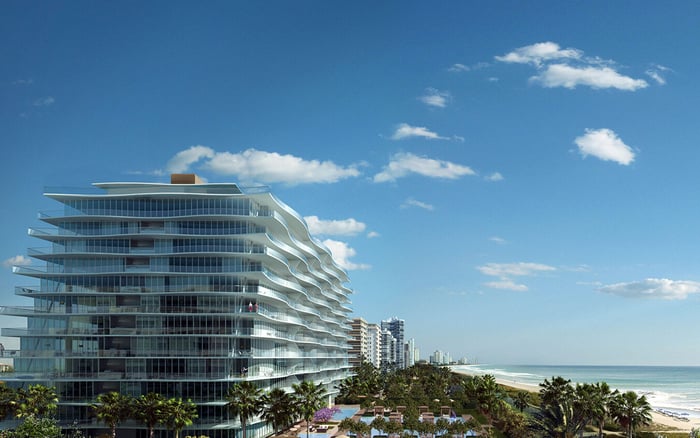
For collectors evaluating a Surfside residence such as Fendi Château Residences Surfside, the insurance review should be as specific as the interior specification. Request a written master-policy/HO-6 responsibility matrix identifying who insures each component and under which policy provision.
Florida’s condominium insurance framework identifies floor, wall and ceiling coverings, cabinets, countertops, appliances, water heaters and window treatments as items excluded from association property insurance and left to unit owners. Yet “walls-in” is insufficient shorthand for a collector’s entire installation.
Gallery walls, specialized lighting and climate-control equipment require individual review. Do not assume every installation is excluded from the master policy, or that every item assigned to the owner is automatically covered by the proposed HO-6.
Set interior limits around replacement cost, reviewing custom millwork, expensive finishes and gallery-related improvements individually. Ask the adviser to reconcile the proposed limit with the actual specification. The question is not the purchase price, but what it would take to replace the interiors for which the owner needs protection.
Request explicit written confirmation that the proposed HO-6 includes wind and hurricane damage. Obtain the applicable deductible, its calculation basis and an explanation of how it would apply to covered interior damage. The label “condo insurance” does not answer these questions.
Keep this review separate from the association’s wind provisions. A master policy’s terms do not establish what the owner’s policy will pay. Ask both advisers to work through the same hypothetical storm so the building obligation, interior claim and potential uninsured amounts can be considered together.
Florida law establishes a baseline, not a tailored solution for a luxury residence. Section 627.714 requires unit-owner residential property policies issued or renewed on or after July 1, 2010, to include at least $2,000 in coverage for assessments arising from the same direct property loss, regardless of the number of assessments.
The statutory loss-assessment deductible is capped at $250 per direct property loss. No loss-assessment deductible applies when a deductible has already been applied to the owner’s property loss arising from that same direct loss. This protection does not eliminate the association’s master-policy deductible.
Request the actual loss-assessment endorsement and its distinct limit. Increasing dwelling or personal-property coverage does not automatically increase loss-assessment protection. An endorsement may also impose a lower sublimit on payments for assessments attributable to the association’s deductible.
Ask the association’s broker and your adviser to compare your allocated master deductible with both the headline loss-assessment limit and any applicable sublimit. An assessment is not automatically an insured claim: payment depends on a covered cause of loss, policy terms, exclusions and limits. Routine maintenance, cosmetic improvements and reserve contributions unrelated to a covered loss are generally not what this coverage funds.
When considering Park Grove Coconut Grove or another Coconut Grove condominium, separate the collection discussion from the interior replacement-cost exercise. Ask a fine-art insurance specialist to explain how the proposed arrangements address the works themselves. Coverage for the room does not answer the question of coverage for its contents.
Request written guidance on valuation, flood exposure, transit to the residence and climate-control failure. These are questions to resolve against actual policy language, not assurances that any particular protection exists. Have the specialist identify the documentation needed and any unanswered questions about the proposed protection.
Before closing, assemble one coordinated file: the master policy, unit-allocation calculation, interior responsibility matrix, HO-6 wind terms, loss-assessment endorsement and collection review. Ask your advisers to identify the remaining uninsured exposures in writing. For a primary residence, that clarity is part of choosing a home that can serve both everyday life and a carefully assembled collection.
For a considered approach to your South Florida residence search, explore MILLION.
If branded residences are on your mind — as a home or as an allocation — we would be glad to share what we are seeing, privately.
Begin a quiet conversationRequest the complete current master property policy, including declarations, forms and endorsements. Review the insurer, policy period, building limits, exclusions and storm deductible provisions.
The policy determines the calculation base. If a 5% deductible applies to a $30 million insured building value, it equals $1.5 million, not 5% of the repair bill.
That produces only an equal-share illustration. Obtain a written calculation using the actual allocation applicable to the unit you intend to purchase.
Yes. An owner may face an assessment related to the association’s master deductible and a separate HO-6 deductible for covered interior damage.
Review floor, wall and ceiling coverings, cabinets, countertops, appliances, water heaters and window treatments. Gallery walls, lighting and climate-control equipment need item-by-item responsibility and coverage confirmation.
Do not assume it does. Request explicit confirmation of wind and hurricane coverage, together with the applicable deductible and calculation basis.
Section 627.714 requires qualifying unit-owner residential property policies issued or renewed on or after July 1, 2010, to include at least $2,000 for assessments from the same direct property loss, regardless of their number.
It is capped at $250 per direct property loss. No loss-assessment deductible applies if a deductible has already been applied to the owner’s property loss arising from that same direct loss.
No; payment depends on the covered cause, policy terms, exclusions and limits, including any master-deductible sublimit. Routine maintenance and reserve contributions unrelated to a covered loss are generally not covered.
Request a policy-specific review of protection for the works, including valuation, flood exposure, transit and climate-control failure. Coverage for interiors should not be treated as confirmation of protection for the collection.