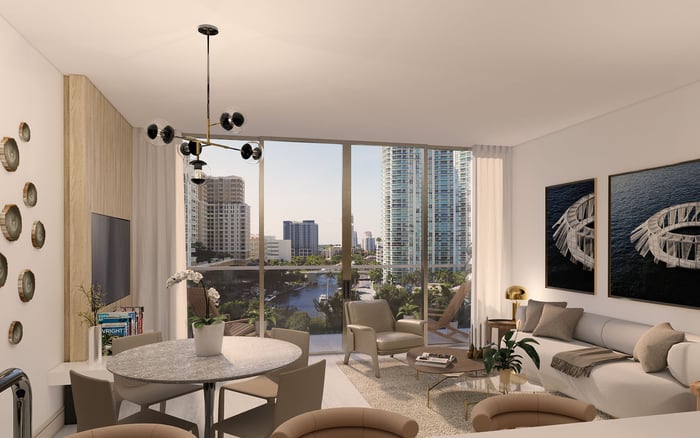
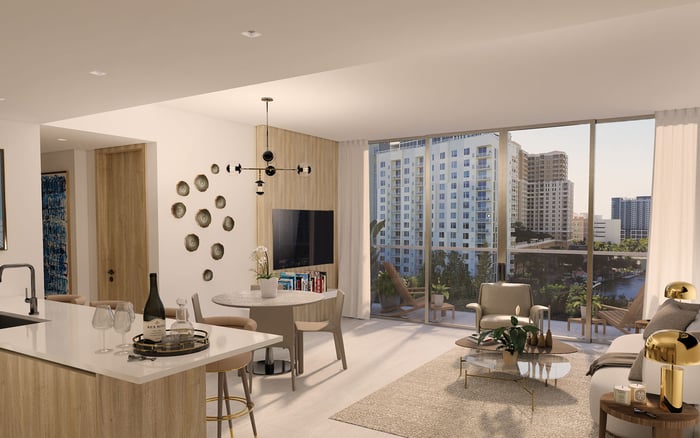
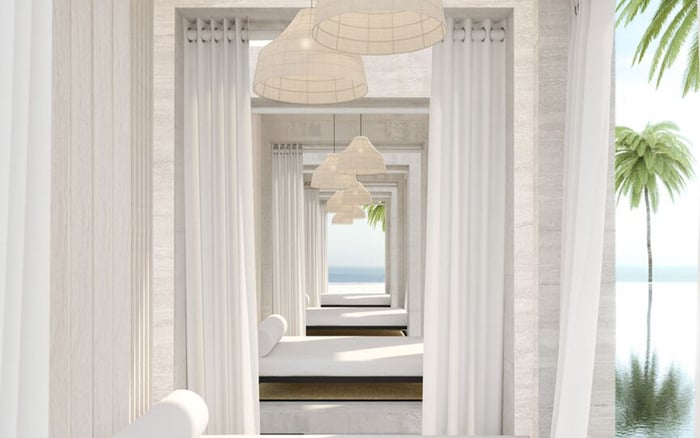
At Sixth & Rio, privacy is a residence-specific question. Buyers should test sightlines, arrival sequences, and amenity circulation from the exact home, at different times of day, before treating a waterfront position as a complete measure of discretion.
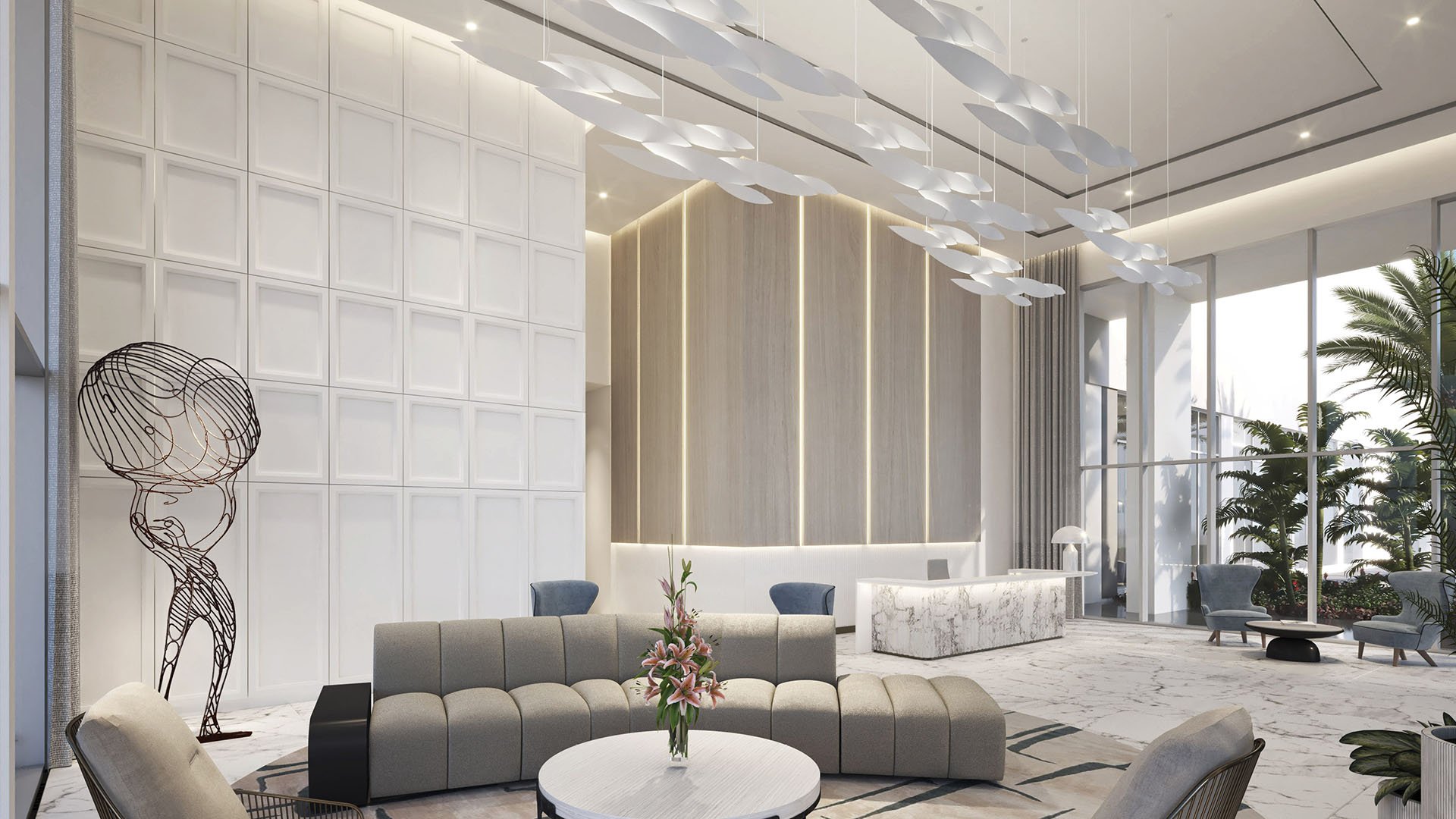
For buyers considering Sixth & Rio Fort Lauderdale, waterfront privacy should be evaluated at the residence level. A project name, floor number, or view description cannot establish how private a particular home will feel.
Review the exact residence line, exposure, window placement, balcony orientation, and path from the building entrance to the front door. Confirm all relevant conditions through current plans, project materials, and an in-person inspection rather than relying on assumptions.
Begin inside the residence at the places where daily life will occur. Check the outlook from principal seating areas, the kitchen, bedrooms, bathrooms, terrace doors, and multiple points across the balcony. A view that appears private from one position may feel different from another.
Then reverse the perspective. Consider where the interior and outdoor areas may be visible from neighboring residences, boats, shared spaces, or nearby circulation paths. Pay particular attention to angled windows, overlapping balconies, transparent railings, and direct visual axes.
Floor height should be assessed together with orientation and surrounding conditions. Buyers can also tour Riva Residenze Fort Lauderdale as a separate comparison, while avoiding assumptions that one project's layout or privacy conditions apply to another.
Privacy begins before the front door. Walk from the building entrance through the lobby, elevator area, residential landing, corridor, and residence entry. Note where residents or guests may wait, turn, gather, or pass one another.
Request the current elevator arrangement, stacking plan, corridor configuration, and location of the relevant front door. Verify whether the residence entrance sits near an elevator, stair, service route, or other active circulation point.
A visit to Four Seasons Hotel & Private Residences Fort Lauderdale may offer another arrival sequence to consider. The useful comparison is not a claim of equivalence; it is a way to identify which circulation pattern best fits the buyer's preferences.
Review how residents and guests move between elevators, shared indoor areas, outdoor spaces, and the relevant residential level. The key question is whether those routes bring regular movement close to a front door, landing, window, or private outdoor area.
Study where people are likely to pause as well as where they walk. A residence near a shared area may offer convenience, but the buyer should determine whether that proximity fits the desired balance between access and discretion.
Buyers may also review St. Regis® Residences Bahia Mar Fort Lauderdale as an additional project comparison. Any conclusions should remain residence-specific and be based on verified plans and direct observation.
Daylight can help reveal balcony relationships, window angles, surrounding structures, and activity in shared areas. After dark, interior lighting can change visibility through windows and across outdoor spaces.
If access permits, inspect the exact residence at both times. Sit and stand in the locations that matter most, use the terrace, wait near the elevator landing, and walk the routes connecting the residence with shared areas. Note whether privacy depends on window treatments, furniture placement, screening, or avoiding active periods.
Separate the review into three questions: what the residence sees, who may be able to see into it, and how often others may pass nearby. Apply those questions to living areas, bedrooms, bathrooms, outdoor space, the front door, elevator landing, and shared circulation routes.
Record observations rather than relying on a single overall impression. The preferred residence will be the one whose verified sightlines, arrival sequence, and relationship to shared areas best support the buyer's routines and privacy expectations.
Does a waterfront position guarantee privacy? No. Buyers should verify sightlines, surrounding conditions, and circulation from the exact residence.
Does every residence offer the same privacy experience? Privacy can differ by residence line, floor, exposure, window placement, and balcony orientation, so each home requires separate review.
Does a higher floor automatically provide more privacy? Not necessarily. Height should be considered alongside orientation, balcony relationships, and surrounding visual axes.
What should buyers inspect from a balcony? Review views in every direction and consider visibility from neighboring residences, boats, shared spaces, and nearby paths.
Why should buyers reverse the sightline test? Looking back toward the residence helps identify where interiors or outdoor areas may be visible to others.
Why does elevator configuration matter? Elevator placement and landing design can affect how frequently people pass, wait, or gather near a residence entrance.
Which arrival details should be verified? Review the route through the lobby, elevator area, landing, corridor, and front door using current plans and an in-person walk-through.
How should amenity circulation be assessed? Trace likely movement between shared spaces, elevators, outdoor areas, and residential levels, noting activity near the specific home.
Why inspect after dark? Interior lighting can alter visibility through windows and across balconies, revealing conditions that may not be apparent during daylight.
What is the most useful final privacy test? Compare verified sightlines, arrival circulation, and nearby activity with the buyer's actual routines and tolerance for visibility.
For a confidential assessment and a building-by-building shortlist, connect with MILLION.
If branded residences are on your mind — as a home or as an allocation — we would be glad to share what we are seeing, privately.
Begin a quiet conversation