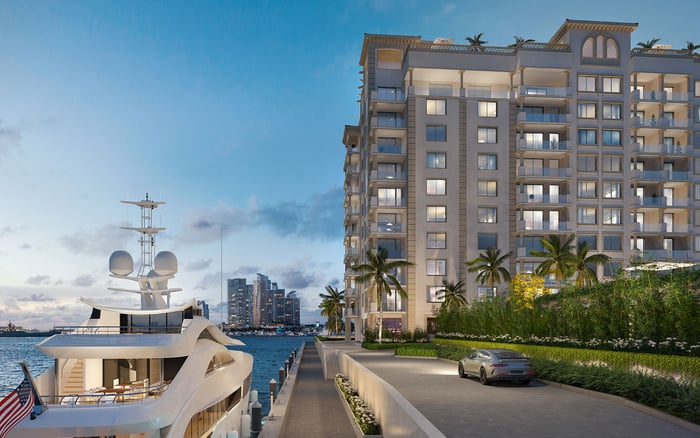
Armani/Casa design gives this Pompano Beach waterfront development a distinctive identity, but prudent acquisition analysis extends well beyond branding. Buyers should review the master insurance program, unit-owner coverage boundaries, wind-exposed assemblies, flood and elevation records, critical building systems, reserves, and potential assessment exposure before committing.

Armani Casa Residences Pompano Beach brings Armani/Casa branding to a luxury waterfront development in Pompano Beach. Its design identity may inspire the initial attraction, yet the most consequential ownership questions reside in documents rarely displayed in a presentation gallery.
For buyers, branded design and technical resilience belong in separate columns. Armani/Casa defines the aesthetic proposition; insurance terms, structural criteria, product approvals, elevations, and operating systems shape risk and carrying costs. The objective is not to diminish the lifestyle case, but to understand precisely what supports it.
That distinction applies across South Florida branded residences. Nearby alternatives such as The Ritz-Carlton Residences® Pompano Beach warrant the same disciplined review, with each property assessed on its own documentation rather than reputation alone.
The association's master insurance declarations should be requested early, together with deductibles, exclusions, limits, and claims history. A summary cannot substitute for the operative documents. Buyers and their advisers should determine which building elements fall within the association's responsibility and where the individual owner's obligations begin.
That boundary matters for interior finishes, upgrades, contents, personal liability, and any loss-assessment exposure addressed by an individual condominium policy. The policy structure should be reconciled with the condominium documents, ensuring that the legal allocation of responsibility aligns with the contemplated insurance coverage.
Wind and water also require separate analysis. Hurricane-force wind, wind-driven rain, flooding, and other water-related hazards should not be treated as a single insured event. Coverage triggers, exclusions, and deductibles may differ. An insurance adviser should explain how the master policy and proposed unit policy would respond under distinct scenarios-and where gaps could remain.
The same questions apply when considering W Pompano Beach Hotel & Residences. A new-construction or branded proposition does not, by itself, establish the availability, scope, or future cost of coverage.
Waterfront towers place the building envelope at the center of due diligence. Buyers should request project-specific records for façade systems, glazing, exterior doors, balcony assemblies, roof systems, and other wind-exposed components. The pertinent question is not whether a feature is described as robust, but which documented standard, approval, and installation process applies.
The review should identify the building-code edition governing the completed tower, the applicable wind-design criteria, product approvals, and inspection process. Qualified legal, engineering, and insurance professionals are best positioned to assess these records, each addressing a distinct aspect of the same risk profile.
Transitions and penetrations deserve particular attention: they are where separate assemblies meet and where water management can become consequential. Buyers should rely on documentation rather than infer performance from appearance. Luxury materials and refined detailing can coexist with rigorous technical standards, but one does not prove the other.
This approach also establishes a consistent comparison framework for projects such as Waldorf Astoria Residences Pompano Beach. The comparison should focus on disclosed criteria, approvals, inspections, insurance structure, and ownership obligations-not brand hierarchy.
Flood-zone information is only one element of the water-risk review. Buyers should also examine finished-floor elevations, garage elevations, equipment-room elevations, and any available elevation certificate. The placement of electrical, mechanical, pumping, access, and elevator infrastructure can affect how a building functions during and after severe weather.
Ask how drainage and pumps are configured, how emergency power is allocated, which elevators can operate, and how access controls are protected. The practical concern is continuity: whether residents can enter, circulate through, and safely use essential areas if normal power or surrounding access is disrupted.
This systems-level review is particularly important because a residence is experienced through the entire property. A beautifully finished private interior does not operate independently of garages, elevators, pumps, electrical rooms, life-safety systems, and common-area access.
A lower-scale local option such as Ocean 580 Pompano Beach may present a different physical format, but the core inquiry remains the same: establish the relevant elevations, understand exposed components, and verify how critical systems are protected.
A credible carrying-cost analysis should combine the owner's proposed policy with the association's broader financial obligations. Variables include master-policy premiums, hurricane deductibles, reserve funding, potential assessments, and the cost of individual coverage. None should be treated as permanently fixed.
Buyers should model a base case and more conservative scenarios, then determine how a large deductible would be allocated among owners. They should also review whether reserves and insurance obligations appear coordinated with the condominium documents and the anticipated maintenance of wind-exposed systems.
Here, technical diligence becomes financial diligence. Building-envelope documentation may influence underwriting conversations. Elevations and equipment placement may affect the practical severity of water-related events. Deductible structure and reserves may determine whether an association can absorb a loss without placing unexpected pressure on owners.
The refined purchase decision therefore unites three perspectives: the private residence, the shared building, and the association balance sheet. At Armani Casa Residences Pompano Beach, the Armani/Casa identity can remain central to the emotional appeal, while documentation provides the foundation for a measured commitment.
What master insurance documents should a buyer request? Request declarations, coverage limits, deductibles, exclusions, and claims history, then review them alongside the condominium documents.
Does the association's policy cover the residence interior? Coverage boundaries vary, so confirm responsibility for interiors, upgrades, contents, and liability before arranging an individual policy.
Are wind and flood the same insurance risk? No. Hurricane-force wind and water-related hazards can involve different coverage triggers, exclusions, and deductibles.
Which wind-exposed components deserve review? Examine documentation for glazing, façade systems, exterior doors, balconies, roof assemblies, and related exposed elements.
Which building standards should be identified? Confirm the governing code edition, wind-design criteria, applicable product approvals, and inspection process for the completed tower.
Why do finished-floor and garage elevations matter? They help frame how water exposure could affect residences, vehicles, circulation, and essential building spaces.
Should buyers ask for an elevation certificate? Yes, if one is available. Consider it alongside flood-zone information and equipment-room elevations.
Which operational systems should be examined? Review emergency power, drainage, pumps, elevators, access controls, and the protection of mechanical equipment.
How should hurricane deductibles enter the budget? Understand their size, application, and potential allocation, then incorporate possible owner exposure into conservative cost scenarios.
Can branding replace technical due diligence? No. Branding informs design and lifestyle positioning; insurance, engineering, and financial documents address ownership risk.
If you'd like a private walkthrough and a curated shortlist, connect with MILLION.
If branded residences are on your mind — as a home or as an allocation — we would be glad to share what we are seeing, privately.
Begin a quiet conversation