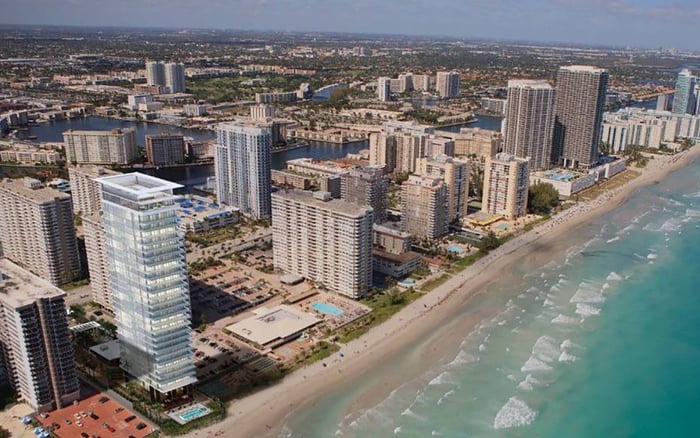
A document-led guide to evaluating waterfront privileges, year-round service, guest access, and rental implications at Shell Bay by Auberge in Hallandale Beach.

For a seasonal owner, the most consequential amenity is often not the one presented most beautifully, but the one that remains available when family arrives, a boat day is planned, or the residence is occupied outside the busiest months. At Shell Bay by Auberge Hallandale, the proposition combines branded residences, private-club experiences, and hospitality-oriented living in Hallandale Beach. Its identity is that of a resort-style enclave rather than a conventional oceanfront condominium tower.
That distinction should shape the inquiry. Proximity to the water does not, by itself, establish direct, deeded, or guaranteed access. Buyers should identify the precise mechanism behind every waterfront privilege: an on-site dock, controlled marina slips, preferred bookings with an outside operator, arranged excursions, or another structure entirely. Each model can deliver an elegant experience, but each raises different questions about availability, cost, control, and continuity.
The essential question is whether a privilege belongs to the real estate, depends on club membership, or is extended through a separate arrangement. Request written confirmation of whether access runs with the residence, is personal to the original purchaser, or may be revised by the club or association. Determine, too, whether initiation charges, recurring fees, usage charges, reservations, or approvals apply.
A seasonal buyer should read the purchase documents, association rules, club agreements, current fee schedules, and relevant management contracts together. Marketing may describe the lifestyle; these documents define who may use an amenity, under what conditions, and for how long. If access depends on a marina, yacht club, transportation company, or excursion provider, review the contract term, renewal rights, and termination provisions. A preferred relationship is not necessarily a permanent property right.
This documentary discipline is equally useful when comparing nearby or regional alternatives such as 2000 Ocean Hallandale Beach. The objective is not merely to compare amenity names, but to assess the durability and practical usability of the rights offered.
Reservation rules can matter as much as physical infrastructure. Request the booking window, capacity limits, blackout dates, cancellation policy, waitlist procedure, and any priority hierarchy during peak season. Clarify whether owners who book well in advance receive preference, whether same-day requests are realistic, and what happens when demand exceeds capacity.
Then examine the quieter months. Seasonal ownership can create the opposite concern: an amenity may be easier to reserve, while staffing or supporting services operate at a different level. Confirm whether attendants, concierges, transportation, vessel support, and safety personnel are available throughout the year. If schedules vary, request the operating calendar and determine how changes are communicated.
Golf and wellness experiences are central to Shell Bay's private-club positioning, yet waterfront use should be evaluated on its own terms. A polished club environment does not establish whether a launch, transfer, attendant, or safety service is available on a particular day. Buyers seeking a broader branded-residence comparison might also examine Auberge Beach Residences & Spa Fort Lauderdale, applying the same document-first standard rather than assuming shared branding produces identical rules.
Access should be tested person by person. Ask how the rules differ for an owner, spouse or partner, immediate family, accompanied guests, unaccompanied guests, tenants, club members, and outside visitors. The most useful answer is a written matrix identifying which amenities each category may use, whether the owner must be present, and which charges or reservations apply.
For family visits, verify guest-number limits, advance-registration deadlines, identification requirements, supervision rules, and applicable age restrictions. Determine whether guests may use transportation and waterfront services independently or only with the owner. If entertaining is important, review event rules at the same time, including whether a larger gathering changes the approval process or amenity access.
The same scrutiny belongs in any comparison with St. Regis® Residences Bahia Mar Fort Lauderdale. Buyers should request project-specific governing materials rather than infer privileges from location, brand, or presentation.
Owners considering rental income should establish whether tenants receive the same club and waterfront privileges as owners. Some arrangements may distinguish among owner occupancy, family use, short stays, and approved tenancies. Confirm whether privileges transfer for the full lease term, require separate registration, incur charges, or remain unavailable to tenants.
Rental, event, and guest policies should be read as a single operating framework. A residence may satisfy a second-home plan yet prove less flexible for unaccompanied adult children, extended-family visits, or tenant use. Likewise, an owner who expects to host frequently should understand whether repeated guest registrations, capacity controls, or owner-presence requirements alter the experience.
The prudent approach reflects the best buyer's guides: translate every lifestyle promise into a specific question, identify the controlling document, and obtain the answer before committing. That process preserves the pleasure of ownership by aligning expectations with the rules that govern actual use.
Before signing, request the complete access map, current staffing calendar, guest matrix, reservation policy, fee schedule, and copies of all relevant third-party agreements. Ask who may amend each rule, what notice owners receive, and whether any right survives a change in management or service provider.
Counsel should review the controlling documents, while the buyer's representative can test the operational details against the owner's intended calendar. The final analysis is personal: how often the residence will be occupied, who will visit, whether boating is essential, and whether rental flexibility matters. Precision at this stage is not a restraint on resort living; it is what makes the experience dependable.
Does proximity to the water guarantee direct waterfront access? No. Buyers should verify whether access is direct, deeded, guaranteed, membership-based, reservation-based, or provided through a third party.
Could waterfront privileges require separate club membership? Yes. Confirm membership requirements, initiation charges, recurring fees, usage costs, approvals, and whether rights run with the residence.
What reservation terms should a seasonal owner request? Request written booking windows, capacity limits, blackout dates, waitlist rules, cancellation terms, and peak-season priorities.
Should off-season staffing be reviewed? Yes. Confirm the year-round availability of attendants, concierges, transportation, vessel support, and safety personnel.
Do immediate family members automatically receive owner privileges? Not necessarily. Review how the rules treat spouses, partners, children, other relatives, and accompanied or unaccompanied use.
What guest controls may affect family visits? Relevant controls may include guest limits, advance registration, identification, supervision, owner-presence rules, and amenity restrictions.
Do tenants receive the same access as owners? Buyers should not assume so. Verify tenant eligibility, registration, fees, reservation priority, and club or waterfront exclusions.
Why review event and rental policies together? Both can affect visitor numbers, owner-presence requirements, amenity use, approvals, and the residence's practical flexibility.
What matters when access relies on an outside provider? Review the agreement's term, renewal rights, service obligations, amendment provisions, and termination risk.
Which materials should control the purchase decision? Rely on purchase documents, association rules, club agreements, fee schedules, management contracts, and applicable third-party agreements.
When you're ready to tour or underwrite the options, connect with MILLION.
If branded residences are on your mind — as a home or as an allocation — we would be glad to share what we are seeing, privately.
Begin a quiet conversation