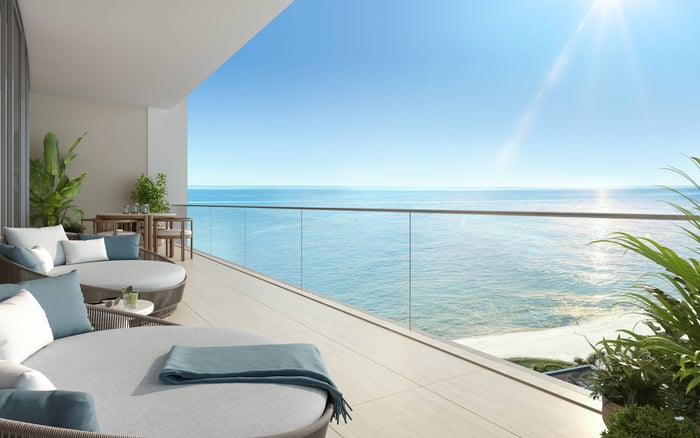
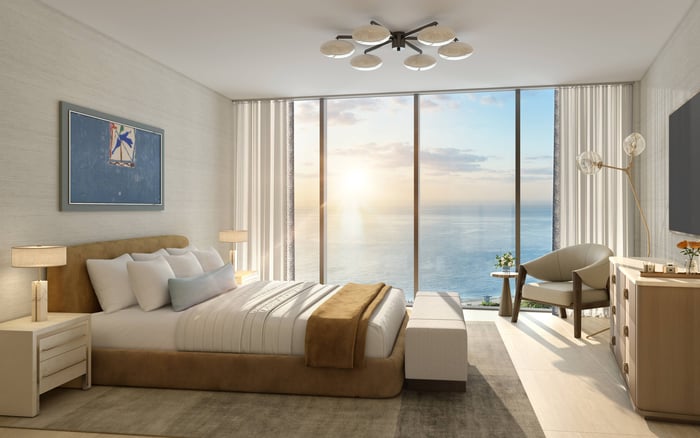
W Pompano Beach pairs a planned owner-exclusive pool deck and club lounge with access to a larger hotel amenity program. The buyer’s test is whether that separation delivers meaningful daily utility at an acceptable total ownership cost.

At W Pompano Beach Hotel & Residences, the most consequential amenity distinction is not another pool. It is the proposed ability to choose between an owner-exclusive setting and a broader hotel environment. For a buyer considering a residence at 20 North Ocean Boulevard in Pompano Beach, that distinction deserves more attention than the length of the amenity list.
The project combines a W Hotel with private residences, offering owners a separate residential amenity collection alongside access to hotel facilities. Its planned 12,000-square-foot owner-exclusive pool deck and Owner’s Club Lounge are central to that proposition. Their potential value lies in making hotel participation a choice rather than the default for every swim or social encounter.
Owner-only access, however, does not guarantee quiet, available seating or uninterrupted service. The purchase decision should turn on what the documents protect, how the spaces will operate and what ownership will cost.
The planned residential pool deck measures 12,000 square feet and is advertised with a dedicated spa, private cabanas and a chef’s grilling station. Those features suggest uses beyond swimming: an afternoon outdoors, a family gathering or an informal meal without relying entirely on hotel venues.
The hotel’s separate WET® Pool Deck is advertised at 60,000 square feet. Its program includes a resort-style pool, Jacuzzi, private cabanas, pickleball courts and padel courts, alongside a WET® Deck bar and grill. The two figures describe deck areas, not swimming-pool water areas. Neither is a direct measure of swimming capacity or personal space.
The smaller deck’s appeal is its owner-exclusive designation-not an assumption that smaller means better. Buyers should examine seating, shade, circulation and cabana allocation when reviewing plans. A large footprint alone cannot establish comfort, and restricted access cannot guarantee a preferred chair.
The Owner’s Club Lounge adds a separate residential gathering space to the planned amenity collection. Its role differs from the pool’s: it offers another setting in which residential life need not revolve around the hotel’s social spaces.
The advertised owner-exclusive program also includes a private resident lobby, fitness center, saunas and steam rooms. Additional residential amenities include a business center, meeting rooms and a Great Room with individual wine storage. Together, these spaces offer the possibility of a residential routine within a hospitality-led property.
For an owner who works intermittently from home or regularly hosts visitors, that separation may have practical appeal. But the lounge’s usefulness depends on details the advertised program does not establish: hours, guest allowances, reservations, staffing and any separate charges. Buyers should also distinguish the Owner’s Club Lounge from the Great Room rather than assume the two share functions or rules.
The hotel amenity program includes AWAY® Spa, FIT® Gym and The Living Room. The advertised residential offerings also include valet parking, housekeeping and in-residence dining. These services broaden the proposition beyond the private pool and lounge, but availability should not be confused with inclusion in recurring ownership charges.
A useful comparison with Four Seasons Hotel & Private Residences Fort Lauderdale begins with questions, not assumptions about equivalent benefits. Which services are available to private-residence owners? Which are separately billed? What booking priority, if any, accompanies ownership? Apply the same questions to each property’s documents.
At W Pompano Beach, buyers should obtain written terms specific to the private residence under consideration. Services marketed to furnished-suite owners should not be assumed to carry identical terms for private-residence owners. The relevant distinction is the ownership category and its contractual rights, not the shared brand name.
The most important diligence concerns the boundary between the residential and hotel programs. Request condominium documents confirming who may use the private deck and lounge, how access is controlled and whether hotel guests are excluded. Clarify owner guest allowances, including the treatment of visiting family and accompanied guests.
Next, investigate reservations and exceptions. Are cabanas separately charged? Can the lounge be reserved for private gatherings? What happens during hotel events or buyouts? Ask whether owner access rights can be suspended, restricted or amended, and under what conditions.
These questions also sharpen a comparison with The Ritz-Carlton Residences® Pompano Beach. The purpose is not to presume matching amenity arrangements, but to compare documented residential privileges rather than treat two luxury amenity descriptions as interchangeable.
The advertised program does not establish operating hours, guest limits, reservation rules, staffing levels or separate usage charges. Those details could materially change how often an owner uses the spaces and how valuable the separation feels.
The residences are marketed as two- to four-bedroom homes of approximately 2,400 to 3,400 square feet, with rooftop pools offered in penthouses. Shared amenities should therefore be evaluated alongside the particular home: its layout, outdoor space and suitability for the buyer’s routine.
For a wider Broward shortlist that includes Waldorf Astoria Residences Pompano Beach, build a consistent cost comparison. Obtain association budgets, reserve information, insurance obligations, hotel-related charges and service fee schedules. Ask how residential and hotel expenses are allocated and which obligations can change.
Separate anticipated use from the appeal of access alone. An owner who expects to use the private deck frequently may assign it greater personal value than someone who prefers the hotel environment. Neither preference establishes a resale premium. No quantified premium attributable specifically to W’s private pool and lounge is established here.
W Pompano Beach’s planned owner-exclusive pool and lounge offer a credible lifestyle distinction: residential separation with the option of broader hotel participation. That is a more meaningful proposition than simply adding another pool to a brochure.
Their value remains conditional on protected access, workable guest policies, appropriate operating arrangements and acceptable costs. Treat the facilities as planned or advertised, not as evidence of completed operations or demonstrated service quality. The strongest purchase case is personal and grounded in the documents: these spaces fit the way an owner intends to live, and the associated rights and obligations are clear.
For a considered comparison of South Florida residences and ownership priorities, explore MILLION.
If branded residences are on your mind — as a home or as an allocation — we would be glad to share what we are seeing, privately.
Begin a quiet conversationThe project is located at 20 North Ocean Boulevard, Pompano Beach, Florida 33062.
The planned owner-exclusive pool deck measures 12,000 square feet. That figure describes the deck, not the swimming-pool water area.
The planned deck includes a dedicated spa, private cabanas and a chef’s grilling station.
The hotel’s advertised 60,000-square-foot WET® Pool Deck is distinct from the smaller owner-exclusive deck.
It is an advertised resident gathering space within the owner-exclusive amenity collection. Its hours, guest policies and reservation terms require confirmation.
The program includes a private resident lobby, fitness center, saunas and steam rooms.
Residential marketing lists valet parking, housekeeping and in-residence dining. Buyers should confirm availability, charges and terms for their specific ownership category.
No. Restricted access does not establish actual noise levels, crowding, seating availability or service quality.
No quantified resale premium attributable specifically to those amenities is established. Their personal value depends on use, access rights and ownership costs.
Review condominium documents, guest restrictions, reservation policies, cabana charges and event-related access rules. Also examine association budgets, reserves, insurance obligations and hotel-related fees.