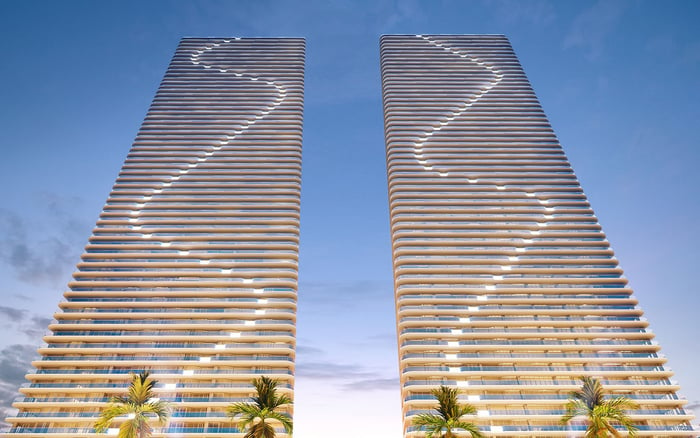
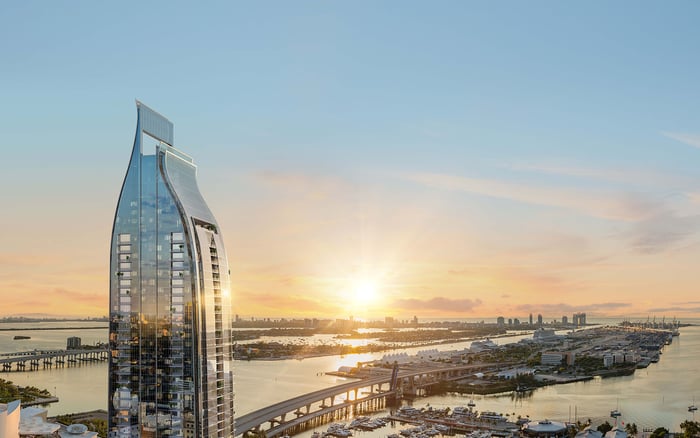
A discreet lifestyle guide to Villa Miami in Edgewater, written for buyers who want hospitality-style service, waterfront living, and a residential atmosphere with less public turnover.

For a certain South Florida buyer, luxury is no longer measured by how much is happening downstairs. The sharper question is how well a residence supports daily life without turning home into a stage. Villa Miami is positioned for precisely that audience: buyers who want hospitality-style service in a setting that still reads as residential first.
That distinction matters. In Miami, hospitality has become a powerful residential language, but not every buyer wants the energy of a hotel-driven property. Some want refined service, culinary access, and convenience, while still expecting the building to feel like home rather than a node of tourism infrastructure. Villa Miami enters that conversation as a waterfront residential tower in Edgewater, with an emphasis on privacy, curated access, and a calmer rhythm.
The result is not anti-hospitality. It is hospitality edited for people who live here, return often, or intend to make Miami part of their permanent pattern. The promise is less about spectacle than intention.
Edgewater has become one of Miami’s most compelling residential waterfront corridors because it sits between the city’s cultural, business, and dining centers while retaining a bayfront residential identity. For buyers who value proximity but do not want to live inside the constant movement of a more public-facing district, that balance is significant.
Villa Miami’s Edgewater setting supports convenience without full exposure. A buyer can remain close to Brickell, the Design District, Wynwood, Miami Beach, and Coconut Grove, then return to a neighborhood anchored by residential towers and waterfront perspective. Water view is not merely a backdrop in this context; it becomes part of the emotional logic of the home.
This is why Villa Miami belongs in the same broader Edgewater conversation as EDITION Edgewater and Aria Reserve Miami. Each reflects a larger moment in which buyers are examining how service, design, access, and privacy function in daily use, not just in marketing language.
The most important idea behind Villa Miami is the separation of hospitality from heavy public traffic. In traditional hotel-driven luxury, the arrival sequence, lobby atmosphere, restaurants, lounges, and programming can generate a steady flow of guests. For some owners, that energy is part of the appeal. For others, it dilutes the feeling of privacy.
Villa Miami is framed for the second buyer. The lifestyle concept centers on high-touch hospitality without the churn associated with transient activity and guest turnover. That makes it especially relevant for full-time and semi-permanent residents who want hotel-caliber convenience integrated into ordinary life, rather than reserved for vacation moments.
This buyer tends to be service-oriented but privacy-sensitive. They want refinement, not performance. They value the ease of curated experiences, but they do not necessarily want to share their daily environment with a constant public audience. In that sense, the project speaks to discretion over spectacle.
South Florida’s luxury market has long been fluent in resort living, from oceanfront icons to branded residences with global recognition. What is changing is the way buyers define the ideal service environment. The most sophisticated purchasers are not automatically choosing the loudest brand or the busiest amenity culture. Increasingly, they are asking whether a building will feel peaceful on a Tuesday morning, not only impressive during a launch event.
Villa Miami reflects this shift toward residential hospitality. The goal is not to replicate a resort, but to bring a curated service sensibility into a private home environment. That is a meaningful distinction for buyers comparing Miami’s waterfront pipeline with established private communities and branded residences across the region.
In Brickell, projects such as Cipriani Residences Brickell show how hospitality names and residential expectations can intersect in an urban setting. Villa Miami’s more privacy-protective positioning offers a different interpretation, one oriented toward access and ease without a constant public atmosphere.
Villa Miami is likely to resonate with buyers who already understand high-service living, but who have become more selective about the social texture surrounding it. These are not buyers chasing novelty. They are often choosing among several versions of luxury and asking which one will age best with their routines.
A full-time Miami resident may appreciate the ability to live with convenience while maintaining separation from public-facing hospitality. A semi-permanent resident may value a home that feels prepared and supported without feeling like a hotel suite. A second-home buyer may find the concept especially efficient, provided the building’s residential atmosphere aligns with how often they plan to be in Miami.
The project also suits buyers who entertain selectively. They may want refined culinary and service experiences available to them, but they do not want their address defined by public programming. For this audience, privacy is not isolation. It is control.
Buyers considering Villa Miami should compare it by lifestyle architecture, not simply by name recognition. The first question is how much public energy they want around their residence. The second is whether service is meant to enhance privacy or create a social scene. The third is how the building’s location supports the buyer’s actual weekly pattern.
This is where neighborhood comparisons become useful. Miami Beach may appeal to those who want ocean proximity and an established leisure identity. Coconut Grove may appeal to buyers seeking a village-like residential atmosphere. Brickell is often preferred by those who want a denser financial and dining core. Edgewater occupies a distinct middle ground: waterfront, central, and increasingly residential in tone.
For buyers tracking new-construction choices, it is also helpful to distinguish between brand theater and operational comfort. A famous name can be valuable, but day-to-day living depends on circulation, privacy, service culture, and the way residents and guests move through the property. Villa Miami’s appeal rests on the idea that hospitality can be present without overwhelming the residential experience.
In the ultra-premium market, privacy is not a single feature. It is a cumulative feeling shaped by arrival, staff culture, resident mix, amenity use, and the absence of unnecessary friction. Villa Miami’s positioning emphasizes this cumulative privacy by pairing service and convenience with a quieter residential atmosphere.
That is why the project is best understood as an intentional alternative to developments where guest turnover and public programming are central to the experience. The buyer is not rejecting energy entirely. They are choosing where energy belongs. Miami can provide nightlife, restaurants, culture, and social access outside the front door. Home can remain composed.
This matters for families, executives, collectors, seasonal residents, and anyone whose life already contains enough visibility. For them, luxury is the ability to withdraw gracefully, with the right level of support waiting in the background.
Villa Miami’s strongest message is not that hospitality should disappear from residential living. It is that hospitality should be calibrated. The project presents a model for buyers who want service, culinary refinement, waterfront setting, and central Miami access, while avoiding the heavier public traffic that can accompany hotel-led luxury.
That makes it especially relevant in a market where buyers are learning to look beyond surface-level branding. The more meaningful question is whether the building’s lifestyle philosophy matches the way the owner wants to live. Villa Miami answers that question for a buyer who wants refinement without exposure, convenience without churn, and a home that remains a home.
What is the core appeal of Villa Miami? Villa Miami is positioned for buyers who want hospitality-style service in a residential setting that still feels private and composed.
Where is Villa Miami located? Villa Miami is presented as a waterfront residential tower in Miami’s Edgewater neighborhood.
Who is the ideal buyer for Villa Miami? The ideal buyer is privacy-sensitive, service-oriented, and drawn to discretion rather than spectacle.
Is Villa Miami intended to feel like a hotel? Its positioning emphasizes hospitality-level convenience while preserving the atmosphere of a home rather than a public-facing hotel environment.
Why does reduced public traffic matter to luxury buyers? Less public movement can support a calmer daily rhythm, stronger privacy, and a more stable residential atmosphere.
How does Edgewater support this lifestyle? Edgewater offers waterfront living near major Miami districts while maintaining a residential character suited to quieter daily use.
Is Villa Miami relevant for full-time residents? Yes, the concept is especially relevant for full-time and semi-permanent residents who want service integrated into daily life.
Can Villa Miami work as a second home? Yes, it may appeal to second-home buyers who want convenience and privacy without a heavily transient hotel atmosphere.
How should buyers compare Villa Miami with branded residences? Buyers should look beyond branding and focus on privacy, service culture, guest flow, and how the property feels day to day.
Is Villa Miami part of a broader South Florida trend? Yes, it reflects the shift toward residential hospitality, where service is curated for owners rather than driven by resort tourism.
For a confidential assessment and a building-by-building shortlist, connect with MILLION.
If branded residences are on your mind — as a home or as an allocation — we would be glad to share what we are seeing, privately.
Begin a quiet conversation