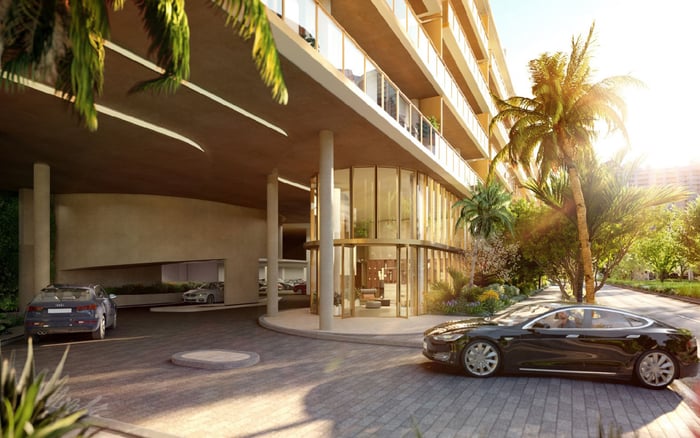
A buyer-focused guide to evaluating valet parking dimensions, circulation, clearances, and vehicle handling in newer South Florida luxury condominiums.
In South Florida’s newest luxury condominiums, valet parking is not a back-of-house detail. For many buyers, it is the first daily contact with the building: a quiet choreography of arrival, security, privacy, and vehicle care. The question is not simply how many spaces are included. It is whether the parking environment can comfortably accommodate the vehicles residents actually own.
For collectors, high-performance drivers, family-office users, and seasonal residents, valet parking space dimensions are part of the value proposition. A wide SUV, a low-slung coupe, a long-wheelbase sedan, an EV with specific charging needs, or a weekend collectible can all expose weaknesses in a garage that appears elegant on paper. The striped stall is only one component. The real test is the full path: porte cochère, staging area, ramp transition, aisle width, turning movement, clear height, stall access, and the way staff handles peak arrivals.
That is why buyers evaluating newer towers in Brickell, Miami Beach, Sunny Isles, Fort Lauderdale, and other prime corridors should treat parking diligence with the same seriousness as views, ceiling heights, elevator privacy, and amenity programming.
A parking space can look adequate in isolation yet feel tight in operation. The practical dimension is the maneuver required to enter and exit it without excessive corrections, curb rash, door anxiety, or reliance on perfect conditions. Luxury vehicles often have broader bodies, longer doors, lower front splitters, larger turning circles, or specialized finishes that make ordinary contact points unacceptable.
Buyers should ask to see garage plans and, where possible, experience the arrival sequence in person. Pay attention to the approach from the street, the slope into the garage, the angle of the first turn, and the distance between structural columns. A column beside a stall can be harmless for a compact car and problematic for a grand touring coupe. A tight ramp can be acceptable for a daily SUV and uncomfortable for a low-clearance sports car.
In a valet-served building, the resident may not personally park every time, but the vehicle still moves through the same physical envelope. The sharper question is this: can a trained valet consistently move a luxury vehicle through the garage without improvisation?
New-construction marketing often emphasizes lifestyle, service, wellness, and design. Parking may be reduced to a short line, even when it has major implications for daily life. Buyers should request the exact parking plan available for review, including stall locations where assigned parking is part of the offering, access paths, ramp geometry, EV-ready areas, and any private or reserved parking accommodations.
In dense urban settings such as 888 Brickell by Dolce & Gabbana, parking design intersects with arrival theater. The front door experience must support privacy, traffic flow, and fast transfers from vehicle to lobby. In coastal buildings, the garage conversation often adds another layer: how salt air, security, and seasonal usage patterns affect where a vehicle sits and how it is handled.
A discerning buyer should not assume that a new tower automatically means a more generous garage. Newer design can be more sophisticated, but it may also be more space-efficient. The difference lies in execution.
A full-size SUV needs different scrutiny than a collectible Ferrari, a Rolls-Royce, a Bentley coupe, or a low electric performance sedan. For SUVs, the buyer should focus on clear height, ramp slope, mirror clearance, and turning space. For sports cars, the critical points are approach angles, ramp transitions, wheel stops, and the ability to avoid front-end contact. For long sedans, aisle movement and the angle into a stall matter. For EVs, the conversation expands to charging access, cord reach, stall adjacency, and how valet staff rotates vehicles when charging is shared.
This is especially relevant in buildings that appeal to automotive-minded buyers, including Bentley Residences Sunny Isles, where the vehicle experience is naturally part of the ownership conversation. Even when a building’s brand language celebrates design and performance, the buyer should still verify the physical conditions that affect the car each day.
The most useful exercise is simple: bring the actual vehicle, or a comparable model, during due diligence if access is available. If not, ask the sales team or building representative specific questions about similar vehicles already accommodated.
South Florida is not one parking market. Brickell towers often balance urban density with polished arrival courts and high-volume valet movement. Miami Beach properties may place more emphasis on discretion, oceanfront access, and the transition between resort service and residential privacy. Sunny Isles often attracts buyers with larger vehicles, multiple cars, and a stronger emphasis on waterfront convenience. Fort-lauderdale can bring a yachting lifestyle into the parking equation, where residents may move between garage, marina, beach, and airport with different rhythms.
At The Perigon Miami Beach, the broader buyer expectation is one of composure and seamless service. In Fort Lauderdale, St. Regis® Residences Bahia Mar Fort Lauderdale sits within a lifestyle context where arrival, waterfront access, and vehicle handling all become part of the daily residential sequence.
These differences matter because dimensions are experienced through use. A seasonal owner arriving from the airport with luggage, family, and staff needs a different valet performance standard than a weekday commuter. A collector who leaves a vehicle for months needs confidence in storage, movement, and access protocol.
Before removing contingencies or finalizing a purchase, buyers should ask practical, written questions. Are parking spaces assigned, deeded, licensed, or valet-managed only? Are any spaces suitable for oversized vehicles? Are there limitations on height, weight, length, charging, covers, trickle chargers, or long-term storage? How are exotic or low-clearance vehicles handled? Can residents request that certain vehicles not be stacked, moved frequently, or placed in exposed locations?
The buyer should also understand the operating rules. A garage that works beautifully at midday may feel different during dinner hours, holiday weekends, storms, building events, or peak season. Valet staffing, staging capacity, and retrieval protocol can matter as much as the dimensions themselves.
For ultra-luxury ownership, parking is not an afterthought. It is a private utility, a service layer, and sometimes a collection-management issue. The best buildings make this feel effortless. The best buyers verify why it feels effortless before they buy.
Should buyers ask for exact valet parking space dimensions? Yes. Buyers should request the available garage or parking plans and confirm how the specific vehicle will move through the building.
Is a valet garage always easier for luxury vehicles? Not always. Valet service helps when staff and circulation are strong, but physical clearance and maneuvering space still control the experience.
What matters besides the width of a parking space? Ramp slope, aisle movement, column placement, turning radius, clear height, staging room, and valet operating procedure all matter.
Are low sports cars more difficult to accommodate? They can be. Approach angles, ramp transitions, wheel stops, and front splitter clearance should be reviewed carefully.
Should SUV owners focus on height clearance? Yes. Roof rails, cargo boxes, lifted suspensions, and large mirrors can make clear height and aisle width especially important.
Do EVs require different parking diligence? Yes. Buyers should confirm charging access, cord reach, assigned charging rights, and valet procedures for charging rotation.
Can a buyer test the garage before closing? Sometimes. If access is available, a real-world vehicle test is one of the most useful ways to evaluate comfort and clearance.
Are assigned spaces better than valet-only parking? It depends on the building and the vehicle. Assigned spaces add predictability, while strong valet operations can add convenience.
Should collectors ask about long-term vehicle storage? Yes. Storage protocol, movement frequency, security, battery maintenance, and environmental exposure should be understood in advance.
When should parking questions be raised in the purchase process? Early. The best time to clarify dimensions, rules, and accommodations is before deadlines, selections, or closing commitments.
For a discreet conversation and a curated building-by-building shortlist, connect with MILLION.
If branded residences are on your mind — as a home or as an allocation — we would be glad to share what we are seeing, privately.
Begin a quiet conversation