A buyer-focused comparison of practical view protection at Casa Bella and One Thousand Museum, including exposure, elevation, surrounding land uses, and legal diligence.
In Downtown Miami, a dramatic outlook can be central to both daily experience and long-term value. Yet “panoramic,” “unobstructed,” and similar marketing language should not be mistaken for an enforceable right to preserve a view. The more useful question is whether elevation, distance, public infrastructure, water, parks, or institutional land uses protect that view in practice.
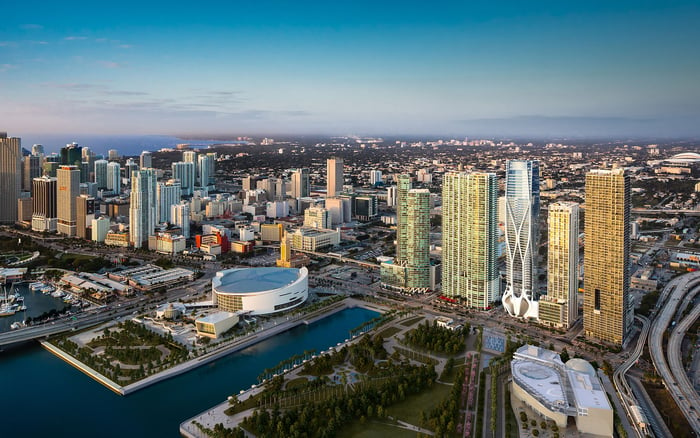
That distinction is especially relevant when comparing Casa Bella by B&B Italia Downtown Miami with One Thousand Museum Downtown Miami. Both towers look toward Biscayne Bay from prominent Biscayne Boulevard settings, but their foregrounds are materially different. One Thousand Museum faces a broad civic landscape of parkland, museums, boulevard, and waterfront. Casa Bella faces Biscayne Boulevard and the Adrienne Arsht Center complex, with less separation than its neighbor farther south but more breathing room than an ordinary private parcel might provide.
The durability of a view depends on what occupies the foreground and who controls it.
Casa Bella is under construction on a 2.69-acre site along Biscayne Boulevard between Northeast 14th and 15th streets, immediately south of the elevated Metromover tracks near Adrienne Arsht Station. Its address appears as both 1400 Biscayne Boulevard and 1444 Biscayne Boulevard. Its story count likewise varies between 55, 56, and 57. Buyers should let the latest approved plans and transaction documents control.
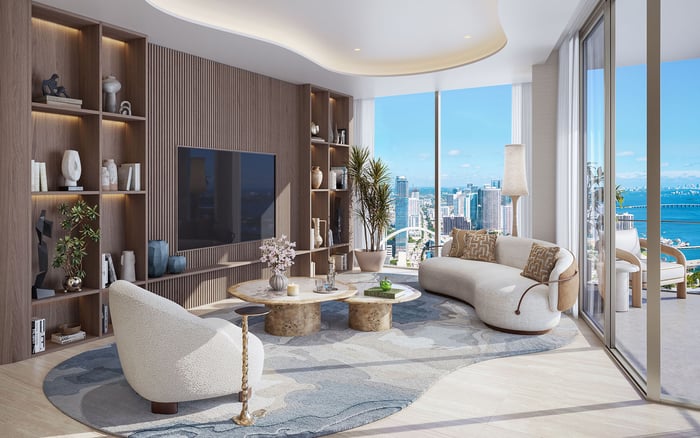
The tower’s eastern side benefits from Biscayne Boulevard and the cultural complex across it, rather than an immediately adjoining private development parcel. For higher east-facing residences, the combination of elevation, road width, and institutional frontage should create the building’s most durable bay-oriented outlooks in practical terms.
That does not make the panorama immutable. Roads and cultural uses reduce immediate obstruction risk, but they do not constitute a blanket legal promise that every sightline will remain unchanged. The exact floor and the residence’s relationship to nearby rooflines and balcony orientation still matter.
Casa Bella’s west-facing and lower-level city views warrant more conservative underwriting. Underbuilt urban parcels behind a tower generally lack the spatial buffer created by water, a park, or a broad institutional campus. In a high-density corridor, future infill can alter depth, light, skyline composition, and privacy without erasing a view completely.
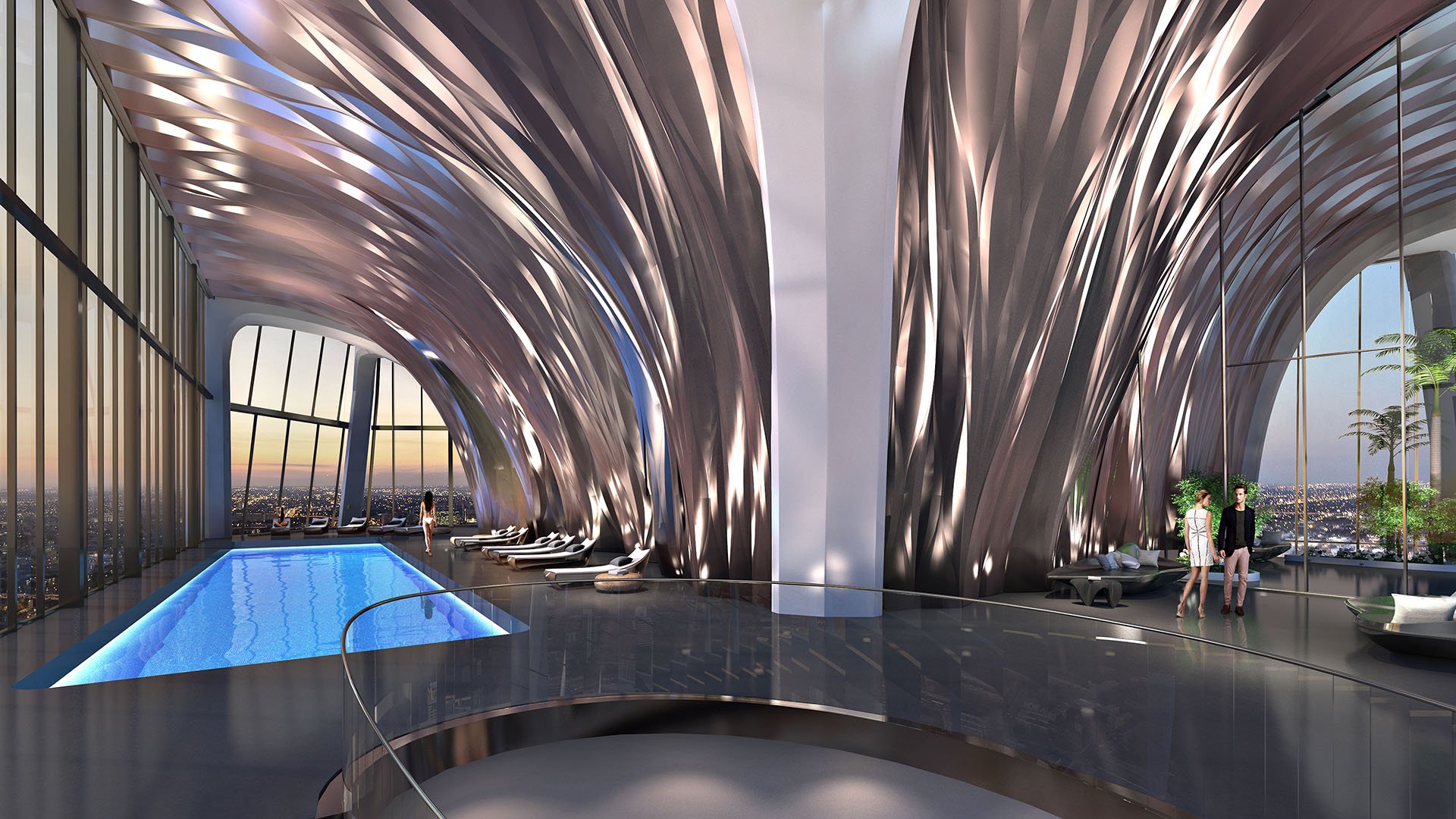
The 12th-floor pool terrace illustrates why amenity views should be evaluated separately from those of upper residences. Terrace sightlines at this elevation are inherently more sensitive to nearby construction than the outlook from the tower’s rooftop pool, terrace, and private observatory, approximately 650 feet above ground.
Balcony geometry also shapes the experience. A pass-through layout may offer city, bay, and ocean outlooks, but each direction carries its own risk profile. Investment analysis should therefore assign value to the precise exposure rather than treat every residence in the tower as equivalent.
One Thousand Museum occupies 1000 Biscayne Boulevard opposite Maurice A. Ferré Park, the Pérez Art Museum Miami, the Frost Museum of Science, and Biscayne Bay. Together, these elements establish a substantial open and institutional foreground on the tower’s principal bay side.
Its east-facing residences consequently have the strongest practical view-security profile in this comparison. The foreground is broader than at Casa Bella and provides several layers of separation before the bay. This matters because it reduces, in practice, the risk of a conventional private tower rising directly in front of the residence.
Still, “reduced” is not “eliminated.” A park, road, museum, or waterfront setting is not, by itself, a recorded view easement. North-, south-, and west-facing outlooks remain more exposed to an evolving urban skyline, and parcel-specific predictions on those sides are not warranted.
Future construction affects more than the horizon. A neighboring building can influence lateral views, morning or afternoon light, perceived openness, privacy, construction noise, and the visual character of an amenity deck. A partial obstruction can be commercially relevant even when the principal bay view remains visible.
For Casa Bella, the eastern foreground is comparatively favorable, while the western urban condition calls for closer parcel review. The corridor’s broader development pattern also matters. High-density zoning farther north at 3601 Biscayne Boulevard illustrates the continuing potential for high-rise infill along Biscayne Boulevard, but the site is several miles north and does not pose an adjacent threat to Casa Bella.
For One Thousand Museum, the eastern civic and waterfront setting is the primary strength. Buyers considering other orientations should avoid broad assumptions and focus on the specific neighboring lots visible from the residence.
The first step is to identify the precise floor, compass exposure, balcony direction, and position within the floor plate. The second is to compare that sightline with existing rooflines and nearby parcels. A high floor can clear a current building while remaining vulnerable to a taller future structure; a lower east-facing residence may retain attractive openness because of a road or park.
The same discipline applies when comparing other central Miami choices, including Waldorf Astoria Residences Downtown Miami and Aston Martin Residences Downtown Miami. Building reputation and architecture may shape desirability, but view risk remains specific to a home’s elevation, orientation, and foreground.
Buyers should ask counsel to examine the condominium declaration, survey, title materials, recorded easements, and current municipal development filings. They should also reconcile Casa Bella’s differing address and story count with the governing documents. No generalized promise of panoramic views should replace this review.
For the most defensible bay-facing outlook, One Thousand Museum holds the stronger practical position because its eastern view crosses a broader park, museum, boulevard, and waterfront foreground. At Casa Bella, higher east-facing residences appear best positioned, benefiting from elevation, Biscayne Boulevard, and the Arsht Center complex.
The trade-off becomes more nuanced on other sides and at lower elevations. Casa Bella’s west-facing city views and 12th-floor pool terrace warrant greater caution, while One Thousand Museum’s north, south, and west exposures should be assessed without presuming permanent protection. In both buildings, the premium belongs not merely to a view today, but to a well-understood relationship between the residence and the land before it.
For discreet guidance on evaluating a specific residence, its exposure, and its surrounding parcels, connect with MILLION.
If branded residences are on your mind — as a home or as an allocation — we would be glad to share what we are seeing, privately.
Begin a quiet conversationThe article does not establish recorded view rights. Buyers should have counsel examine governing documents, surveys, title materials, and easements.
Higher east-facing residences appear strongest in practice because elevation, Biscayne Boulevard, and the Arsht Center complex provide meaningful separation.
The western side faces an evolving urban condition where underbuilt parcels do not offer the same buffer as a boulevard, park, or waterfront.
Yes. The pool terrace is reported on the 12th floor, making its outlook more sensitive to nearby development than upper-level amenities and residences.
Its east side faces Maurice A. Ferré Park, major museums, Biscayne Boulevard, and Biscayne Bay, creating a broad open and institutional foreground.
No. The setting reduces obstruction risk in practice, but it should not be treated as an absolute legal guarantee for every residence.
North-, south-, and west-facing residences merit closer analysis because they are more exposed to Miami’s changing urban skyline.
Buyers should prioritize exact floor, compass exposure, balcony orientation, nearby rooflines, and the development status of visible neighboring parcels.
Yes. It can affect lateral views, light, privacy, perceived openness, and the visual character of an amenity deck.
Counsel should review the condominium declaration, survey, title materials, recorded easements, transaction documents, and current municipal development filings.