A buyer-focused examination of storm-resilience due diligence at two branded waterfront developments, distinguishing tower height from equipment elevation and emergency power from everyday comfort.
For a waterfront buyer, resilience belongs alongside architecture, privacy, and service in the purchase conversation. At St. Regis® Residences Bahia Mar Fort Lauderdale and The Ritz-Carlton Residences® Pompano Beach, the central question is not simply how high the towers rise. It is which systems are protected, which services remain available during an interruption, and what documentation supports those expectations.
Tower height is not a substitute for equipment elevation. Nor does a private elevator establish emergency-power coverage. A discerning comparison separates the residence’s everyday experience from its intended operation during a storm-and the conditions governing its return to normal afterward.
The facts established here do not support ranking either development above the other for resilience. Equipment elevations, emergency-power loads, fuel autonomy, and in-residence backup coverage require project-specific confirmation. That does not mean either property lacks these features.
St. Regis® Residences Bahia Mar Fort Lauderdale is described as a three-tower community within the broader Bahia Mar resort-and-residences development. Separately, two residential towers are described as having 80 residences each, 23 stories, and a height of 278 feet. Those figures should not automatically be applied to all three towers.
For buyers, that distinction makes tower-specific documentation essential. Ask which building a mechanical schedule, electrical drawing, or operating commitment covers. A development-wide description does not confirm an individual tower’s systems.
The residences are also described as having their own elevators and entry foyers. That is a meaningful privacy feature, but it leaves a separate operational question: what elevator service, if any, is intended during a utility outage? Request written clarification of which elevators are connected to backup power, any operating restrictions, and whether service to the residence depends on additional systems. Do not infer uninterrupted access from the amenity description.
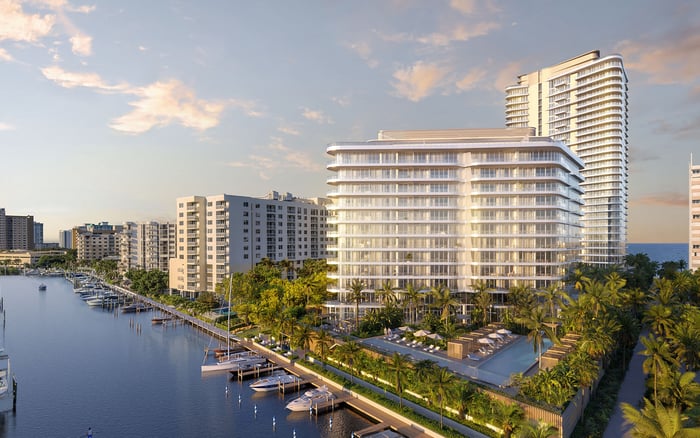
The Ritz-Carlton Residences® Pompano Beach occupies a barrier-island location between the Atlantic Ocean and the Intracoastal Waterway, at 1380-1381 South Ocean Boulevard. That setting makes flood-elevation and building-access questions especially relevant to a purchase review, without establishing any particular level of protection.
As of September 2023, the approved building height was described as 353 feet, with its highest points reaching 361 feet above mean sea level. These are different measurements; neither identifies the elevation of critical mechanical equipment. Likewise, the Yacht Tower’s stated program of 84 residences and four penthouses, with marina and Yacht Club views, describes its residential offering-not its backup-power capability.
Timing deserves equal precision. As of October 18, 2025, completion was projected for sometime in 2026. That remains a dated forecast, not confirmation of completion. Buyers should request current delivery information and distinguish planned system specifications from evidence of installation and testing.
A useful engineering review keeps four concepts separate: overall building height, elevation above mean sea level, the applicable flood elevation, and the elevation of individual pieces of equipment. A number is useful only when the buyer understands what it measures and its reference point.
Ask for drawings that identify the relevant flood criterion and locate critical equipment against it using a clearly identified elevation reference. Request specific locations for electrical distribution equipment, generators, fuel-system components, pumps, and other systems the design team identifies as essential. These are diligence requests, not descriptions of either featured property’s installed design.
Then ask how those systems connect. Rather than accepting an isolated statement that a generator or mechanical room is elevated, request an explanation of the supporting equipment and distribution path. The objective is to understand the complete arrangement, not merely its most reassuring component.
An emergency-power discussion should begin with a written schedule of supported loads, not an assumption of whole-residence service. Ask the project team to distinguish safety functions, common-area operations, vertical transportation, and any service within individual residences.
For the residence itself, request explicit answers about air conditioning, refrigeration, lighting, receptacles, communications, and water service. Treat each as an open question until documented. For elevators, ask which cars are included and under what operating conditions. The answer should describe intended service, not simply confirm the presence of a generator.
Fuel autonomy also needs context. Request the stated operating duration, the load assumptions behind it, the fuel arrangement, and the replenishment plan. Do not assign either featured property a runtime or coverage level without supporting specifications.
The same review is appropriate if a shortlist extends to Four Seasons Hotel & Private Residences Fort Lauderdale. This is a recommendation for consistent diligence, not a claim about that property’s systems or comparative performance.
Build the purchase review around a concise written package: relevant elevation drawings, critical-equipment locations, the emergency-power load schedule, runtime assumptions, and proposed operating procedures. Ask that each item identify the tower, its revision date, and whether it describes a planned or completed condition.
Next, have an independent qualified professional review the technical material and counsel clarify which representations form part of the transaction documents. Request available testing and commissioning records appropriate to the project’s stage. Keep promised capabilities distinct from demonstrated operation.
Finally, ask management to explain storm procedures, access restrictions, resident communications, and the process for restoring services. A backup-power specification is not permission to remain during an evacuation or a promise of unrestricted occupancy. The goal is a documented understanding of what the building is designed to do, what remains conditional, and how those capabilities align with the way you intend to live.
For a discreet discussion of your South Florida residence shortlist, connect with MILLION.
If branded residences are on your mind — as a home or as an allocation — we would be glad to share what we are seeing, privately.
Begin a quiet conversationThe established facts do not support a ranking. A meaningful comparison requires project-specific equipment elevations, backup-power specifications, and operating information.
Tower height does not identify critical-equipment elevation. Buyers should request drawings showing equipment locations relative to the applicable flood criterion.
The community is described as having three towers. The figures of 80 residences each, 23 stories, and 278 feet apply to two residential towers and should not automatically be extended to the third.
No. Private elevators and entry foyers describe residential amenities, not confirmed elevator operation during a utility outage.
The development occupies a barrier-island site between the Atlantic Ocean and the Intracoastal Waterway, at 1380–1381 South Ocean Boulevard in Pompano Beach.
The September 2023 figures describe a 353-foot approved building height and highest points reaching 361 feet above mean sea level. Neither figure establishes critical-equipment elevation.
As of October 18, 2025, completion was projected for sometime in 2026. That forecast does not confirm completion, so buyers should request current delivery information.
Request elevation drawings, critical-equipment locations, emergency-power load schedules, runtime assumptions, and operating procedures. Each document should identify the tower, revision date, and whether it describes a planned or completed condition.
Request written confirmation of any supported air conditioning, refrigeration, lighting, receptacles, communications, and water service. Do not infer whole-residence coverage from the presence of a generator.
Ask for the operating duration together with its load assumptions, fuel arrangement, and replenishment plan. No specific runtime is established here for either featured development.