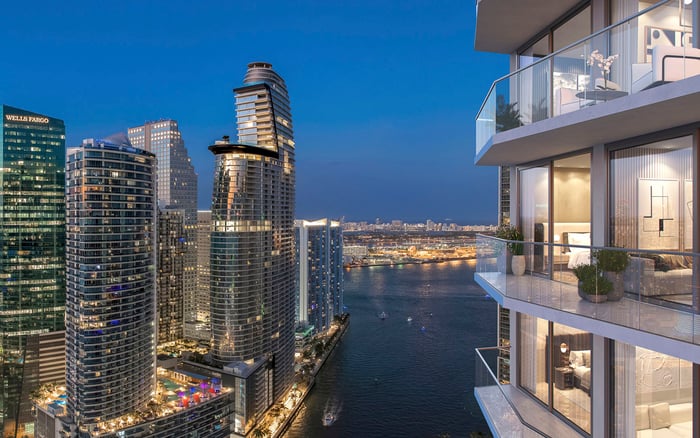
At One Thousand Museum, an asset-qualified mortgage and a securities-backed credit line create different paths to closing. The distinction affects collateral, funding readiness, mortgage documents and costs, while leaving unit-specific title diligence essential.

At One Thousand Museum Downtown Miami, architectural distinction and financial planning meet in the purchase decision. Designed by Zaha Hadid Architects, the condominium at 1000 Biscayne Boulevard contains 84 residences and was completed in the third quarter of 2019. For a buyer with substantial invested wealth, the question is not simply whether to borrow, but which assets should support that borrowing.
Half- and full-floor residences have been advertised from $6.75 million. That is an advertised starting point, not a current availability quote. A closing plan should begin with the specific residence, negotiated price and proposed funding structure-not a marketing threshold.
The essential distinction is straightforward: qualifying for a mortgage using investment assets is not the same as borrowing directly against those investments. Both approaches can connect portfolio wealth to a property purchase, but their collateral, documentation and funding sequences differ.
“Portfolio loan” is too imprecise for a closing conversation. Ask the lender to identify the product, its collateral and its underwriting requirements in writing.
In an asset-depletion mortgage structure, assets help establish qualification. These programs can still apply asset-coverage and debt-to-income requirements. Substantial wealth alone therefore does not establish approval. When the purchase is mortgage-financed, the borrower signs a promissory note and a mortgage that creates a lien against the condominium.
A securities-backed line of credit, or SBLOC, instead uses eligible stocks, bonds and other assets in a nonretirement investment portfolio as collateral. It can fund a home purchase without first selling the pledged investments. The borrowing obligation is distinct from a mortgage secured by the residence.
This distinction also matters when comparing One Thousand Museum with Aston Martin Residences Downtown Miami. A property shortlist is not a financing approval. For either purchase, ask what the lender has approved, what remains conditional and whether the proposed debt will encumber the real estate.
An SBLOC’s borrowing limit depends on the lender’s advance rate and eligible collateral-not simply the investment account’s total value. A statement showing enough wealth to cover the purchase does not establish that the same amount can be drawn.
Before committing to a funding timetable, request confirmation of the eligible assets, approved borrowing capacity and amount accessible for the transaction. Ask the lender to distinguish an indicative calculation from an established line whose draw conditions have been satisfied. The closing team needs a usable funding amount, not an estimate based on gross portfolio value.
Opening the facility may require completed paperwork and the transfer of eligible securities into a dedicated account. A two- to three-week approval process is one example, not a universal service standard. Nor does approval guarantee a particular approval-to-wire timetable.
Build the purchase calendar around confirmed readiness. Ask who must complete each remaining step and when funds can reach the closing agent. A newly submitted application should never be treated as immediately available closing cash.
With a property-secured mortgage, the promissory note and mortgage form part of the borrower’s loan package. The mortgage creates the lien against the residence. These documents are mortgage-specific, not universal requirements for every condominium purchase.
Using an SBLOC to fund the purchase does not automatically create a mortgage lien on the condominium. Nor does it make the buyer debt-free: the securities-backed borrowing remains an obligation, even when no purchase mortgage is placed on the residence.
The property-transfer work remains. Florida’s closing process includes recording the deed in county records and addressing the seller’s existing mortgages and liens. Neither the source of the buyer’s liquidity nor the absence of a new purchase mortgage substitutes for that work.
For a search extending into Brickell, including Una Residences Brickell, apply the same discipline: separate financing documents from title-transfer documents. Do not assume that one residence’s proposed structure or lender response carries over to another.
Request separate closing estimates for the structures under consideration. Florida closing-cost categories include mortgage-related taxes and recording charges, title-insurance premiums and transfer-tax treatment specific to Miami-Dade. Their applicability depends on the transaction.
An SBLOC-funded acquisition without a purchase mortgage should not automatically carry the same mortgage-related charges as a mortgage-financed acquisition. Conversely, avoiding a purchase mortgage does not eliminate title-related costs or every recording and transfer charge.
Ask the closing agent to distinguish costs arising from the property transfer from those arising from a mortgage on the property. Separately, obtain the securities lender’s proposed borrowing terms and charges. Compare the complete funding arrangements, not closing estimates in isolation.
One Thousand Museum’s historical developer financing should be kept separate from an individual buyer’s loan. In May 2019, the developer sought a $331 million condominium inventory loan as construction approached completion. In March 2021, a $90 million inventory loan resolved foreclosure proceedings and allowed the developer to retain the remaining 15 units pending sales. That loan was reportedly paid off in December 2021 following Miami Art Week sales.
That chronology neither establishes a current lien on a particular residence nor proves that its title is clear. What matters is the title position of the unit being acquired and the treatment of any outstanding encumbrances in that transaction.
Title insurance addresses covered ownership-history defects, including certain unreleased mortgages, recording errors, defective deeds and liens. Have counsel and the title team explain the coverage and any exceptions applicable to the residence. Historical building-level financing is no substitute for unit-specific review.
An SBLOC can bridge a purchase until another source of liquidity becomes available. Before choosing that route, identify the intended repayment source and ask the lender what obligations apply if the timing changes. Preserving investments at acquisition is a funding choice, not a complete repayment strategy.
For an asset-qualified mortgage, focus on confirmed qualification, outstanding conditions and the property-secured documents. For an SBLOC, focus on eligible collateral, accessible capacity and draw readiness. In both cases, ensure the lender, financial adviser, counsel and closing agent are working from the same transaction details.
The objective is a closing in which the residence, the debt and the portfolio each have a clearly understood role.
For a discreet conversation about your Downtown Miami purchase, connect with MILLION.
If branded residences are on your mind — as a home or as an allocation — we would be glad to share what we are seeing, privately.
Begin a quiet conversationOne Thousand Museum is at 1000 Biscayne Boulevard in downtown Miami. The Zaha Hadid Architects-designed condominium contains 84 residences.
No. It is an advertised starting price for half- and full-floor residences, not a verified quote for current availability.
No. Asset-depletion mortgage qualification uses assets within mortgage underwriting, while an SBLOC borrows directly against eligible investment collateral.
No. Asset-depletion mortgage programs can apply asset-coverage and debt-to-income requirements, so wealth alone does not establish approval.
Yes. An SBLOC can provide home-purchase funds against eligible investments without first liquidating the pledged assets.
Not necessarily. Available borrowing depends on eligible collateral and the lender’s advance rate, rather than simply matching the account’s total value.
One program describes a two- to three-week approval process, but that is not a universal timeline. Paperwork, collateral transfers and draw conditions can affect funding readiness.
No. An SBLOC is secured by eligible investment assets and does not automatically create a mortgage lien on the purchased residence.
No. A purchase without a new mortgage may avoid applicable mortgage-specific charges, but title-related costs and other recording or transfer charges still require transaction-specific review.
No. Historical developer financing does not establish whether a particular residence currently has a lien or clear title; unit-specific title review remains necessary.