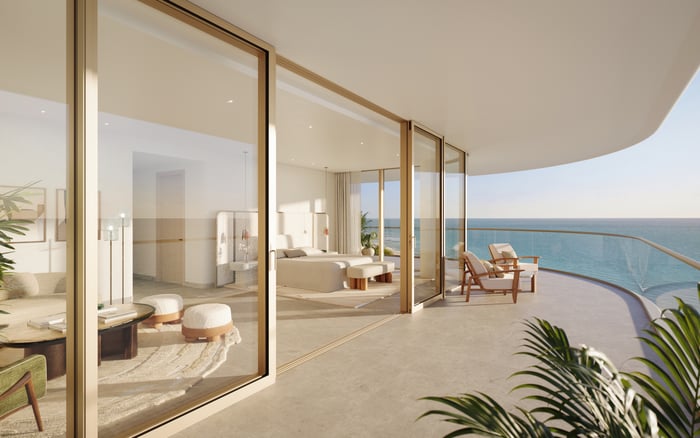
A buyer-focused examination of what is publicly described, what remains undisclosed, and which documents matter when assessing resilience at two prominent South Florida oceanfront developments.

For a South Florida luxury buyer, storm resilience is not a single specification. It is the interplay among the building envelope, structural design, drainage, utility placement, emergency power, access, and the procedures for restoring service after an event. Impact glazing may protect openings, but it does not indicate whether switchgear, pumps, elevator controls, or cooling equipment will remain operable if lower areas are exposed to water.
That distinction is especially relevant when considering Shore Club Private Collections Miami Beach and The Ritz-Carlton Residences® Pompano Beach. Both offer compelling coastal settings and extensive hospitality-oriented programs. Yet the available information for each does not provide the detailed engineering record required to compare mechanical elevation or emergency-power coverage conclusively.
True storm readiness depends on which essential systems remain protected and operational.
The sophisticated approach is neither to assume resilience nor to dismiss it. Buyers should distinguish confirmed features from unresolved technical questions, then request building-specific documents before reaching a judgment.
Shore Club is an oceanfront development at 1901 Collins Avenue in Miami Beach with 49 private residences. Witkoff is developing the property with Auberge Resorts Collection branding and hospitality services. Its residential composition spans a new tower, the restored Cromwell House, and a standalone Beach House, alongside a hotel component and separate residential access.
The lifestyle proposition centers on private beach access, pools, wellness facilities, and Auberge-managed service. Floor-to-ceiling impact-resistant glass is described along the exterior walls. Most residences are also described as having direct-entry elevators and dedicated service entries.
Those details are meaningful, but they address different questions. Impact-resistant glass relates to the exterior envelope. A direct-entry elevator relates primarily to privacy and circulation. Neither establishes the elevation of elevator machinery, electrical controls, generators, pumps, or cooling systems.
Measured elevations for switchgear, water pumps, generators, cooling equipment, and other essential machinery have not been publicly specified. Nor is there a published generator load schedule identifying whether emergency power serves residential elevators, water service, HVAC, access control, garage functions, or private residences. Buyers drawn to nearby The Perigon Miami Beach can apply the same discipline: compare architecture and service, then independently verify the infrastructure behind them.
The Ritz-Carlton Residences® Pompano Beach is located at 1380 S Ocean Boulevard and is developed by Fortune International Group, Oak Capital, and Fairwinds. Its 205 residences are divided between a 117-residence Beach Tower on the Atlantic and an 88-residence Marina Tower on the Intracoastal Waterway.
The dual-waterfront concept combines beachfront access with a private marina. Its amenity program includes a private beach club, resort-style pools, spa and fitness facilities, resident lounges, recreational spaces, and marina access. Impact windows and smart-home pre-wiring are also described.
Here again, lifestyle and envelope descriptions do not constitute a complete account of storm-hardened utility placement. Measured elevations for generators, electrical switchgear, water pumps, HVAC equipment, and other critical machinery have not been publicly stated. Nor is there a defined emergency-power load schedule for elevators, garage systems, water service, HVAC, access control, or individual residences.
This project-specific standard matters throughout Pompano Beach. A buyer considering W Pompano Beach Hotel & Residences should request that development’s own plans and schedules rather than use another property as a proxy.
“Elevated mechanicals” may sound reassuring, but the phrase requires precision. A buyer should ask which systems are elevated, their measured elevations, the datum used, and how those positions relate to the project’s governing flood criteria. The inquiry should encompass electrical service and distribution equipment, generator components, domestic-water and fire pumps, elevator machinery and controls, cooling systems, communications equipment, and access-control infrastructure.
Useful substantiation includes approved plans, equipment schedules, sections showing vertical placement, elevation records, impact-glass specifications, and relevant inspection documentation. The objective is not merely to confirm that one mechanical room sits above a lower level. It is to determine whether the chain of systems required for safe access and basic habitability has been considered as a whole.
Specifications from another branded development cannot establish conditions in Pompano Beach. Shared branding does not make engineering specifications transferable between sites.
A permanent generator, if confirmed, is only the beginning of the analysis. Capacity must be evaluated against the loads assigned to it. Buyers should request the emergency-power load schedule, anticipated runtime, fuel type and storage arrangement, transfer-equipment information, testing protocol, and restoration priorities.
The practical questions are direct. Will backup power operate one or more residential elevators? Are domestic-water and fire pumps included? Which lighting, access-control, communications, garage, refrigeration, ventilation, or cooling functions are supported? Is any power delivered inside residences and, if so, to which circuits? How does the system perform when several essential loads compete for capacity?
Answers should be documented rather than inferred from brand standards, concierge service, or amenity breadth. The same principle applies when reviewing other coastal options such as Armani Casa Residences Pompano Beach. Emergency preparedness belongs in the technical review, not merely the sales narrative.
A disciplined buyer’s-guide approach follows a concise sequence. First, distinguish confirmed design features, such as described impact glazing, from systems whose locations and operating scope have not been publicly disclosed. Second, obtain the project-specific package: approved plans, elevation records, product specifications, inspection records, equipment schedules, and generator documentation. Third, have qualified legal, insurance, construction, and engineering advisers interpret the materials in the context of the residence and ownership objectives.
For Shore Club, the review should account for its mix of new construction, the restored Cromwell House, and the standalone Beach House rather than assume every component shares an identical configuration. For the Pompano project, buyers should examine the Beach Tower and Marina Tower independently where systems or exposures may differ. No difference should be presumed, but neither should uniformity.
The result is a more rigorous form of luxury due diligence. It respects the architectural and service ambitions of both properties while recognizing that storm resilience must be demonstrated through coordinated, building-specific evidence. For discreet guidance on comparing South Florida’s most considered residences, connect with MILLION.
If branded residences are on your mind — as a home or as an allocation — we would be glad to share what we are seeing, privately.
Begin a quiet conversationNo. It addresses part of the exterior envelope but does not establish the protection, elevation, or backup-power status of essential building systems.
Shore Club is described as having 49 private residences across a new tower, the restored Cromwell House, and a standalone Beach House.
The development has 205 residences, with 117 in the Beach Tower and 88 in the Marina Tower.
The reviewed public materials do not provide measured elevations for switchgear, pumps, generators, cooling equipment, or other essential systems.
The reviewed materials do not state measured elevations for generators, switchgear, water pumps, HVAC equipment, or other critical machinery.
No. It describes privacy and circulation, not the elevation of elevator machinery or whether the elevator receives emergency power.
Buyers should request the backed-up load schedule, runtime assumptions, fuel arrangement, transfer-equipment details, testing procedures, and restoration priorities.
No defined load schedule reviewed for either property confirms emergency-power coverage inside individual residences.
No. Engineering specifications must be verified for the individual building and cannot be transferred between branded developments.
Buyers should seek approved plans, elevation records, impact-glass specifications, equipment schedules, inspection records, and generator documentation.