Villa Miami presents the more explicit public framework for resident dining and catering, while Shore Club emphasizes a broader Auberge hospitality experience. At both properties, buyers should treat event access as a document-level due-diligence issue rather than assume that a marketed amenity guarantees unrestricted private use.

In an ultra-premium residence, hospitality is more than an amenity category. It shapes how an owner hosts a family dinner, arranges a chef-led celebration or welcomes guests without turning the residence itself into an event venue. The distinction between restaurant access, private dining access and permission to stage a private event is therefore essential.
The public positioning of Shore Club Private Collections Miami Beach and Villa Miami reflects two different expressions of residential hospitality. Shore Club foregrounds an Auberge-curated resort environment. Villa Miami presents a dining ecosystem shaped by Major Food Group, with several resident-specific entertaining features expressly identified.
Neither concept should be interpreted as an unconditional right to reserve a room, bring in a preferred chef or host an event of any size. Marketing establishes the anticipated experience; condominium documents, management rules, vendor requirements and a resident event handbook govern how that experience may actually be used.
The meaningful luxury is not simply access to dining, but clarity around how it may be used.
In Edgewater, Villa Miami is presented as a Major Food Group residential experience, with food and beverage curated throughout the building. The centerpiece is a planned two-level, Italian-inspired restaurant with bayfront dining. Most relevant to owners who entertain, the restaurant is also described as having private dining rooms designated for residents.
The offering extends beyond conventional restaurant privileges. Kitchens and dining rooms on demand are advertised alongside private and on-site catering by Major Food Group chefs. Provisioning and in-residence grocery stocking add a practical layer for owners who prefer to entertain at home. A residents-only juice bar and coffee lounge, together with planned poolside food-and-beverage service on the bayfront deck, broadens the service environment from formal occasions to daily use.
Preferred reservations, concierge assistance and charging privileges across Major Food Group restaurants are also part of the stated proposition. The Copper Club, described as a residents-only private club, is intended to support social and dining programming curated by the same hospitality group.
This makes Villa Miami comparatively legible for a buyer whose lifestyle priorities include serviced entertaining. Yet important boundaries remain unpublished. Public information does not specify room capacities, minimum spends, cancellation terms, booking priority, quiet hours or limits on event frequency. Nor does it state whether an owner may substitute an outside caterer or private chef for the in-house culinary program.
Buyers considering Villa Miami alongside another Edgewater address, such as EDITION Edgewater, should compare actual use rights rather than amenity names alone. A dining room available on demand may still carry advance-booking requirements, mandatory staffing and charges that materially affect spontaneous use.
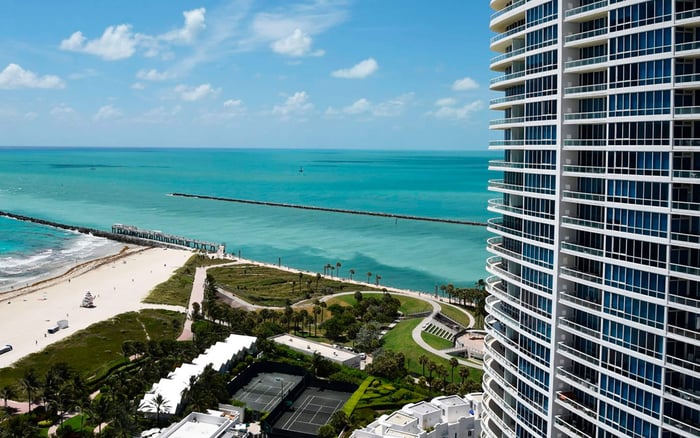
At Shore Club in Miami Beach, the residential proposition centers on an Auberge-curated food-and-beverage program. Signature restaurants, a café bar and poolside dining form part of that hospitality environment. Residents are also offered access to Auberge amenities, tailored services and in-home offerings.
The residential amenities include a residents-only pool, private fitness center, library and lounge. Access to an Auberge beach club and hospitality services further reinforces the resort-style character. For an owner, that combination may make everyday hosting feel highly serviced, particularly when entertaining begins at the beach, pool or restaurant rather than in a formally reserved private room.
The public distinction is important: Shore Club materials do not expressly identify resident-exclusive private dining rooms comparable to those promoted at Villa Miami. They also do not confirm whether Auberge must provide catering or whether licensed outside caterers and private chefs may work in a residence. Residence-specific guest capacities, operating hours, insurance requirements, service charges and booking rights are likewise not publicly established.
A buyer comparing the property with another oceanfront option, such as The Perigon Miami Beach, should not treat broad hospitality access as synonymous with private-event permission. The question is not simply whether food service exists, but where it may be delivered, who may provide it and what approvals apply when guests are invited.
Branded residences often make culinary service feel seamless, but operational exclusivity can carry meaningful consequences. An in-house team may provide consistency, familiarity with service corridors and simplified billing. Conversely, an owner may prefer a longstanding private chef, a specialist caterer or a culturally specific menu outside the resident program.
At both properties, buyers should request written confirmation of whether outside chefs and caterers are permitted in private residences, shared dining rooms and outdoor amenity spaces. If permitted, management may require business licenses, certificates of insurance, security deposits, approved delivery windows or the use of designated entrances and elevators. These details have not been publicly defined for either property and should not be assumed.
The same discipline applies to alcohol service, rentals, floral installations and entertainment. Under building rules, a private dinner can become an event once it crosses a guest threshold, employs outside staff or uses music equipment. Owners should ask how management classifies gatherings and whether different approval standards apply to an intimate meal, a cocktail reception and a professionally produced celebration.
Capacity is only the opening question. A complete review should cover resident booking priority, reservation windows, minimum spending, deposits and cancellation penalties. Buyers should also confirm mandatory staffing, security, valet, housekeeping, cleaning and damage charges. If the space connects to a restaurant or club, operating schedules may affect privacy and availability.
Sound and frequency controls deserve equal attention. Written policies should address quiet hours, DJs, live music, amplified sound and the number of events an owner may host within a defined period. Commercial, promotional, ticketed or sponsored gatherings may be treated differently from personal entertaining and could be restricted entirely.
The practical test is to describe several realistic occasions and ask management to explain how each would work. Examples might include a catered dinner in the residence, a chef's table in a private dining room, a poolside birthday gathering and a larger evening reception. For each scenario, the response should identify the reservable space, maximum guest count, approved provider, fees, staffing and lead time.
Villa Miami currently presents the more explicit public framework for private entertaining. Resident-designated dining rooms, on-demand kitchens and dining rooms, Major Food Group catering, provisioning and preferred restaurant access create a clearly articulated culinary network. Shore Club offers a compelling hospitality setting through Auberge, but its publicly described residential program provides less specificity about exclusive private dining rooms and event mechanics.
That distinction is not a final judgment on service quality or future access. The decisive information will reside in binding documents and current management policies, not in the broad promise of hospitality.
For confidential guidance on dining-led ownership and private-event due diligence, connect with MILLION.
If branded residences are on your mind — as a home or as an allocation — we would be glad to share what we are seeing, privately.
Begin a quiet conversationVilla Miami currently does, because it expressly markets resident-only private dining rooms, on-demand dining spaces and catering by Major Food Group chefs.
Yes. Its planned two-level, Italian-inspired restaurant includes private dining rooms expressly designated for residents.
The publicly available amenity information does not confirm whether outside caterers or private chefs may replace the Major Food Group offering.
Villa Miami advertises private and on-site catering by Major Food Group chefs, as well as provisioning and in-residence grocery stocking.
Its public materials do not expressly identify resident-exclusive private dining rooms comparable to those advertised at Villa Miami.
Published materials do not confirm whether Auberge is mandatory or whether licensed outside caterers and private chefs are permitted.
No complete private-event capacities are publicly specified for Villa Miami or Shore Club's residences.
Buyers should confirm minimum spends, deposits, service charges, staffing, security, valet, housekeeping, cleaning and damage fees.
Owners should request written rules for quiet hours, DJs, live music, amplified sound, event frequency and commercial or ticketed gatherings.
No. Marketing describes the anticipated experience, while condominium documents and management rules determine actual access and restrictions.