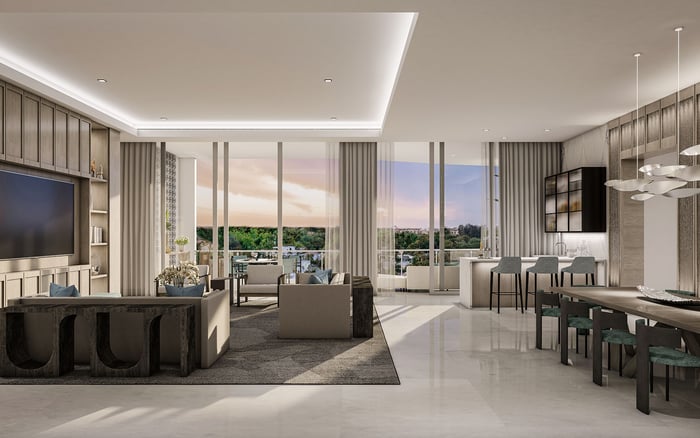
A due-diligence framework for evaluating private dining, catering access, and event restrictions at two South Florida branded residences without assuming property-specific rights that have not been confirmed.

Private entertaining can involve several distinct questions: whether residents may reserve a space, whether a booking provides exclusive use, how guests are admitted, and whether culinary professionals or other vendors may enter. A venue name or service description alone does not resolve those operational details.
That distinction should guide any comparison between Shore Club Private Collections Miami Beach and The Ritz-Carlton Residences® West Palm Beach. The supplied record does not confirm property-specific dining privileges, catering permissions, event capacities, fees, or restrictions for either residence. Buyers should therefore rely on current governing documents and written management responses rather than inference.
Dining service, catering access, and venue use should be examined independently. Food delivery to a private residence may be treated differently from staffed catering inside a home, while an event in a shared amenity space may involve a separate reservation process.
Ask whether a resident may use an outside caterer or private chef, whether vendors require advance approval, and whether building staff must coordinate access. Other practical questions may concern loading, service elevators, equipment, cleanup, security, guest registration, parking, music, and alcohol service. These are due-diligence topics, not confirmed rules for either property.
A buyer should not assume that reserving a room makes it fully private. Written terms should identify the reservable area, permitted hours, booking priority, lead time, deposits, cancellation conditions, cleaning obligations, and any continued access for other residents.
Capacity and guest limits also require property-specific confirmation. The appropriate inquiry should identify the proposed venue, date, number of attendees, service format, duration, alcohol plan, and preferred vendors so management can respond to a realistic event brief.
Other South Florida projects can provide useful context without establishing the rules at the two residences named in the title. Buyers exploring Miami Beach may also review Setai Residences Miami Beach and The Ritz-Carlton Residences® Miami Beach, while a West Palm Beach search may include Mr. C Residences West Palm Beach.
These project references are navigation points rather than evidence that any building shares another property’s policies. Brand affiliation, design language, or similar amenity names should not be used to infer reservation rights, catering access, or event restrictions.
Before relying on an entertaining plan, request the current declaration, bylaws, rules and regulations, amenity reservation terms, fee schedule, and vendor procedures where available. Ask for written clarification of any issue material to the purchase decision.
The review should distinguish rights inside the residence from permissions in common areas. It should also identify who administers reservations, whether approvals can change, and which document controls if marketing language and operating procedures differ.
For both Shore Club Private Collections Miami Beach and The Ritz-Carlton Residences® West Palm Beach, the prudent conclusion is limited: the supplied facts do not establish the relevant event framework. A buyer should treat every material permission as unconfirmed until it appears in current property-specific documentation or a reliable written management response.
Does this review confirm a private dining right at either residence? No. The supplied facts do not establish property-specific dining rights for either residence.
Is in-residence catering confirmed at Shore Club? No property-specific catering terms are confirmed by the supplied record. Buyers should request current written details.
Is outside catering confirmed at The Ritz-Carlton Residences® West Palm Beach? No. Permission for outside caterers should be verified through current property documents or management.
Does access to a dining venue guarantee exclusive use? Not necessarily. Exclusivity should be stated in the applicable reservation terms.
Are guest limits or event capacities established here? No. Capacity and guest limits require venue-specific confirmation.
Are alcohol service and music rules confirmed? No. Buyers should ask how alcohol, entertainment, noise, and event hours are handled.
Which documents should a buyer request? Request current governing documents, rules, reservation terms, fee schedules, and vendor procedures where available.
Can policies from another branded residence be used as a substitute? No. Each property should be evaluated under its own current documents and operating procedures.
What should an event brief include? Include the proposed date, venue, attendance, duration, service format, alcohol plan, and preferred vendors.
Why is written confirmation important? It helps distinguish marketing descriptions from the procedures and permissions that apply to a specific residence.
For a discreet conversation and a curated building-by-building shortlist, connect with MILLION.
If branded residences are on your mind — as a home or as an allocation — we would be glad to share what we are seeing, privately.
Begin a quiet conversation