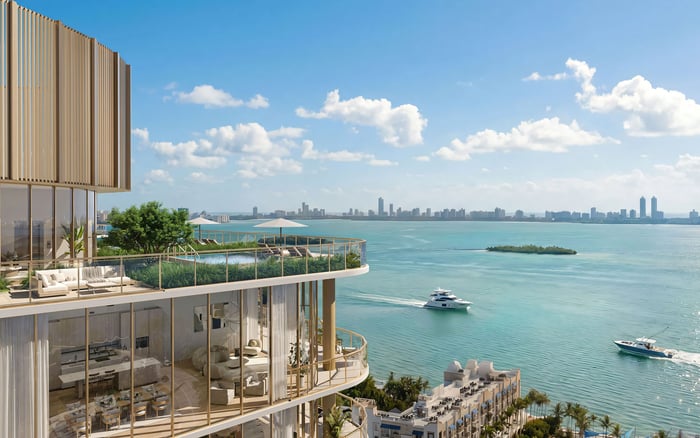
A buyer-focused guide to separating condominium assessments, club obligations, paid usage and brand privileges when evaluating two prominent South Florida branded residences.

At South Florida’s most service-rich residential addresses, the word “included” demands precise definition. A buyer may gain access to common amenities through ownership, owe condominium assessments for their operation, pay separate private-club dues and still incur à la carte charges for dining, treatments, guest accommodations or transportation. These are four distinct financial and legal concepts.
That distinction is especially relevant when comparing Kempinski Residences Miami Design District with St. Regis® Residences Sunny Isles. Both belong in the broader conversation around Branded Residences, but a hospitality name alone does not confer identical ownership privileges, club structures or resale rights.
For buyers considering Pre-Construction opportunities in the Design District and Sunny Isles Beach, the prudent question is not simply, “What amenities are offered?” It is, “Which rights attach to the residence, which benefits attach to the individual, and what will each category cost?”
Condominium assessments generally support the shared property and its operations. Private-club dues, where applicable, sustain a distinct membership structure. Initiation fees may be charged upon joining, while transfer fees may arise when a residence or membership changes hands. Usage charges cover services consumed by a particular owner or guest.
These categories may overlap in daily life, but they should remain separate in a buyer’s financial model. Access to a spa does not necessarily make treatments complimentary. The presence of dining facilities does not imply that meals are covered. A guest suite reserved for residents’ visitors may still carry a nightly rate or service charge.
The most useful Buyer's Guides distinguish access from consumption. Buyers should request a written schedule detailing what the regular assessment covers, which services are billed separately, whether gratuities or service charges apply, and whether any minimum spending commitment exists.
Kempinski is planned for 3801 and 3883 Biscayne Boulevard, with two 20-story towers comprising 132 private residences, six townhomes and 17 guest suites reserved for residents’ visitors. Approximately 70,000 square feet of indoor and outdoor amenities will connect across an elevated third-floor bridge.
The North Tower is oriented toward health and wellness, with fitness, treatment and spa facilities; a cold plunge; infrared and steam saunas; gender-specific spa zones; a wellness café; and a long lap pool with cabanas and adjoining outdoor dining and lounge space. The South Tower concentrates social and entertainment uses, including a resort pool, golf and Formula 1 simulators, a music studio, screening room, library, wine and game lounges, business facilities and outdoor gathering areas.
Family spaces, padel, pickleball, a dog park, maker space, garden lounge and electric-vehicle charging broaden the residential program. Each tower is also planned with a dedicated house car for local transportation.
Crucially, these facilities are presented as residential amenities rather than a separately branded public club. No separate initiation fee, recurring private-club dues schedule or club transfer-fee chart has been disclosed. That does not mean every service is complimentary. Exact condominium assessments and usage charges for dining, spa treatments, transportation and guest-suite bookings remain subject to the operative documents and fee schedules.
Kempinski’s deposit structure is $50,000 at reservation, 20 percent at contract, 10 percent at groundbreaking, 10 percent at top-off and 60 percent at closing. The anticipated timeline calls for groundbreaking in Q2 2027, top-off in Q2 2028 and closing in Q4 2029. These construction payments are distinct from future ownership expenses.
Kempinski owners are offered Titanium status in the Kempinski DISCOVERY program, subject to enrollment and the program’s applicable terms. Privileges include owner rates, 7 percent earnings on eligible spending, early check-in, late checkout, 48-hour guaranteed room availability, a welcome amenity, suite upgrades and breakfast, among other benefits.
These are hospitality-program privileges, not a documented ownership interest in a transferable private-club membership. A purchaser should confirm whether status is assigned to each named owner, limited by a term, renewable or reissued after a unit transfer. Program terms may govern the benefit independently of the condominium documents.
This distinction also matters when comparing other branded offerings, whether oceanfront Bentley Residences Sunny Isles or an urban project such as St. Regis® Residences Brickell. Shared branding does not make one project’s fee structure evidence of another’s.
For St. Regis® Residences Sunny Isles, exact private-club dues, initiation charges, transfer fees, minimum spending obligations and resale-transfer rules should not be assumed. Branded services or club-style spaces do not, by themselves, establish whether membership follows the unit, belongs to an individual, ends upon resale or requires a separate agreement.
Before signing, buyers should obtain the condominium declaration, proposed budget, purchase agreement, club or membership agreement if one exists, rules and regulations, management disclosures, and all current fee schedules. Written clarification should identify who may use each facility, whether family members and guests qualify, how access may be suspended, and which rights survive a sale, inheritance, trust transfer or entity transfer.
A resale buyer needs an equally disciplined review. Marketing language from an original launch may not govern a later transaction. The decisive terms should appear in the governing documents, amendments, membership instruments and current program conditions applicable to that residence and buyer.
A sound underwriting worksheet should separate regular assessments, special assessments, insurance obligations, club initiation fees, recurring dues, transfer charges, minimum spending, guest-suite bookings, dining, spa treatments, transportation, parking, and gratuities or service charges. A zero should be entered in any category only after written confirmation.
Buyers should also test the model against different patterns of use. A seasonal owner hosting family may place greater value on guest suites and visitor privileges. A full-time resident may use wellness, dining and transportation more frequently. An investor or future seller should scrutinize assignment restrictions and whether an incoming purchaser must qualify, enroll or pay a new fee.
The central lesson is straightforward: amenity access, service consumption, loyalty status and private-club membership can coexist, but they are not interchangeable. At Kempinski, an extensive residential amenity program and loyalty status are visible, while separate club dues and transfer charges are not specified. At St. Regis Sunny Isles, transferability and club economics require confirmation in the controlling documents rather than inference from the brand.
For private guidance on comparing these ownership structures and their practical costs, connect with MILLION.
If branded residences are on your mind — as a home or as an allocation — we would be glad to share what we are seeing, privately.
Begin a quiet conversationNo separate initiation fee is publicly disclosed in the supplied project materials. Buyers should confirm all obligations in the governing documents and current fee schedules.
Not necessarily. Access may be residential, while spa treatments, dining, transportation or guest-suite use may carry separate charges.
It spans wellness, pools, fitness, spa facilities, family spaces, entertainment rooms, sports facilities, work areas and resident hospitality services.
No. The 17 guest suites are reserved for residents’ visitors, although applicable booking charges have not been publicly disclosed.
No documented transferable club ownership is established. Titanium status is a hospitality-program benefit governed by enrollment and program terms.
That should not be assumed. Transferability must be confirmed through the condominium, club and membership documents governing the transaction.
Request the declaration, proposed budget, purchase agreement, rules, fee schedules and any separate club or membership agreement.
Model them separately. Assessments support shared residential operations, while club dues may fund a distinct membership program.
They should confirm whether benefits attach to the unit or owner, whether re-enrollment is required, and whether transfer or initiation fees apply.
It is $50,000 at reservation, 20 percent at contract, 10 percent at groundbreaking, 10 percent at top-off and 60 percent at closing.