A buyer-focused comparison of arrival paths, domestic-staff movement and visitor oversight at two distinct waterfront condominiums in northern Miami-Dade.

In a refined condominium, arrival is less about spectacle than sequence. The essential questions begin at the property line: who sees a resident enter, where a driver waits, how a guest is cleared, whether domestic staff share resident circulation, and what happens when deliveries, contractors and marina arrivals overlap.
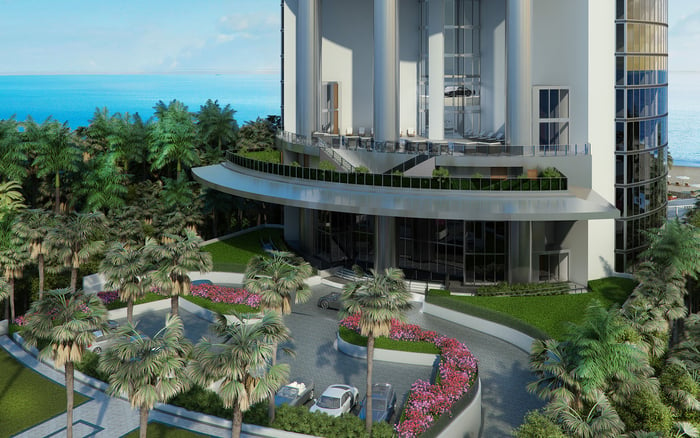
Onda Bay Harbor and The Ritz-Carlton Residences® Sunny Isles address this operating brief at distinctly different scales. Onda is an eight-story, 41-residence condominium in Bay Harbor Islands. The Ritz-Carlton Residences® Sunny Isles Beach is a 52-story, 210-residence tower completed in 2018 and presented as entirely residential, with no on-site hotel or transient use.
Neither scale is inherently more private. Boutique density can reduce daily interactions, while a larger branded residence may support a more extensive operating structure. The decisive issue is how each building translates its physical plan, staffing and house rules into predictable separation.
The truest measure of private arrival is not grandeur, but controlled continuity.
At 10301 East Bay Harbor Drive, Onda's vehicular infrastructure includes a covered valet drop-off, 24-hour valet service, personal parking spaces and a fully enclosed garage. Together, these features create several possible transitions from vehicle to residence, but they should not be treated as interchangeable. A buyer who routinely self-parks may experience the building differently from one who uses valet or arrives with a chauffeur.
Front-desk reception, 24-hour security and video surveillance provide stated layers of oversight. Personalized concierge service and an integrated digital concierge offer channels for coordinating resident and visitor needs. At a 41-residence property, that combination suggests an intimate operating environment, although the exact visitor credentials and elevator-release sequence are not publicly specified.
The private marina adds another dimension. Its 14 boat slips create a waterfront arrival point distinct from the street, valet area and enclosed garage. Buyers should evaluate waterside access as its own sequence, from dock entry and guest identification to movement toward residential elevators or common areas. Marina-screening procedures are not publicly defined, making assumptions based on the lobby experience premature.
For buyers studying the wider Bay Harbor Islands market, La Maré Bay Harbor Islands can serve as another project for document-level comparison. Search terminology may vary, including the label Bay-harbor, but the useful comparison remains operational: arrival points, staff movement and permission controls.
The Ritz-Carlton property stands at 15701 Collins Avenue in Sunny Isles Beach. Its all-residential identity matters: there is no on-site hotel and no transient use. That distinction removes the presumed flow of hotel guests from the ownership environment, but it does not reveal the current rules for personal guests, domestic employees, vendors or contractors.
An on-site Safety & Security Officer role sits within Rooms & Guest Services Operations. Its stated responsibilities include monitoring closed-circuit television, perimeter alarms, duress alarms and fire-life-safety systems. The role also includes responding to owner and guest requests for visitor information and special arrangements, along with escorting unwelcome persons from the property. Those responsibilities indicate active oversight rather than surveillance alone.
Still, the current visitor-preapproval process, guest-parking terms, household-staff circulation and elevator-authorization rules are not publicly established. Buyers considering this tower, or comparing it with Bentley Residences Sunny Isles, should request the present procedures rather than infer them from brand, scale or neighborhood.
Domestic staffing can expose the distinction between architectural and operational privacy. A residence may offer an elegant owner arrival while still requiring household employees to cross guest-facing spaces, wait at a common desk or depend on management for repeated elevator release. None of these details should be assumed at either property.
At Onda, household-staff routes and elevator-release procedures are not publicly specified. Due diligence should establish where recurring staff enter, whether they use the garage, valet zone or lobby, how credentials are issued, and which floors and amenity areas those credentials permit. Buyers with drivers, childcare providers, housekeepers or private chefs should test the rules against a normal weekly schedule-not an occasional visit.
At The Ritz-Carlton Residences® Sunny Isles, the same inquiry should account for the larger 210-residence population. Ask whether recurring household personnel are treated differently from one-time vendors, whether credentials expire, and how access changes outside normal service periods. These questions belong with current management and governing documents; they are not settled by the property's no-hotel positioning.
Visitor control is strongest when every handoff is clear. A prospective owner should walk through several realistic scenarios: an expected dinner guest, an unannounced visitor, a contractor carrying equipment, a delivery requiring residence access, and a guest arriving by boat at Onda. For each, identify who receives notice, who verifies identity, where the person waits and what authorizes onward movement.
At Onda, concierge channels may help coordinate needs, while reception, security and surveillance form the disclosed oversight layers. Yet current credential rules and elevator permissions still require confirmation. At the Ritz-Carlton, the disclosed security function includes visitor information, special arrangements and the removal of unwelcome persons, but the precise preapproval and guest-parking process is not publicly established.
Here, scale becomes practical. A boutique building may offer familiarity, but it still requires resilient procedures across shifts. A larger tower may have broader staffing, but residents should understand how requests move among security, guest services and parking operations. In both cases, privacy depends on repeatable execution.
Before contracting or closing, request current condominium documents, house rules, parking policies, access-control procedures, and written protocols for staff and vendors. Confirm whether the rules presented during a tour are formal policy, routine practice or a courtesy subject to change.
Then request a live demonstration. Trace self-parking, valet and guest arrival. At Onda, include the marina route. At the Ritz-Carlton, test how an approved visitor moves from vehicle arrival to the appropriate elevator. Buyers with household teams should request a separate walkthrough focused on recurring credentials, service access, waiting areas and after-hours entry.
The objective is not maximum restriction. It is a system aligned with the owner's life-one that admits trusted people gracefully while preserving residents' discretion. For more guidance on evaluating South Florida's most considered residential addresses, connect with MILLION.
If branded residences are on your mind — as a home or as an allocation — we would be glad to share what we are seeing, privately.
Begin a quiet conversationOnda is an eight-story condominium with 41 residences, giving it a comparatively boutique operating scale.
Onda identifies a covered valet drop-off, 24-hour valet service, personal parking spaces and a fully enclosed garage.
Yes. Its private marina has 14 boat slips and creates a waterside approach separate from street, valet and garage arrivals.
Onda identifies front-desk reception, 24-hour security and video surveillance, along with personalized and digital concierge services.
No. Public materials do not specify household-staff routes, elevator-release procedures, marina screening or visitor-credential rules.
No. The property is presented as completely residential, with no on-site hotel and no transient use.
The tower contains 210 condominium residences across 52 stories and was completed in 2018.
The disclosed role includes monitoring closed-circuit television, perimeter alarms, duress alarms and fire-life-safety systems.
No. Current visitor preapproval, guest parking, household-staff circulation and elevator authorization should be confirmed with management.
Buyers should request current condominium documents, house rules, parking policies, access-control procedures and staff or vendor protocols.