A discreet buyer's guide to separating published arrival architecture from the still-undisclosed operating rules that govern guests, household staff, vendors, elevators, and residential privacy in two Brickell developments.
In Brickell, discretion begins well before a resident reaches the lobby. Driveway placement, valet choreography, the elevator journey, and the handling of guests collectively determine how private a residence feels in daily life. These details are especially important for owners who employ household staff, receive frequent visitors, or divide their time among multiple homes.
At Baccarat Residences Brickell, the published proposition is architecturally clear: a secluded landscaped entrance, riverfront arrival court, sheltered porte-cochère, attended security, and direct elevator access. At House of Wellness Brickell, the publicly disclosed information considered here does not provide comparable detail about private arrival, household-staff circulation, or visitor-control procedures. The distinction matters. Buyers should compare confirmed design and operating provisions rather than infer them from positioning alone.
True residential privacy is created by the full journey from curb to vestibule.
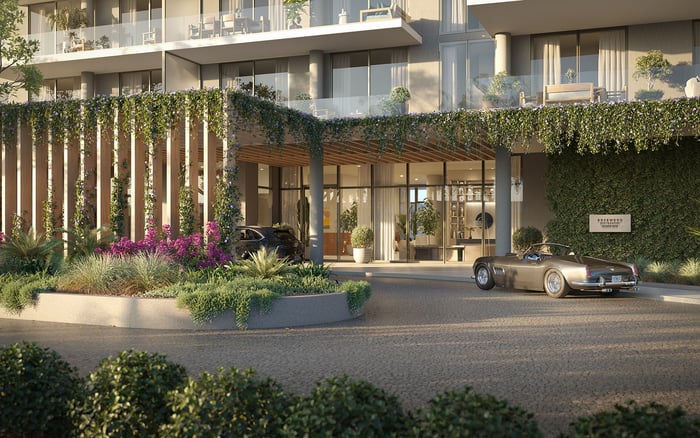
Baccarat's residential approach begins with a secluded, landscaped private entrance designed to create separation from the surrounding streetscape. From there, the sequence proceeds to a riverfront arrival court and elegant porte-cochère, providing a sheltered setting for vehicle drop-off and pickup.
The project also advertises complimentary valet service around the clock. Owners who prefer to park independently may opt for assigned spaces in a covered, secured garage. These two arrival modes accommodate different routines, but buyers should clarify how each route connects to security screening, the lobby, and the residential elevator banks.
Inside, the entrance lobby is described as having grand, high ceilings and direct connections to the residential elevators. Three banks of double private elevators are specified. Residence descriptions further detail private, key-activated access, with two elevators opening directly into each home and an entry vestibule in every residence.
Within branded-residence and pre-construction offerings, this combination is significant because it reduces the number of shared thresholds between vehicle and home. It does not, however, explain how every category of user moves through the building.
Direct elevator arrival can feel exceptionally composed, but its effectiveness depends on credentialing and destination control. A key-activated system indicates controlled resident access, while the in-home vestibule provides a buffer between the elevator doors and principal living areas. That vestibule can be particularly valuable when residents receive deliveries, welcome visitors, or coordinate household routines.
Published amenity information does not explain guest preregistration, host-escort requirements, visitor waiting areas, or the issuance of temporary credentials. Nor does it specify whether guest access can be restricted by floor or residence. These are operational questions, not decorative details, and they can materially affect both convenience and discretion.
Buyers comparing The Residences at 1428 Brickell or Cipriani Residences Brickell should apply the same standard: trace the complete route for residents, guests, staff, vendors, and deliveries rather than treating a private elevator as a complete answer.
For a residence supported by housekeepers, private chefs, personal assistants, drivers, or caregivers, circulation should be assessed as a recurring operational system. Available Baccarat materials do not specify dedicated household-staff elevators, staff-only corridors, or a separate vendor-access network. This absence of published detail should not be interpreted as proof that such provisions will-or will not-exist.
Purchasers should request plans showing service and loading access, elevator zoning, back-of-house connections, and the route from building entry to residence. They should also clarify whether household employees use resident elevators, service elevators, or different routes depending on the hour and task. The answer shapes privacy, efficiency, and the tone of daily life.
This is where design and architecture intersect with management. A thoughtfully placed corridor is useful only when building procedures support it. Conversely, attentive operations can improve a conventional plan but cannot fully resolve circulation conflicts embedded in the physical layout.
Baccarat advertises 24-hour attended security services and controlled access. Both are meaningful components of the arrival framework, but “controlled access” does not define the complete visitor protocol.
Buyers should determine who authorizes a guest, where that person waits, whether identification is required, and when access expires. They should also distinguish among social visitors, household employees, contractors, wellness practitioners, caterers, and delivery personnel. Each group may require different permissions and routes.
The most refined protocol is not necessarily the most restrictive. It should be proportionate, intelligible, and simple for residents to administer. Excessive friction can undermine hospitality, while vague permissions can weaken privacy. For households that entertain frequently, the central question is whether control remains discreet during peak arrival periods.
House of Wellness Brickell warrants the same room-by-room, route-by-route scrutiny. The publicly disclosed detail considered here does not establish its private-arrival sequence, dedicated staff circulation, elevator allocation, visitor waiting arrangements, or temporary-access procedures. Buyers should therefore avoid assuming equivalence with Baccarat's published features.
Rather than compare broad lifestyle identities, buyers should present both developments with the same operational questions. This produces a cleaner comparison and allows future condominium documents, management rules, and technical plans to carry greater weight than generalized impressions.
For buyers, the essential distinction is straightforward: Baccarat presents a defined architectural arrival narrative, while crucial operating protocols remain unconfirmed. House of Wellness requires confirmation of both the relevant design routes and the rules governing them.
Request the current access-control rules and identify every credential type available to residents, guests, household employees, vendors, and contractors. Determine whether permissions are permanent, scheduled, temporary, floor-restricted, or residence-specific.
Review loading and service diagrams alongside residential floor plans. Confirm elevator zoning, after-hours procedures, delivery routes, move-in protocols, and any circumstances in which service personnel use residential areas. At Baccarat, also clarify how valet arrival and optional self-parking connect to controlled entrances and elevator access.
Test several real-life scenarios: an overnight guest arriving before the host, a chef carrying equipment, a caregiver working a recurring schedule, or a contractor requiring short-term access. The building's response to these routine situations reveals more than a general security description.
Finally, determine which provisions are architectural commitments and which may change through management policy. In Brickell, enduring privacy depends on alignment among physical planning, technology, staffing, and enforceable rules. The most persuasive residence is the one whose complete circulation system suits the household it is intended to serve.
For a discreet discussion of South Florida luxury residences and their operational details, connect with MILLION.
If branded residences are on your mind — as a home or as an allocation — we would be glad to share what we are seeing, privately.
Begin a quiet conversationThe development is in Brickell, Miami.
The sequence includes a secluded landscaped entrance, a riverfront arrival court, and a sheltered porte-cochère.
Yes. The project describes three banks of double private elevators and private, key-activated residential access.
Published residence descriptions state that two elevators open directly into each home, which also includes an entry vestibule.
The amenity program advertises 24-hour attended security services and controlled access.
Yes. Complimentary valet service is advertised as operating 24 hours a day.
Optional self-parking is advertised through assigned spaces in a covered, secured garage.
Available public materials do not specify dedicated household-staff elevators or staff-only corridors.
Public amenity information does not detail guest preregistration, host escorts, visitor waiting areas, or temporary credential procedures.
Buyers should confirm arrival routes, elevator allocation, staff and vendor circulation, visitor procedures, and access-control rules in the relevant plans and documents.