A buyer-focused look at arrival routes, amenity access, and residential privacy at Auberge Beach and St. Regis Bahia Mar, distinguishing advertised features from the operating rules that matter most.

For a buyer choosing a beachfront home in Fort Lauderdale, privacy depends less on a celebrated hospitality name than on the experience of arriving, moving through common areas, and returning upstairs. An elegant lobby can serve as both a residential gathering place and a key circulation junction. The essential question is who may pass through it, for what purpose, and under whose supervision.
At Auberge Beach and St. Regis Bahia Mar, that inquiry must begin without assuming identical operating models. Resort-style services do not, by themselves, establish a conventional hotel component. Nor does an extensive amenity collection prove that owners encounter public visitors on their daily routes. Privacy rests on the relationship among physical layout, access permissions, and operating practice.
Located at 2200 North Ocean Boulevard, Fort Lauderdale, FL 33305, Auberge Beach Residences & Spa Fort Lauderdale is presented as a beachfront residential development with resort-style amenities. It should not automatically be assessed as a hotel with residences attached. Calling every non-owner a hotel guest obscures the more useful distinctions among invited houseguests, tenants, service personnel, and any separately authorized amenity visitors.
The announced ground-level program includes private club-style amenities: an indoor-outdoor lounge and restaurant, spa, meeting rooms, children's center, swimming pools, and gardens. That program describes an intended lifestyle, not a complete set of current admission rules. A restaurant or spa designation alone does not establish whether outside patrons are admitted or which route they would use.
For a purchaser, the next step is to establish the permitted user groups for each space. Keep eligibility separate from circulation: authorization to use one amenity should not be presumed to extend to residential corridors or another amenity.
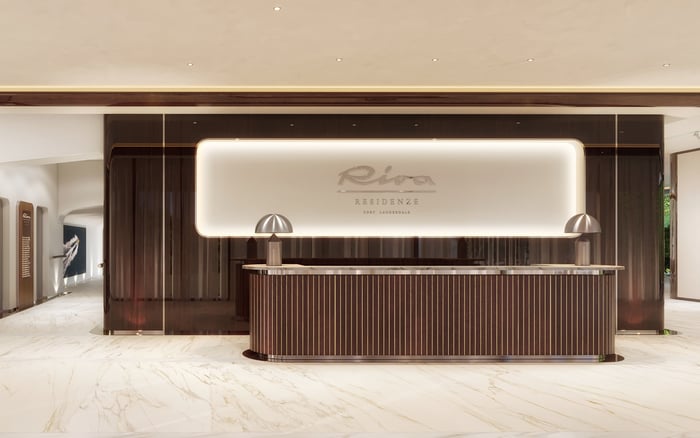
Auberge's described layout includes a two-story lobby opening to the oceanfront pool deck, spa, and cabanas, with ground-level common amenities immediately above a below-grade parking garage. These connections show buyers where to focus their attention. They do not establish that every connection is unrestricted or that every user follows the same path.
Walk the proposed daily owner route from vehicle arrival to residence, then separately trace the routes to the pool and spa. Identify where credentials are required, where a concierge intervenes, and whether an invited guest can proceed unaccompanied. Ask management to explain the routes used by deliveries and service providers rather than assuming they match the owner's route.
Card/code access, security guards, and concierge services are identified features. Their presence matters, but a security inventory is not an access-control plan. The decisive detail is what each checkpoint controls. A credential at the building entrance serves a different purpose from one restricting elevator floors or access through an amenity door.
Auberge's advertised amenities include multiple pools with cabanas, a 6,000-square-foot fitness center, a Napa Valley Wine Room, and a signature Cigar Lounge. The collection also includes a club room, HD golf simulator, and screening room. None of these descriptions establishes public access.
For owners, the practical issue is how amenity use is allocated. Request the current rules covering guest accompaniment, reservations, visitor limits, and any restrictions affecting tenants. Confirm whether permissions differ among the pool deck, fitness center, and social rooms. These are questions to resolve, not policies to presume.
The distinction matters aesthetically as well as operationally. Common-area art, including work by Fernando Botero in the advertised program, contributes to the property's identity but says nothing about who may enter those spaces. Likewise, the breadth of the amenity offering cannot establish low crowd levels. A private setting can still be active; a calm visit cannot prove consistent seclusion.
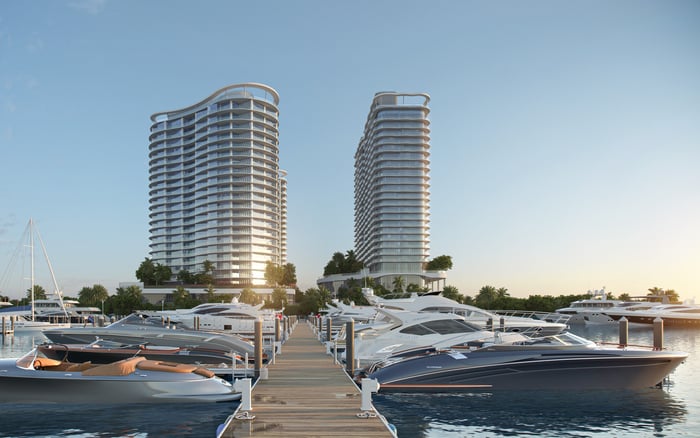
At St. Regis® Residences Bahia Mar Fort Lauderdale, the advertised marina accommodates megayachts up to 350 feet. For a privacy-minded buyer, that feature raises a distinct circulation question: where, if anywhere, do marina users' routes intersect with residential arrival and amenity routes?
Vessel capacity does not answer that question. It should not be used to infer shared lobbies, separate entrances, owner-only waterfront paths, or unrestricted access from the docks. Ask for a plan distinguishing residential entrances, marina access points, and any controlled connections. Where routes intersect, establish the permissions governing those intersections.
The same discipline applies to hotel-related questions. Confirm the applicable operating components and the rights attached to each rather than inferring the presence or absence of a hotel from branding. Guest-suite policies, any hotel-guest permissions, and shared versus separate entrances require explicit confirmation before they inform a purchase decision.
A St. Regis residents-only app is an advertised feature at Bahia Mar. It does not establish whether the app issues visitor credentials, controls elevators, authorizes parking, or manages marina access. A digital service channel and a physical security system should be evaluated separately unless their integration is expressly demonstrated.
Request a demonstration of the functions relevant to your household. For an owner who travels frequently, useful questions include how an invited visitor is approved, what happens when authorization expires, and whom staff contact when instructions are unclear. Treat these as capabilities to verify, not benefits established by the app's name.
A buyer also considering Four Seasons Hotel & Private Residences Fort Lauderdale should apply the same questions without assuming equivalent circulation arrangements. A meaningful comparison follows each household's expected journeys: parking to residence, residence to wellness facilities, and guest arrival to the owner's front door.
Request current condominium rules, visitor policies, relevant access plans, and written clarification of unresolved permissions. For any arrangement still presented as planned, distinguish the proposed design from binding commitments and eventual operating procedures. Ask which entity can change access rules and how owners would be notified.
Neither Auberge's amenity depth nor Bahia Mar's marina scale establishes which offers greater privacy. The stronger choice is the property whose documented permissions and demonstrable routes fit the buyer's expectations. For some households, occasional social overlap may be acceptable; for others, a consistently controlled route to the residence is essential. That preference belongs in the decision before finishes and views make the choice feel settled.
For a discreet assessment of South Florida residences through the lens of daily living and owner privacy, connect with MILLION.
If branded residences are on your mind — as a home or as an allocation — we would be glad to share what we are seeing, privately.
Begin a quiet conversationAuberge Beach is presented as a beachfront residential development with resort-style amenities. That description does not establish a conventional hotel-and-residences operating model.
The property is at 2200 North Ocean Boulevard, Fort Lauderdale, FL 33305.
Its described two-story lobby opens to the oceanfront pool deck, spa, and cabanas. Buyers should verify the access controls at those connections rather than assume unrestricted or fully separated circulation.
The advertised pools and cabanas do not establish public access. Current admission and guest rules should be confirmed before drawing that conclusion.
The offering includes a 6,000-square-foot fitness center, Napa Valley Wine Room, and signature Cigar Lounge. Their inclusion does not establish access rights for nonresidents.
No. Card/code access, security guards, and concierge services do not establish how every elevator, corridor, or amenity entrance is controlled.
The marina is advertised with slips accommodating megayachts up to 350 feet. That capacity does not establish whether marina users share residential routes.
The app is an advertised feature, but its role in visitor credentials, elevators, parking, and marina access requires confirmation.
No. Buyers should confirm the applicable operating components and entrance arrangements without assuming either a hotel component or fully separate circulation.
Request current condominium rules, visitor policies, relevant access plans, and written clarification of unresolved permissions. Trace owner and visitor routes separately during the evaluation.