A buyer-focused penthouse shortlist led by Rivage Bal Harbour, Forte on Flagler and Turnberry Ocean Club, with a precise distinction between advertised outdoor amenities and the roof rights, mechanical separation and service arrangements that require independent review.
The most consequential penthouse luxury may be control: over who crosses the terrace, when equipment is serviced, and whether a private rooftop remains meaningfully private. A pool above the coastline is compelling. The documents and operating arrangements behind it deserve equal attention.
For buyers seeking discreet service, three questions should guide the purchase. What rooftop space is legally assigned to the residence? What equipment occupies or serves the surrounding roof? How do staff and contractors reach their destinations without unnecessarily entering the owner's living space? Advertised amenities alone answer none of these questions.
On the Collins Avenue oceanfront, Rivage Bal Harbour offers the prospect of a rooftop pool in a tower described as having 61 residences. That scale is a useful starting point for a privacy discussion, not evidence of discreet service. The distinction matters throughout this shortlist: attractive outdoor features invite investigation; they do not assure protected roof rights or quiet mechanical surroundings.
1. Rivage Bal Harbour: rooftop-pool penthouse
Rivage leads with a penthouse marketed at $67.5 million and described as having a private rooftop pool. Its Bal Harbour oceanfront setting and 61-residence scale give buyers two concrete characteristics to weigh alongside the rooftop offering. The advertised price does not confirm current pricing or availability.
The broader advertised amenities include more than 25,000 square feet of indoor and outdoor lounge areas, a spa, beach cabanas, and sunrise and sunset pools. Those features establish the scope of the amenities, not staff discretion. Before assigning a premium to the rooftop, establish its recorded boundaries, the association's access rights, and the locations of surrounding equipment.
2. Forte on Flagler: expansive private rooftop terrace
Forte on Flagler, on West Palm Beach's Intracoastal waterfront, advertises a penthouse with a 7,189-square-foot private rooftop terrace. Its advertised features include a pool, outdoor kitchen, cabana bath with sauna, enclosed steam shower, and dressing area. That specificity makes it a particularly useful candidate for buyers who want outdoor living to function as an extension of the residence.
The next step is to reconcile the advertised area with recorded exhibits and approved plans. Ask which portions are allocated exclusively to the penthouse, where pool and spa equipment sits, and how technicians reach it. Neither the legal roof boundaries nor the mechanical locations are established here.
3. Turnberry Ocean Club Residences: private pool and summer kitchen
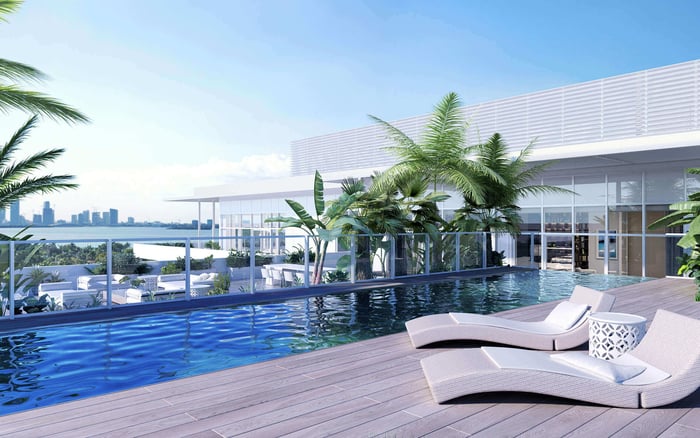
A featured penthouse at Turnberry Ocean Club Residences in Sunny Isles Beach is marketed with a private infinity-edge swimming pool and summer kitchen. For buyers envisioning private outdoor entertaining, the pairing offers a clear reason to explore the residence.
It does not, however, establish exclusive roof ownership, equipment clearances, or service routes. Review the exact allocation of outdoor space and request a coordinated plan showing equipment, access doors, and maintenance routes. A private pool is not a promise that all adjoining rooftop space is reserved to the owner.
4. Continuum on South Beach: ancillary private space
Continuum's featured penthouse is a more qualified consideration. In 2015, the residence in South of Fifth, Miami Beach, was advertised with a private 250-square-foot beach cabana loft. That is a distinct ancillary amenity, not evidence of a private rooftop allocation.
For this brief, keep the cabana benefit separate from the roof question. Any purchase decision requiring defensible rooftop rights must rest on current, residence-specific documents, not the existence of another private space. The historical offering should not be interpreted as current availability.
An expansive terrace can be visually persuasive before its legal structure is understood. At Forté on Flagler West Palm Beach, the advertised 7,189-square-foot rooftop makes document reconciliation especially important: compare the space shown in marketing with the space identified in the governing documents.
Ask condominium counsel to examine the declaration, amendments, and recorded rooftop exhibits. Determine whether the space falls within the unit boundaries or carries an exclusive-use designation, including any limited-common-element status. Have counsel explain the practical consequences rather than treating those descriptions as interchangeable.
Then examine the qualifications. What access is reserved for the association? What restrictions govern alterations? Can equipment be installed or relocated nearby, and what approvals would apply? Request a clear allocation of maintenance and repair obligations for the terrace, pool, and underlying roof. The objective is not merely a right to occupy the space, but a precise understanding of that right's limits.
At Turnberry Ocean Club Sunny Isles, the marketed infinity-edge pool and summer kitchen make equipment and servicing practical priorities for review. They neither indicate an adjacency problem nor establish acceptable equipment separation.
Request equipment schedules, roof plans, acoustic information where available, and diagrams showing maintenance access. Ask an appropriate professional to assess potential noise, vibration, exhaust, and the relationship between equipment and outdoor seating. Where a site inspection is possible, evaluate relevant systems while they are operating rather than relying solely on a quiet viewing.
Keep municipal rules separate from private rights. In Miami Beach, covered operational and mechanical equipment must receive Design Review Board approval and remain at least 25 feet from street-facing roof parapets. Relevant rooftop trellises and pergolas have 15-foot street-facing setbacks and specified area restrictions. These provisions do not establish equipment separation from a particular penthouse terrace, and they should not be applied to other municipalities.
For buyers considering Continuum on South Beach, as elsewhere, evaluate staff circulation separately from private amenities. A cabana, rooftop pool, or limited residence count cannot substitute for an explanation of daily service operations.
Request a walkthrough of deliveries, housekeeping, pool servicing, and contractor access. Ask who authorizes entry, how visits are scheduled, and which routes avoid the residence's principal entertaining areas. For rooftop work, clarify both routine access and emergency procedures. Written arrangements are more useful than a general assurance of discreet service.
The strongest purchase case aligns the legal, physical, and operational reviews. A compelling terrace should withstand document review; acceptable mechanical adjacency should be assessed against actual plans; and privacy should be supported by service arrangements the buyer understands. That is the difference between purchasing an impressive amenity and securing a residence suited to private living.
Explore South Florida's luxury residences with MILLION.
If branded residences are on your mind — as a home or as an allocation — we would be glad to share what we are seeing, privately.
Begin a quiet conversationNo. The declaration, amendments and recorded exhibits must establish the rooftop's legal allocation and any limits on exclusive use.
It has been marketed at $67.5 million with a private rooftop pool in a tower described as having 61 residences. The advertised price does not confirm current pricing or availability.
The advertised private rooftop terrace measures 7,189 square feet. Its legal boundaries and mechanical locations require separate review.
The advertised program includes a pool, outdoor kitchen, cabana bath with sauna, enclosed steam shower and dressing area.
A featured penthouse is marketed with a private infinity-edge swimming pool and summer kitchen. These features do not establish exclusive roof ownership or mechanical clearances.
No. The private 250-square-foot beach cabana loft described in 2015 is an ancillary space, not a documented rooftop allocation.
Request the declaration and amendments, recorded rooftop exhibits, equipment and access plans, maintenance obligations and service-routing details.
Ordinance 2021-4437 sets that minimum distance from street-facing roof parapets for equipment covered by its provisions. It does not establish a buffer from a particular private terrace or apply across South Florida.
Have an appropriate professional review equipment schedules, roof plans, acoustic information where available and maintenance routes. Where possible, inspect relevant systems while they are operating.
No. Buyers should examine staff circulation, entry authorization, scheduling and privacy procedures independently of building density or amenity scale.