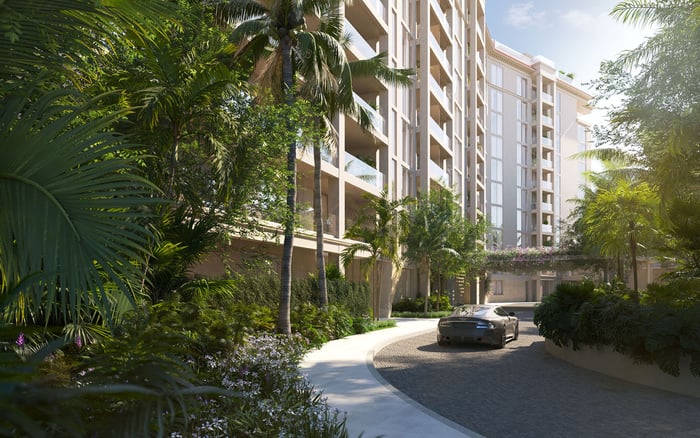
A buyer’s brief for evaluating South Florida residences through five priorities: accessible daily living, controlled guest access, limited data exposure, delegated permissions, and dependable alternatives to app-based services.

For a buyer planning to age in place, luxury deserves a more exacting definition. A beautiful residence should be evaluated not only for its setting and interiors, but also for the independence it supports: welcoming a friend, admitting a caregiver, or receiving assistance without surrendering control of the household.
Guest registration and building-app privacy belong alongside physical accessibility in that assessment. The objective is not simply tighter security. It is an arrangement in which authorized people can enter predictably, personal information remains appropriately restricted, and the resident retains meaningful choices about technology.
The five priorities below form a buying brief, not a verified ranking of five residences. Use them to establish what a property must demonstrate before it earns a place on your shortlist.
1. Accessible daily living: independence before amenities
Begin with the entire journey home, not the apartment alone. Walk from the arrival point through the entrance, elevator, corridor, and residence. Assess changes in level, door operation, resting opportunities, lighting, and the ease of carrying groceries or moving with assistance. Test the route you would actually use, not just the presentation route.
Inside, ask an appropriately qualified accessibility professional to assess circulation, bathroom arrangements, and potential adaptations against your anticipated needs. Clarify which alterations require approval. An attractive plan is no substitute for a practical assessment of everyday movement.
2. Resident-controlled guest registration: specific permission, not blanket access
Ask management to demonstrate how a resident approves, changes, and withdraws a visitor’s authorization. Look for the ability to distinguish a dinner guest from a recurring caregiver or a service appointment, with permissions tailored to each purpose.
Request a demonstration of scheduled access and credential expiration, where offered. Clarify what happens when an unregistered visitor arrives, whether staff can override restrictions, and how identity is checked. Your purchasing standard should be a documented process that preserves resident choice without making legitimate assistance unnecessarily difficult.
3. Limited building-app data exposure: collect less, disclose less
Request the app’s current privacy notice and a written explanation of how the building handles resident and visitor information. Ask which details are mandatory, why they are needed, who can see them, and how long they remain available. Include guest names, contact details, visit histories, and any requested identity documents in that review.
Treat privacy as distinct from entry security. Ask whether other residents can see your profile, whether directory participation is optional, and whether location or contact-list permissions are necessary for essential functions. Do not equate a polished interface with restrained data practices.
4. Delegated access: assistance without sharing the master account
Ask whether a trusted relative or representative can receive a separate account with narrowly defined permissions. A useful demonstration would show someone arranging an authorized visit without gaining access to unrelated household messages, account details, or historical guest records.
Clarify how the resident grants and revokes that authority, including when a caregiver changes. Do not treat shared passwords as the intended household arrangement. Ask how account recovery works and what verification is required when another person requests changes on the resident’s behalf.
5. Dependable alternatives: essential access without a smartphone
Test what happens when the resident cannot use the app. Ask about a lost phone, depleted battery, interrupted connectivity, or temporary difficulty operating the interface. Request the exact alternative procedure for admitting an approved visitor and reaching building staff.
Ask how emergency access differs from routine guest approval. Establish who handles exceptions, how actions are recorded, and how the resident is informed. Favor a clearly explained procedure over an assurance that someone will simply take care of it.
Assess physical suitability at the level of the specific home and its everyday routes. A project name alone should not settle questions about thresholds, bathroom adaptability, or the usability of access controls.
If 2200 Brickell is on your Brickell itinerary, bring the same written accessibility brief you would use anywhere else. Ask to examine the relevant plans and identify which conditions can be inspected directly and which remain subject to confirmation.
For a Boca Raton search that includes Alina Residences Boca Raton, keep those questions equally specific. Neither mention asserts accessibility or privacy performance. The decision should follow a residence-level review, including any approvals needed for future modifications.
Consider the rhythm of a future week: family arriving for lunch, a therapist visiting by appointment, a caregiver returning regularly, and a delivery arriving while you are away. Ask how each would be handled without unnecessarily creating permanent access.
When considering The Perigon Miami Beach during a Miami Beach search, use those scenarios as questions, not assumptions about its services or technology.
Apply the same exercise if Four Seasons Residences Coconut Grove enters your Coconut Grove comparison. These are settings in which to conduct due diligence, not endorsements of particular guest controls. Keep the household brief consistent so that presentation and branding do not alter the standard of evidence you require.
Arrange a demonstration using test information rather than your real visitors’ details. Ask the presenter to create a guest authorization, restrict its duration, revoke it, and show what the guest and front desk can each see. Repeat the exercise from a delegated account, if that option exists.
Follow the information through its lifecycle. Where does a visitor record appear after departure? Who can retrieve it? What retention period applies, and what deletion options or limitations exist? Ask separately about information held by the association, management, and the technology provider.
Finally, compare the demonstration with written rules and privacy terms. Identify which functions are operating now, which are proposed, and who can change the relevant policies. If a feature is essential to your purchase, have your adviser examine how it is addressed in the applicable documents. Do not rely on a verbal description.
Before committing, separate your requirements into essentials and preferences. Independent arrival, reliable authorized assistance, and acceptable handling of personal information may belong in the first category. Interface styling or optional social features may belong in the second.
A compelling long-term home should satisfy the household’s practical brief without requiring the resident to accept unnecessary digital exposure. Keep unresolved questions visible, and base the final choice on demonstrated suitability rather than presumed sophistication.
Explore South Florida residences with MILLION and bring a precise brief for independence, guest access, and privacy to your search.
If branded residences are on your mind — as a home or as an allocation — we would be glad to share what we are seeing, privately.
Begin a quiet conversationNo. The five priorities form a buying brief; the linked residences are contexts for due diligence, not verified recommendations for these features.
Assess the complete route from arrival to the residence, then examine interior circulation and potential adaptations with an appropriately qualified accessibility professional.
Ask to see a visitor authorization created, limited in duration, changed, and revoked. Clarify identity checks and the handling of unregistered arrivals.
Ask whether recurring visits can receive specific schedules and separate credentials. Confirm how authorization is withdrawn when the arrangement ends.
Do not treat it as proof. Examine data collection, visibility, retention, and sharing separately from the process for admitting visitors.
Ask whether location, contact-list access, and resident-directory participation are necessary or optional. Establish whether declining optional permissions affects essential services.
Ask whether separate delegated accounts are available with limited permissions. Verify how authority is granted, reviewed, and revoked.
Request the building’s exact alternative for essential access and visitor approval. Test scenarios involving a lost phone, depleted battery, and interrupted connectivity.
Request the current app privacy notice and written explanations of resident and visitor data handling. Clarify access rights, retention periods, deletion limitations, and responsibility for policy changes.
Use the same accessibility brief and household scenarios at each property. Distinguish demonstrated functions from proposed features and reconcile important assurances with written documents.