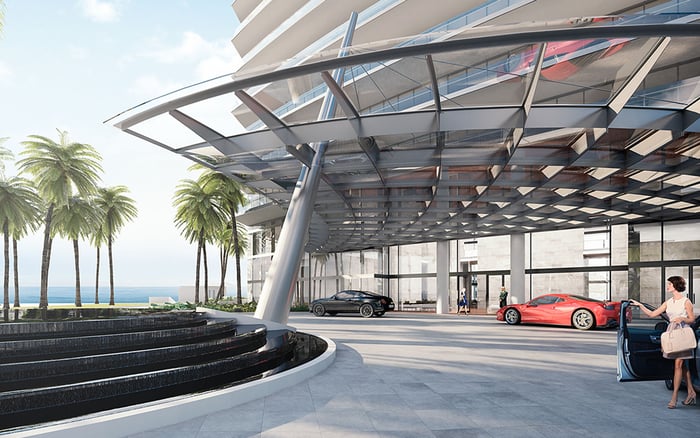
From private sky garages to display-focused interiors, five features distinguish a collector-oriented condominium from a residence with parking. Here is what to prioritize, what remains planned, and what to verify before buying.

For a serious car collector, a parking allocation is not the same as a considered setting for a collection. The distinction spans the entire experience: how a vehicle arrives, where it rests, whether it can be charged, and how its presentation fits the architecture of the home. A garage can serve as functional infrastructure, a private gallery, or both.
Sunny Isles Beach offers concrete examples. Porsche Design Tower integrates glass-encased garages into its residences, while Bentley Residences Sunny Isles plans private residential-floor garages with EV-charging points. These approaches call for more precise questions than how many spaces accompany a purchase.
The following ranking prioritizes five features, not five developments. Direct access comes first, followed by charging, preservation-oriented space, vehicle-handling logistics and display. Each addresses a distinct aspect of ownership; none should be assumed to include the others.
1. Private in-unit sky garage with a vehicle elevator - Porsche Design Tower
At 18555 Collins Avenue in Sunny Isles Beach, Porsche Design Tower contains 132 residences, each designed with a private, glass-encased sky garage integrated into the unit. Developed by Dezer Development in collaboration with Porsche Design, the tower makes vehicle access part of the residential concept rather than a separate parking amenity.
Its patented Dezervator system transports vehicles to residential levels while allowing occupants to remain with their cars. This feature ranks first because it changes the relationship between arrival and home. Buyers should still establish the precise garage configuration and ownership rights attached to the residence under consideration.
2. Private garage access with EV charging - Bentley Residences Miami
Bentley Residences Miami is a planned residential tower in Sunny Isles Beach. Plans include four Dezervator elevators designed to transport residents and their vehicles directly to private garages on their residential floors. The planned garages also include EV-charging points.
The combination earns second place by pairing access with an increasingly relevant ownership requirement. A charging point, however, is not a complete electrical specification. Ask about capacity, metering, installation responsibilities and simultaneous charging. The plans do not establish a uniform four-car allocation for every residence, and buyers should not confuse elevator count with garage capacity.
3. Climate-controlled vehicle showroom - preservation-focused storage
Climate-controlled showroom space ranks third as a preservation-oriented feature to seek and verify. For a condominium purchase, the useful takeaway is the specification to request, not an amenity to assume. Establish whether the garage has dedicated environmental controls, what conditions they are intended to maintain, and who operates and maintains them. Glass enclosure alone does not establish climate-control performance.
4. Controlled vehicle-handling logistics - arrival through garage delivery
Porsche Design Tower’s vehicle-handling system combines a ground-level turntable, robotic loading equipment and vehicle elevators. That structured sequence distinguishes it from an arrival dependent solely on conventional garage circulation. For collectors, the process deserves as much attention as the destination.
Ask for an explanation of every handoff, including the rules governing staff access and procedures during servicing or interruptions. Automated handling does not, by itself, verify surveillance coverage, fire protection or security staffing. Those require separate answers; they are not benefits to infer from the machinery.
5. Display-oriented garage design - the collection within the home
Porsche Design Tower’s glass-enclosed garages were conceived to give vehicles museum-quality prominence. The distinction is architectural: a car becomes part of the residence’s visual composition rather than something concealed in a basic parking space.
Display ranks fifth because its value is most compelling once access and practical requirements are resolved. Buyers should consider sightlines, lighting preferences and the balance between presentation and privacy. A beautiful enclosure answers a design question; it does not independently resolve questions about environmental control, insurance or permitted vehicle use.
A collector’s shortlist may also include Aston Martin Residences Downtown Miami. The basis for comparison is not a shared automotive association, but the documented relationship between the residence and the collection. Request the parking and access specifications rather than assuming the features ranked above apply elsewhere.
Apply the same discipline when considering Pagani North Bay Village. Assess each property independently. The practical question is whether its documented arrangements suit the buyer’s vehicles, usage patterns and presentation preferences. A compelling identity can inform a shortlist without replacing that assessment.
A residential sky garage and a standalone garage condominium solve different problems. The Hangar in Palm Beach County contains 68 private garage-condominium units, with spaces ranging from approximately 1,600 to 4,500 square feet. Collections there include sports cars alongside art, wine, pinball machines and musical instruments.
That broader format provides context for buyers whose interests extend beyond vehicles. It is not interchangeable with a home incorporating a private garage. Residential-use rights must be established independently; ownership of a garage condominium should never be taken to imply permission to live there.
Begin with the collection as it exists, then consider anticipated additions. The right fit depends on more than a headline vehicle count: dimensions, weight limits, access procedures and intended frequency of use all belong in the decision.
Start with the legal interest conveyed. Determine whether the garage is owned with the residence, separately deeded, assigned or governed by another arrangement. Review association fees and clarify responsibility for specialized equipment, maintenance and charging costs. None of those terms should be inferred from a presentation image.
Next, check each vehicle against written dimensional and weight limits. Confirm charging capacity, staff-access rules and insurance requirements. For planned features, distinguish the proposed design from the obligations recorded in the purchase documents. Request the procedures governing equipment interruptions, vehicle retrieval and access for authorized drivers.
Finally, assess the five features separately. A residence may offer compelling display without establishing preservation specifications, or charging without the access arrangement a buyer prefers. The strongest choice is the one whose documented capabilities align with the actual collection, not merely its image.
Explore a residence that fits both your collection and your way of living with MILLION.
If branded residences are on your mind — as a home or as an allocation — we would be glad to share what we are seeing, privately.
Begin a quiet conversationA private in-unit sky garage served by a vehicle elevator ranks first for direct access. Porsche Design Tower illustrates this arrangement with integrated, glass-encased garages.
Porsche Design Tower is at 18555 Collins Avenue in Sunny Isles Beach.
The tower contains 132 residences, each designed with a private, glass-encased sky garage integrated into the unit.
At Porsche Design Tower, the patented system transports vehicles to residential levels while allowing occupants to remain with their cars.
Yes, its planned private residential-floor garages include EV-charging points, with capacity and operating details to be verified for the purchase.
The plans include four Dezervator elevators. That number does not establish a uniform four-car garage allocation for every residence.
No, buyers should verify environmental-control specifications separately rather than infer them from the enclosure or display design.
No, surveillance, fire protection and security staffing require separate verification from the vehicle-handling system.
No, The Hangar is a Palm Beach County garage-condominium facility, and residential-use rights should not be assumed to match those of a home with an integrated garage.
Review garage ownership rights, association fees, vehicle dimensions and weight limits, charging capacity, insurance and staff-access rules. For planned features, check the purchase documents rather than relying on presentation materials.