A privacy-led shortlist of four branded Pompano Beach projects and one boutique alternative, with the plan-level questions buyers should ask before treating private arrivals or low density as evidence of quiet interiors.
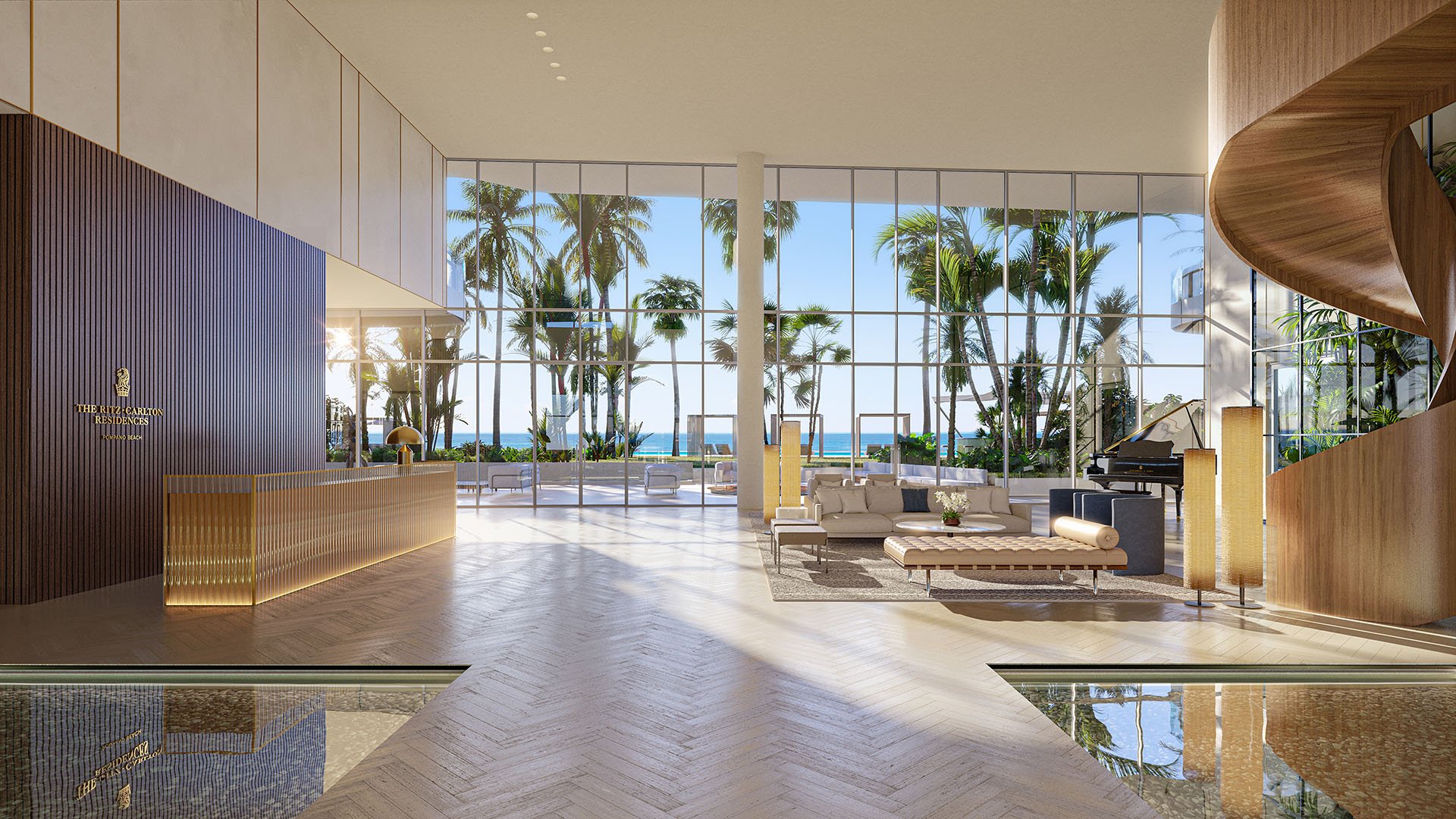
For a buyer who values an undisturbed bedroom as highly as an ocean view, the decisive luxury is often invisible: the relationship between private rooms, service circulation and the building's social spaces. A beautifully appointed foyer can make arrival feel discreet without revealing what happens acoustically behind the walls.
Pompano Beach offers four branded projects and one boutique alternative worth examining through that lens. Waldorf Astoria, Ritz-Carlton, Armani/Casa and W each offer a distinct residential proposition. Salato belongs here as a smaller-scale comparison, not as an established hotel- or designer-branded residence.
None should be treated as having certified protection from service-elevator noise or public venues on these features alone. Private entry and low density are useful privacy indicators; quiet must be evaluated at the individual residence level.
1. Waldorf Astoria Residences Pompano Beach: 1350 South Ocean Boulevard
This 28-story oceanfront condominium leads on documented entrance privacy. Its 92 residences are described as having private elevator entries and dedicated foyers-a concrete distinction for buyers seeking a more controlled arrival. The project is also conceived as the brand's first standalone residential development, rather than a combined hotel-and-residence property.
Layouts span approximately 2,100 to 6,100 square feet, with two to five bedrooms. That range gives buyers several configurations to examine, but neither a dedicated foyer nor the standalone format proves separation from service equipment. The essential next step is to locate bedroom walls relative to elevator shafts, service landings and mechanical spaces.
2. The Ritz-Carlton Residences Pompano Beach: Beach Tower and Marina Tower
The oceanfront Beach Tower and Intracoastal Marina Tower offer two distinct waterfront settings within one residential development. The stated configuration includes a 31-story Beach Tower and a 14-story Marina Tower, with approximately 206 residences overall.
That choice invites comparison; it is not evidence that one tower is quieter. Buyers should assess each prospective residence against its service core, proximity to amenities and circulation plan. An Intracoastal outlook cannot substitute for verified separation from building operations, just as an oceanfront address does not resolve internal acoustic questions.
3. Armani/Casa Residences Pompano Beach: 1550 North Ocean Boulevard
The planned configuration of 28 full-floor residences across twin 19-story circular towers provides the shortlist's strongest low-density indicator. For buyers who prize limited residential density, that scale warrants close attention. Starting pricing has been advertised at around $5 million; that figure does not establish current availability.
Full-floor living does not, by itself, establish a private elevator arrangement or acoustic isolation. Examine how the residence wraps around the core, where service access occurs and which rooms adjoin equipment. The compelling feature here is the full-floor format. Protection from operational noise remains a separate question.
4. W Pompano Beach Hotel & Residences: 20 North Ocean Drive
Announced as a 24-story development on nearly four beachfront acres, W combines 74 condominium residences, three penthouses with private rooftops and 296 furnished condo-hotel suites. Related Group and BH Group are the announced developers, with W Hotels identified as the management brand.
That mix of uses makes residential separation particularly important. Buyers prioritizing quiet should seek clear distinctions between owner arrivals, hotel circulation, service movements and access to public amenities. The penthouses' private rooftops are a lifestyle feature, not evidence of superior acoustic insulation. W belongs on the shortlist for careful evaluation, without an assumption of either noise or silence.
5. Salato Residences: Boutique scale in Pompano Beach
With approximately 40 residences, Salato offers a smaller-scale comparison to the branded developments. Its appeal within this selection is residential scale, not a verified external hotel or designer affiliation. Buyers should retain that distinction when comparing what each project's identity represents.
A smaller residence count does not establish where loading areas, service elevators or shared amenities sit. Salato deserves the same residence-specific review as its larger counterparts, particularly for bedroom placement and adjacent-floor uses. Boutique proportions can inform a shortlist without settling the question of quiet.
At Waldorf Astoria Residences Pompano Beach, private elevator entries and dedicated foyers address how residents arrive. Ask separately whether the selected home shares walls with shafts or service spaces, and what acoustic specifications apply to those interfaces.
For The Ritz-Carlton Residences Pompano Beach, compare equivalent living arrangements across the two towers rather than choosing solely by waterfront orientation. Place bedroom locations, elevator cores and nearby amenity levels side by side. Neither tower has an established quietness advantage here.
Access privacy and acoustic privacy answer different questions. One concerns who passes your entrance; the other, what reaches your rooms. Require clarity on both before assigning a premium to the word private.
At Armani/Casa Residences Pompano Beach, begin with the full-floor plan. Request a drawing that includes the entire core and service access, not just the furnished residential layout. Identify whether dressing rooms, foyers or other spaces separate bedrooms from operational areas; do not assume those buffers exist.
At W Pompano Beach Hotel & Residences, begin with the boundaries between residential and hospitality uses. Ask which entrances and lifts serve each component, how deliveries reach residences and whether any public-facing spaces sit above, below or beside the home under consideration.
Neither format determines the outcome on its own. A full-floor residence still requires a core review; a hotel-and-residence development needs explicit circulation and venue information. Brand identity cannot replace those drawings.
Build the purchase review around the exact home, not merely the tower brochure. Request residential and service-core plans showing elevator shafts, landings and back-of-house rooms. Obtain the layouts immediately above and below, including amenity areas, and identify loading, refuse and delivery routes.
Then request mechanical locations and acoustic specifications. Have a qualified acoustic professional assess what the proposed assemblies address, including equipment vibration and sound transmission. Distinguish design targets from any available measured performance.
For public-facing venues, ask for permitted uses, access arrangements and operating hours. Where those details remain unsettled, treat the issue as unresolved rather than assuming residential separation.
Waldorf offers the clearest entrance-privacy feature; Armani/Casa, the strongest low-density indicator. Ritz-Carlton supplies contrasting waterfront settings, W demands particular attention to mixed-use circulation, and Salato provides a boutique benchmark. Let the residence's documented relationship to service and social spaces guide the final choice-not its name alone.
For a discreet conversation about selecting a Pompano Beach residence around privacy and daily comfort, connect with MILLION.
If branded residences are on your mind — as a home or as an allocation — we would be glad to share what we are seeing, privately.
Begin a quiet conversationWaldorf Astoria Residences Pompano Beach leads on documented private elevator entries and dedicated foyers. Those features do not establish acoustic protection from service equipment.
No. The shortlist identifies privacy features and residential configurations, not measured noise performance or verified separation from public venues.
It is described as the brand's first standalone residential development. That format does not eliminate the need to review service circulation and mechanical locations.
Neither tower has an established quietness advantage. Buyers should compare the specific residence plans, service cores and neighboring amenity spaces.
Its planned 28 full-floor residences across two 19-story towers offer a strong low-density indicator. Private elevator arrangements and acoustic isolation should not be assumed.
Its announced program combines condominium residences, penthouses and 296 condo-hotel suites. Buyers should clarify how residential arrivals and service routes relate to hospitality circulation and public amenities.
No. Private rooftops are a lifestyle feature, not evidence of superior acoustic performance or separation from mechanical equipment.
An external hotel or designer affiliation is not established here. Salato is included as a boutique alternative with approximately 40 residences.
Request residential and service-core drawings, mechanical locations, adjacent-floor layouts, and loading and refuse routes. Review those documents alongside acoustic specifications for the exact residence.
Identify any public-facing spaces above, below or beside the residence, then request their uses, access arrangements and operating hours. Unsettled details should remain open purchase-review questions.