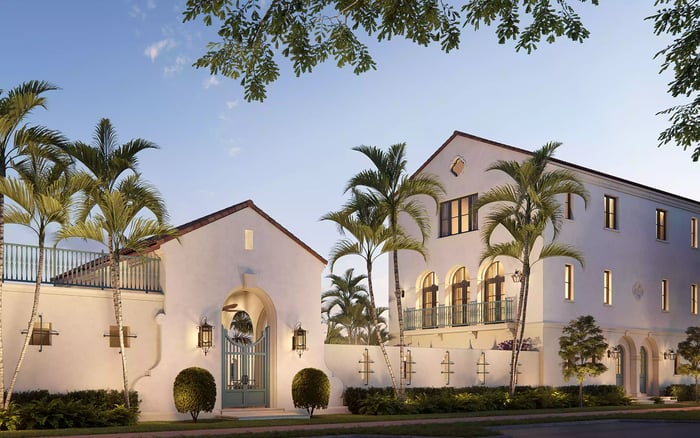
A buyer-focused framework for evaluating Coral Gables luxury addresses through the combined lenses of yacht access, property resilience, operational readiness and ownership practicality.

For a yacht owner, a Coral Gables address must do more than frame the water. It should support the daily mechanics of boating, the legal realities of dock use and a credible severe-weather plan. The most compelling residence is not automatically the one with the broadest view. It is the one whose waterfront, structure and operating plan work in concert.
This edition of MILLION Buyer's Guides ranks five address profiles rather than treating every shoreline home as interchangeable. Each reflects a distinct balance of access, control and preparedness. Before assigning value, buyers should verify every physical, legal and insurance detail for the individual property.
1. Direct-slip residence - maximum operational control
A residence with a dedicated slip places control at the center of ownership. The buyer's review should establish whether the right to use the slip transfers with the property, which vessel dimensions it can accommodate and what approvals govern alterations, lifts, utilities or repairs.
Storm planning must encompass the dock as well as the house. Examine tie-up options, power isolation, removable equipment, access for pre-storm preparation and the written sequence for securing or relocating the vessel.
2. Protected-water residence - a calmer daily interface
A protected setting can appeal to owners focused on boarding, provisioning and routine maintenance. The decisive questions concern the full route from berth to open water, including depth, turning room, fixed obstructions and operating constraints.
Assess resilience across the seawall, drainage, exterior openings and mechanical systems. A polished interior cannot compensate for uncertainty at the water's edge or an incomplete recovery plan.
3. Canal-oriented residence - access balanced with navigation
A canal address can create an intimate relationship with the vessel, but suitability is highly boat-specific. Confirm the navigable path under conditions relevant to the intended yacht rather than assuming that visible water equals practical access.
The inspection brief should align marine and residential considerations. Dock condition, shoreline structures, backup-power priorities, landscaping hazards and post-event access belong in a single ownership plan.
4. Managed waterfront residence - services over sole responsibility
Some buyers prefer a residence where shared management reduces the burden of maintaining every component independently. Under that model, determine precisely which waterfront responsibilities belong to the owner, an association or a third party.
Request the governing procedures for storm preparation, access restrictions, emergency communication and restoration. The quality of the address depends not only on its physical design, but also on whether authority and accountability are clear before an event.
5. Near-marina residence - flexibility without an attached berth
A near-marina address may suit an owner whose yacht is professionally managed or berthed separately. This profile shifts diligence toward the reliability of the off-site arrangement, the practical transfer between home and vessel, and contingency plans when roads or marine facilities are disrupted.
Do not value proximity as though it were a property right. Confirm berth terms independently and assess how the residence functions when the yacht is secured elsewhere.
The residential search should distinguish between an address that supports yachting and one that merely evokes it. Ponce Park Coral Gables, Cora Merrick Park and The Village at Coral Gables offer additional Coral Gables reference points for comparing residential formats. Their inclusion here does not represent marina access, dockage or storm features.
For a broader coastal comparison, Opus Coconut Grove helps frame how another nearby market may fit into a yacht owner's housing search. Each project requires an individual review, particularly when marine access is a nonnegotiable element of the purchase.
The vocabulary also demands precision. Waterfront describes a relationship to the water; marina and boat slip describe distinct operational considerations. Lifestyle value may be immediate, but legal access and vessel compatibility require separate confirmation.
Begin with the vessel. Record its dimensions, draft, clearance needs, shore-power requirements and service routine, then test the property against that operating profile. This reverses the common mistake of choosing a beautiful residence first and asking whether the yacht fits later.
Next, separate ownership rights from physical appearance. Documentation should clarify dock or slip control, transferability, maintenance obligations, shared access and restrictions. Engage qualified professionals to examine the residence, waterfront components and marine route within their respective scopes.
Storm planning warrants a written file, not a verbal assurance. It should address vessel-relocation thresholds, contractor availability, exterior preparation, backup power, water management, communications and return-to-property procedures. Insurance review should begin early enough to inform negotiations, carrying costs and the proposed closing timeline.
Finally, consider recovery. The strongest plan anticipates how the owner, captain, property manager and service teams will coordinate after an event. A luxury address earns confidence when preparation and restoration can proceed without ambiguity.
Does a water view confirm yacht access? No. Buyers should independently verify legal access, dock rights and the complete navigable route.
Should vessel dimensions guide the property search? Yes. Length, beam, draft, clearance and service needs should shape the initial shortlist.
Is a private dock automatically included in a sale? Not necessarily. Ownership, use rights and transferability require document-level confirmation.
What should a marine inspection cover? Qualified professionals should define the scope and tailor it to the dock, shoreline and intended vessel.
Why review navigation before making an offer? The berth may appear suitable even when the route presents depth, clearance or turning constraints.
How does storm planning affect value? A clear preparation and recovery plan can shape risk, carrying costs and ownership confidence.
Should the yacht remain at the residence during a storm? That decision requires a vessel-specific plan informed by current official guidance and professional advice.
When should insurance be reviewed? Early in diligence, so coverage, deductibles and requirements can inform the purchase decision.
Can a managed residence simplify storm preparation? It can, provided responsibilities, authority, access and communication procedures are clearly documented.
What is the best Coral Gables address for a yacht owner? The best fit is the verified address whose access, rights, resilience and operations match the owner's vessel.
If you'd like a private walkthrough and a curated shortlist, connect with MILLION.
If branded residences are on your mind — as a home or as an allocation — we would be glad to share what we are seeing, privately.
Begin a quiet conversation